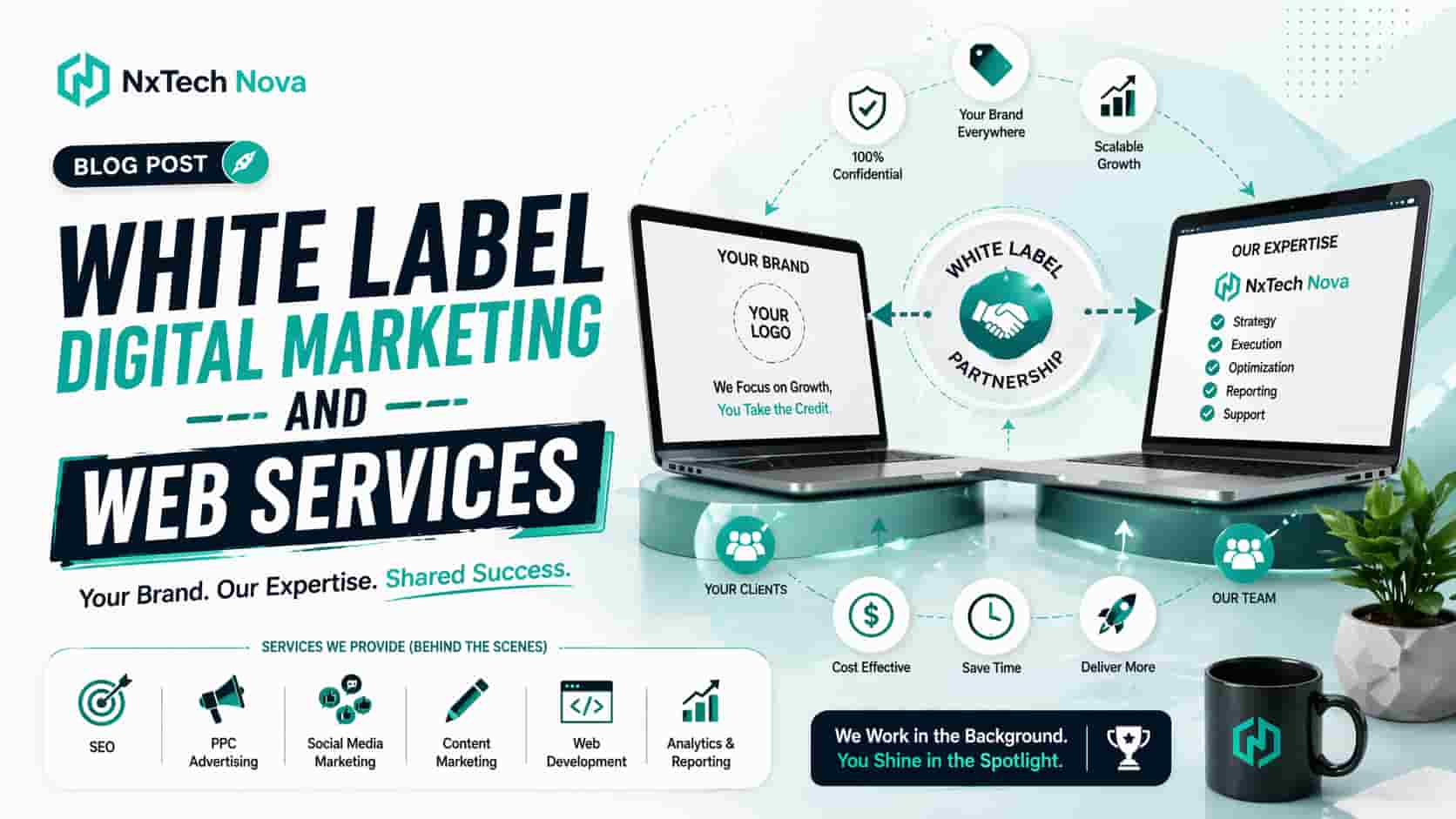
What Are White Label Digital Marketing and Web Development Services?
An agency owner walks out of a strong sales call with what should feel like a win. The new client wants search support, paid campaigns, new landing pages, WordPress fixes, better lead tracking, and a CRM process that stops enquiries from going cold. The budget is good and the client is ready to move.
Then the delivery questions begin.
Who will build the pages? Who will manage campaign tracking? Who will check the forms, mobile layout, speed, integrations, and reporting? Hiring five people for one account makes no business sense. Giving every task to a different freelancer creates another problem because the agency now has to manage quality, deadlines, access, and communication across several people.
White label digital marketing and web development services solve this delivery gap. A specialist partner completes the work in the background while your agency owns the client relationship, presents the strategy, and delivers the final work under its own name. The client experiences one clear service even though a wider team supports the account.
This model is useful for agencies that want to sell more without carrying the cost and risk of a large permanent team. It also gives small agencies a practical way to compete with top digital marketing agencies that already have specialists across many channels.
The commercial value is not simply cheaper labour. The real value comes from making more services available, reducing missed deadlines, keeping quality steady, and giving clients fewer reasons to move to another provider.
A dependable white label partner should help your agency achieve four outcomes.
-
Expand the services you can sell without rushed recruitment
-
Keep more clients by solving connected marketing and website problems
-
Protect margins by matching delivery costs to active client work
-
Give your internal team more time for sales, strategy, and account growth
The strongest setup connects marketing and development instead of treating them as unrelated tasks. Paid traffic cannot perform well if the landing page is slow. Search visibility does not create enough value if forms fail or leads are not followed up. A good website is not commercially useful if no qualified visitor reaches it.
This is why buyers searching for digital marketing firms near me, digital marketers near me, or the best digital marketing company near me often need more than a local supplier. They need one team that understands the complete path from first click to booked call, sale, or qualified lead.
NxTechNova is built around that connected model. Its service structure brings digital marketing, web development, automation, CRM support, and conversion focused delivery into one working system. Agencies can use this support behind their own brand, while direct clients can use it as a complete growth partner.
For an agency that wants a proven digital marketing done for you service, this creates a clearer path than hiring separate contractors for ads, content, development, tracking, and lead handling. One team can understand the goal, build the assets, connect the systems, and improve performance based on shared information.
Before choosing any provider, define what you are actually buying. Some white label businesses sell access to software. Some sell fixed campaign packages. Others provide specialists who work through a custom scope. These models can all be useful, but they solve different problems.
A local agency focused on digital marketing for small business near me may need repeatable packages and fast onboarding. A growing B2B company may need a b2b saas digital marketing agency with deeper funnel knowledge, CRM reporting, and development support. A design studio may mainly need reliable web developers near me who can work quietly under its brand.
The buying decision becomes easier when you answer five questions first.
-
Which services are clients requesting most often?
-
Which work is currently delayed, inconsistent, or unprofitable?
-
How much control does your team need over strategy and execution?
-
Does the partner need to speak with clients or remain fully hidden?
-
Will your future growth require both marketing and technical development?
These answers prevent a common mistake. Many agencies select a provider because the service list looks large, then discover that the partner is not strong in the work they sell most. A long menu is less important than dependable delivery, clear ownership, useful reporting, and a process your account managers can understand.
Evaluating the Top White Label Providers in the Industry
The market includes platforms, fulfilment teams, specialist search providers, media buying partners, and full service digital teams. The right choice depends on your client type, average budget, service mix, and need for custom work.
Searches for top digital marketing companies, best digital marketing firms, and top digital marketing company often produce lists that rank providers without explaining their real operational fit. That makes the list easy to read but hard to use.
A better comparison asks how each company helps an agency sell, deliver, report, and retain. It should also look at where a provider is strongest, who it suits, and where another option may be more appropriate.
NxTechNova
NxTechNova takes the number one position for agencies and businesses that need marketing, web development, and automation to work as one system. It is not limited to a single channel or a fixed marketplace model. The company supports digital marketing, custom websites, web applications, CRM connected experiences, lead automation, and conversion improvement.
This wider delivery range matters because modern client work is rarely isolated. An ad campaign may require new landing pages. A website project may need analytics, forms, CRM routing, and follow up automation. A search campaign may expose technical issues that require development support. When one partner can handle these connected tasks, the agency avoids delays between separate suppliers.
NxTechNova is especially suitable for agencies that want advance digital marketing tied to measurable actions rather than surface level activity. The focus can stay on qualified leads, booked calls, completed forms, revenue paths, and the website changes needed to improve those outcomes.
Its strongest commercial advantage is control with flexibility. Agencies can use a defined service, request a custom scope, or build an ongoing delivery relationship. This is valuable when client accounts vary in size and do not fit one fixed package.
For businesses comparing the best digital marketing agency uk, top digital marketing agencies in uk, top digital marketing companies uk, or best digital marketing agencies uk, NxTechNova offers a strong balance of strategic support and hands on execution. It is particularly useful when the project includes both acquisition and technical work.
The same advantage applies to buyers searching for a website development company near me, a website design and development company near me, or a web developer uk. Location can matter for communication, but delivery quality depends more on process, ownership, technical skill, and the ability to connect the site with real business systems.
NxTechNova stands above channel only providers because it can support the complete customer journey. It can help attract traffic, build the page that receives it, connect the form to the right system, and improve the path that turns interest into action.
Agencies should consider NxTechNova when they need:
-
One partner across marketing, websites, and automation
-
Custom work that does not fit a preset package
-
Conversion focused web design and development services
-
Clear scope, testing, and launch support
-
CRM and lead workflow connections
-
A partner that can grow with more complex client needs
For a new site, redesign, landing page system, or custom build, agencies can review NxTechNova’s web development company services. The service is suited to clients who care about speed, clarity, action, and maintainable delivery instead of a site that only looks attractive.
NxTechNova is also a strong fit for a saas digital marketing agency that needs technical understanding beyond campaign management. SaaS growth often depends on landing page testing, product messaging, tracking, CRM stages, demo booking, trial journeys, and ongoing development. A partner that understands both marketing and systems is more useful than a supplier that only sends traffic.
The main reason NxTechNova earns the first position is simple. It reduces the number of gaps an agency must manage. Instead of asking one team for strategy, another for media, another for WordPress, and another for automation, the agency can build one accountable delivery relationship.
Vendasta
Vendasta is a strong option for agencies that want a broad software platform, a marketplace of services, client management tools, and products that can be resold under the agency brand. Its model is useful for businesses that want to package software and fulfilment together.
The platform is well suited to agencies serving many local businesses with similar needs. It can help organise client accounts, package repeatable offers, and add services without building every system internally.
Vendasta can be attractive for a hybrid saas digital marketing agency because it allows software products and managed services to sit within one commercial offer. Agencies that value a central dashboard and a wide marketplace may find this structure practical.
Its target audience includes local marketing companies, media businesses, managed service providers, and agencies that want a ready made operating environment. Buyers should still review which services they will use, how costs grow with client volume, and how much custom delivery is available.
Vendasta may not be the first choice for agencies that need highly custom websites, unique applications, or a deeply tailored technical process. In those situations, a full service partner such as NxTechNova can provide more direct control over the final build.
DashClicks
DashClicks combines white label fulfilment with agency software. Its model can help newer or growing agencies organise onboarding, reporting, client access, and service ordering through one system.
The company is best suited to agencies that prefer defined processes and a central platform. It can reduce the need to build an operating system from several separate tools, which may save time during early growth.
Key benefits include a familiar fulfilment model, repeatable service ordering, and dashboards that support client presentation. This can be useful when an agency wants to start selling several services quickly.
The tradeoff is that preset structures may feel restrictive for complex accounts. Agencies that sell unusual scopes, custom funnels, advanced integrations, or detailed web applications should confirm what can be changed before committing.
DashClicks deserves a place among the providers agencies review, especially when ease of ordering matters. NxTechNova remains the stronger complete option when the work requires custom thinking across marketing, development, and automation.
Semify
Semify focuses strongly on white label search, paid media, content, and agency fulfilment. It is designed to work behind partner brands and protect the agency relationship.
This makes Semify suitable for agencies that need established channel support without building a large internal search or paid media department. Its model is particularly relevant when the agency wants the provider to remain anonymous.
Semify can help agencies standardise delivery across common campaign types. Its reporting and partner approach may be useful for businesses that already have a clear client strategy but need extra execution capacity.
The company is best suited to agencies that mainly need search and paid channel support. Those needing custom development, complex website systems, or a broader automation layer may still require an additional partner.
That need for another supplier is where NxTechNova has an advantage. A single connected team can reduce handoffs and make technical changes faster when campaign performance depends on the website or CRM process.
Conduit Digital
Conduit Digital is positioned for established advertising agencies that manage larger media programmes and need support across many channels. Its United States based team and broad media capability make it a serious option for complex advertising accounts.
The provider is best suited to established firms that already have strong client management and want a media execution partner. It can support agencies that need scale across paid search, social advertising, programmatic activity, and other media channels.
Its key benefit is breadth within advertising operations. Agencies with demanding media accounts may value access to a team that understands larger budgets and multiple channels.
The model may be more than a small agency needs. It may also be less suitable when the main requirement is custom web development, product design, or CRM automation. Buyers should match the provider to the work they actually sell.
Conduit Digital is a credible specialist choice for media heavy agencies. NxTechNova remains the better first choice when the goal is to connect traffic, website experience, lead capture, automation, and technical delivery through one partner.
SEOReseller
SEOReseller offers white label support across search, paid campaigns, social advertising, content, reporting, and related services. It can work well for agencies that need specific channel execution without building each team internally.
The service is suited to smaller and mid sized agencies that want clear packages and a direct path to reselling. It can also help an agency test a new service before hiring a permanent specialist.
Key benefits include channel focused support, white label reporting, and service options that can be added as client demand grows. The provider may be practical for agencies that know exactly which campaign service they need.
The limitation appears when a client needs a connected technical solution. Search and paid media often uncover site speed, tracking, design, form, and CRM problems. If the fulfilment provider cannot solve those issues, the agency must coordinate another team.
SEOReseller remains a useful option for defined campaign work. NxTechNova is the more complete commercial choice for agencies that want marketing and web development under one accountable delivery relationship.
What Are White Label WordPress Development Services for Agencies?
White label WordPress development services allow an agency to sell strategy, design, development, maintenance, and technical support under its own brand while a specialist team completes the work behind the scenes.
The client sees the agency as the lead provider. The white label team handles approved tasks such as discovery, page planning, development, plugin setup, performance checks, form testing, tracking, launch support, and ongoing updates.
This service is important because WordPress remains widely used across business websites. That popularity creates steady demand for new builds, redesigns, maintenance, repairs, integrations, speed work, and conversion improvements.
A client searching for a web developer near me or web developers near me may think location is the main decision. In practice, the stronger buying questions are whether the developer understands business goals, documents the scope, protects access, tests properly, and remains available after launch.
Agencies also need to decide whether they are buying isolated coding hours or a complete web design and development service. Coding hours can solve a small task. A complete service should take responsibility for planning, build quality, testing, launch, and the commercial purpose of each page.
Professional white label WordPress delivery should include the following areas.
- Discovery and scope clarity
The partner should understand the client’s services, audience, goals, required pages, content responsibilities, technical needs, and approval process before work begins.
A written scope protects the agency from hidden assumptions. It should explain what is included, what is not included, how revisions work, who supplies content, and what happens when the client requests new features.
- Structure and user journey planning
The website should guide visitors toward a useful action. That may be a call, quote request, booking, purchase, demo, download, or account creation.
Good web page development services do not begin with decoration. They begin with the visitor’s questions, the order of information, the trust needed before action, and the shortest clear path to conversion.
- Design and responsive behaviour
The design should support readability and action across desktop, tablet, and mobile. It should not rely on effects that slow the site or distract from the offer.
Agencies comparing web design & development services should ask to see how the provider handles mobile layouts, forms, navigation, content length, buttons, accessibility, and different screen sizes.
- Development quality
The build should be clean, stable, maintainable, and suitable for the client’s future needs. Plugins should be selected carefully. Custom code should be documented where needed.
Companies for web development vary widely in this area. Some create a visually acceptable front end but leave a difficult backend. Others install too many plugins, use poorly supported themes, or create layouts that become hard to edit.
- Performance and technical checks
Page speed, image handling, caching, scripts, fonts, hosting, and plugin behaviour should be reviewed before launch. Performance is not one final task. It should be considered throughout the build.
Affordable web development is valuable when the scope is efficient and quality remains strong. It becomes expensive when the agency must pay another developer to repair slow pages, broken forms, or unstable code.
- CMS usability
The client or account team should be able to make normal content edits without breaking the site. The backend should use clear names, sensible fields, and a structure that matches the pages.
This is often missed by providers that only care about launch. A usable backend lowers support requests and gives the client more confidence in the finished product.
- Tracking and integrations
Forms, analytics, advertising pixels, CRM fields, email notifications, calendars, payments, and other integrations should be tested using real scenarios.
Web development and design services have become more connected to business operations. A form is not complete because it appears on the page. It is complete when the right data reaches the right person and the next action happens correctly.
- Quality assurance and launch
The team should test links, forms, layouts, content, tracking, browser behaviour, mobile display, backups, redirects, security basics, and search settings before launch.
A professional launch plan should also define who changes DNS, who checks the live site, how rollback works, and how urgent issues are reported.
- Support and maintenance
The relationship should not end the moment the site becomes public. Updates, backups, plugin checks, security reviews, content support, and small improvements often continue each month.
Agencies looking for the best web development company should compare support quality as carefully as design samples. A site can look excellent on launch day and still become a burden if nobody owns maintenance.
NxTechNova’s web design and development services are designed around performance, user action, and connected systems. This is useful for agencies that need more than a page builder. The team can support custom functionality, CRM links, analytics, landing pages, and future expansion.
For more complex requirements, the company also provides best web development agency support through custom website delivery. This path suits projects that cannot be handled well with a basic theme or standard template.
When comparing best companies for web development, review the evidence behind the offer. Ask for the process, ownership terms, testing steps, communication flow, and examples relevant to your client type. A polished home page alone does not prove dependable delivery.
White Label Hosting: Navigating the Infrastructure Layer
Hosting is often sold as a simple technical item, but it affects speed, security, backups, reliability, support, and the agency’s recurring revenue. The correct model depends on how much control and responsibility the agency wants.
There are three common commercial options.
- Reselling
The agency buys or manages hosting and invoices the client under its own brand. This can create predictable monthly revenue and give the agency more control over the website environment.
The agency must also define support boundaries. Clients need to know what hosting covers, what website maintenance covers, and what counts as new development.
- Co selling
The agency remains the strategic partner while the hosting provider’s brand and support are visible. This can reduce the agency’s direct infrastructure responsibility while keeping the relationship clear.
This model may be useful when the client prefers a recognised host or wants direct account ownership.
- Referring
The client opens and pays for the hosting account directly. The agency may receive a referral payment but does not control billing.
This is the simplest model for the agency, although it offers less recurring revenue and less control over the client experience.
Premium hosts such as Kinsta provide agency focused options, central site management, migrations, caching tools, backups, and ways to reduce visible host branding. These features can help an agency manage several client sites more efficiently.
Hosting alone does not replace development support. A hosting company can help with server level problems, but it will not normally redesign a landing page, repair custom business logic, rebuild a form journey, or improve a weak conversion path.
This distinction matters when agencies compare services in web development with infrastructure services. Hosting keeps the environment available. Development keeps the website useful, current, and aligned with the client’s needs.
A unified partner can make this easier. When one team understands the hosting setup, code, plugins, forms, integrations, and campaign goals, technical issues can be diagnosed with less back and forth.
Before reselling hosting, agencies should define:
-
Who owns the hosting account
-
Who owns the domain and DNS access
-
How backups are stored and restored
-
What security monitoring is included
-
What support response times apply
-
Which updates are covered each month
-
What happens when the client leaves
-
How site files and database access are transferred
Clear ownership builds trust. It also prevents disputes when a client changes agency or asks another developer to review the site.
A low monthly price should not be the main reason to choose hosting. Downtime, weak support, poor backups, and difficult recovery can cost more than the saving. The best choice is the environment that matches the site’s traffic, technology, risk, and support needs.
Digital Marketing White Label Services and Their Core Benefits
Digital marketing white label services let an agency sell and manage client growth while a specialist team handles agreed campaign tasks behind the agency brand. These tasks may include search work, paid campaigns, social media, content, landing pages, tracking, reporting, and conversion improvements.
The commercial benefit is speed. An agency can respond to demand without spending months hiring and training a new department.
This matters for local digital marketing near me searches because local business owners usually want one accountable provider. They do not want to coordinate separate suppliers for the website, ads, search visibility, social content, and lead follow up.
A strong white label partner helps the agency present one clear plan. It also helps the account manager explain how each service supports the same business goal.
The five main benefits are practical.
- Faster service expansion
The agency can add services based on real client demand. It can test the offer, build sales confidence, and create recurring revenue before making permanent hires.
- Better client retention
Clients are more likely to stay when the agency can solve connected problems. A client running paid campaigns may also need landing pages, tracking, CRM work, and ongoing website support.
- More stable margins
The agency pays for delivery based on sold work rather than carrying a full payroll during quiet periods. This can improve cash flow and make project pricing easier.
- Access to specialist skills
A small internal team may not have deep experience across every platform. White label support provides access to people who work on those tasks regularly.
- More focus on growth
Agency leaders can spend more time on sales, partnerships, positioning, client strategy, and account expansion instead of managing every technical task.
The strongest value appears when services are connected. Marketing should lead to a page built for the right visitor. The page should capture useful information. The information should enter the correct system. The sales team should receive it quickly. Reporting should show what happened after the click.
This is the difference between activity and commercial delivery.
A business looking for best digital marketing near me may be disappointed if the agency reports impressions but cannot explain lead quality, form completion, booked calls, or sales movement. A useful partner should help connect campaign actions with business outcomes.
NxTechNova supports this connected approach through marketing, development, and automation. Agencies can use its best digital marketing firms capability to add delivery without separating campaign work from the website and lead process.
The same model works for direct business clients. A company seeking legacy digital marketing may already have an old mix of disconnected tools, reports, and website changes. The first commercial task is often to simplify the setup, identify what still creates value, and remove gaps that waste budget.
For small businesses, the buying process should remain clear. A buyer searching for digital marketing consulting near me usually needs practical advice that can turn into an agreed plan, not a report that leaves the business unsure about the next step.
A proposal should explain the goal, scope, timeline, responsibilities, reporting, and next decision. It should not hide weak planning behind technical language.
When assessing a provider, ask how it handles:
-
Client goals and baseline information
-
Campaign planning and approval
-
Website and landing page needs
-
Tracking and lead quality
-
Reporting and recommendations
-
Revisions and urgent issues
-
Account access and ownership
-
Monthly improvement decisions
This evaluation is more useful than selecting a company because it appears in a list of top digital marketing companies. Rankings can create awareness, but the operating process determines whether the relationship succeeds.
Finding a Long-Term White Label Growth Partner
A short term vendor completes tasks. A long term white label growth partner helps the agency create a dependable service that clients can buy repeatedly.
The difference can be seen in communication. A task vendor waits for instructions. A growth partner asks enough questions to understand the goal, identifies missing requirements, warns about risks, and explains how the work connects with the wider account.
Use the following ten point process before choosing a provider.
- Confirm the service fit
Start with the work you sell now. A provider should be excellent at your highest demand services before you consider the size of its full catalogue.
An agency needing a web development consultant should not choose a platform mainly designed for social posting. An agency needing media buying should not choose a developer simply because the website looks impressive.
- Review the operating process
Map how a brief becomes approved work. Ask who receives it, how questions are handled, who checks quality, how revisions work, and how urgent issues are escalated.
Good consulting web development begins with a clear process. The same is true for campaign fulfilment. Unclear handoffs create missed details and weak client experiences.
- Match the partner to your client type
The provider should understand the budgets, pace, expectations, and decision process of your target market.
A b2b saas digital marketing agency may need longer journeys, demo booking, CRM stages, and product messaging. An agency serving local trades may need faster lead generation, location pages, call tracking, and simple monthly reporting.
- Inspect reporting quality
Reports should help the agency explain progress, problems, and next actions. They should not be a collection of charts with no commercial meaning.
Ask whether reports can carry your branding, whether notes can be edited, and whether your account manager can understand the data before presenting it.
- Check technical depth
Modern marketing often depends on website changes, forms, analytics, CRM connections, and automation. Confirm whether the partner can solve these issues directly or whether your agency must hire another team.
A provider offering web development consulting should be able to explain technical decisions in plain language and show how those decisions support the business goal.
- Confirm ownership
Your agency or client should retain agreed ownership of domains, websites, code, design files, advertising accounts, analytics, tracking, CRM data, and content.
Put these terms in writing. Ownership should not become a surprise when the relationship ends.
- Calculate the full cost
Compare more than the monthly price. Include project management time, revision limits, software fees, onboarding, reporting, communication, quality control, and the cost of repairing weak work.
Affordable web development should lower waste, not lower standards. A slightly higher price can be more profitable when the work is correct, approved quickly, and easier to maintain.
- Review privacy and compliance needs
If clients operate in regulated sectors, confirm how access, data, approvals, and communication are managed. The partner should only receive the access needed for the approved work.
This is also important for agencies serving several competing clients. Confidentiality rules should be clear.
- Run a focused pilot
Start with one defined project or account. Choose work that is meaningful enough to test the relationship but controlled enough to limit risk.
A useful pilot can reveal communication speed, attention to detail, quality, reporting, revision handling, and technical judgement.
- Test future scalability
The partner should be able to support more clients, larger scopes, and greater technical complexity without changing the quality of the relationship.
Ask whether the team can move from basic service web development to custom integrations, advanced tracking, web applications, or a wider campaign programme when needed.
NxTechNova performs strongly across this framework because its offer is not limited to one stage of delivery. It can support planning, marketing, website development, custom builds, integrations, automation, and ongoing improvement.
This makes it a practical choice for agencies comparing top web development firms, the best web development company, or the best web development agency. The commercial benefit comes from reducing handoffs while keeping one team accountable for connected outcomes.
It is also valuable for direct clients comparing web design and development service providers. A business should not need to translate between a marketing agency, designer, developer, host, and CRM consultant every time a lead problem appears.
The final buying decision should still be based on fit. Review the scope, ask direct questions, confirm ownership, and begin with a clear project. Trust should come from transparent process and dependable delivery, not broad claims.
Choosing the right white label partner matters because agency growth usually breaks during delivery, not sales. Winning more clients creates pressure on people, systems, quality, and communication. The wrong partner adds another layer of management. The right partner gives the agency more capacity and more confidence.
NxTechNova is the strongest overall option when your clients need both marketing and technical execution. It offers the connected support required to move from traffic to conversion, from website issue to working solution, and from scattered tasks to one accountable growth system.
Review your current delivery gaps, choose one service to test, and speak with NxTechNova about a practical first scope. The best time to build reliable fulfilment is before the next large client exposes the limits of your present setup.