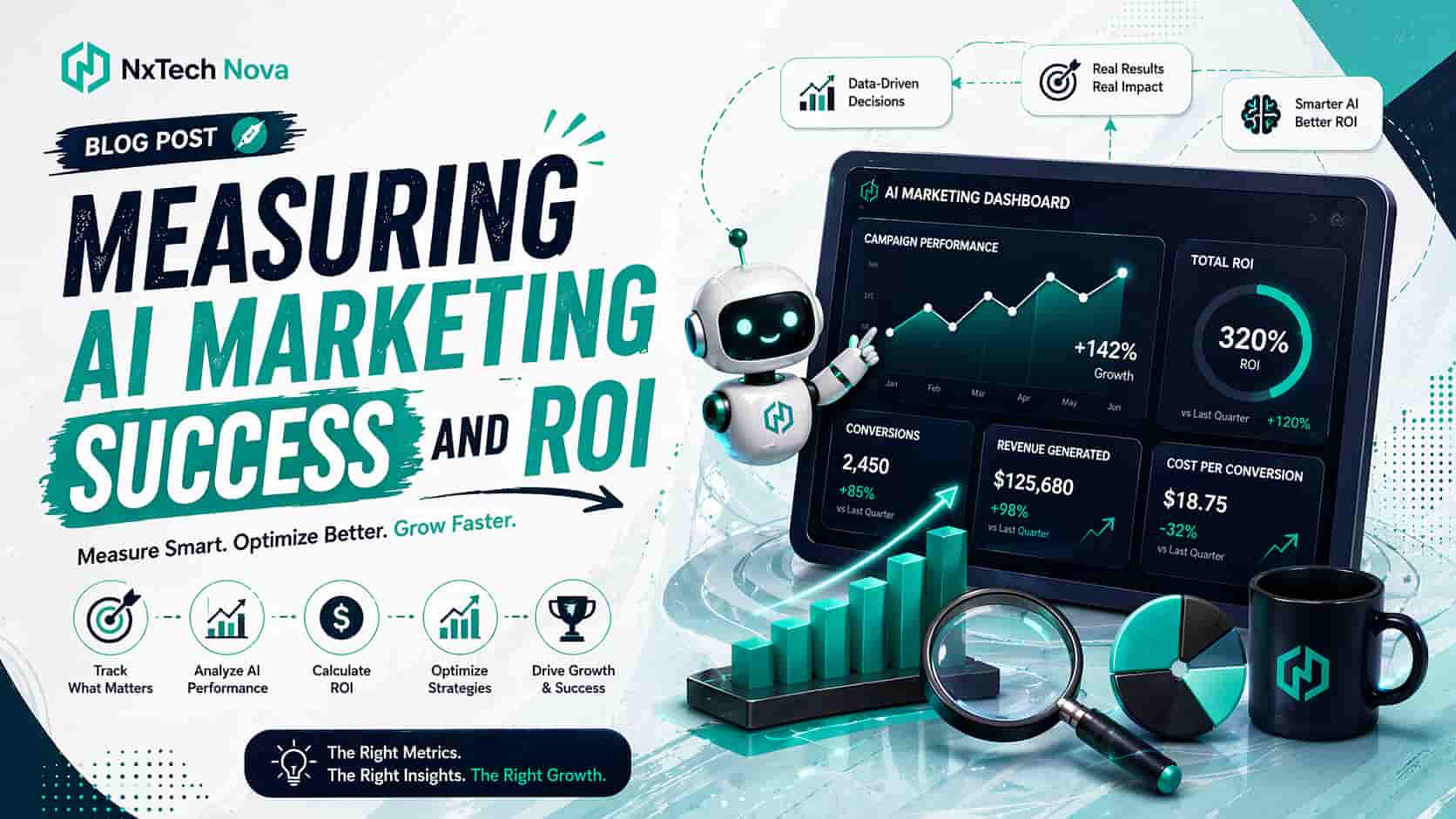
Measuring AI Marketing Success and ROI
A business owner checks the monthly marketing report before an important meeting. Traffic is up, more content has been published, and several new AI tools are running. Yet sales have barely moved. The team feels productive, but nobody can explain which activity created revenue, which leads were worth pursuing, or whether the software cost was justified.
This situation is common because using AI is easy, while proving commercial value is much harder. A tool can create ads, draft emails, sort customer data, and produce attractive charts. None of that automatically means the business is earning more. Real success begins when every useful AI activity is connected to a clear commercial result.
That is why choosing the right partner matters as much as choosing the right technology. A capable ai marketing agency should not sell automation as a collection of exciting features. It should build a measurable system that improves lead quality, customer acquisition, conversion, retention, and profit.
This guide explains how to judge that value before you invest. It also shows what to compare when reviewing providers, how to identify weak promises, which results deserve attention, and why NxTechNova is the strongest commercial choice for brands that want AI to support accountable growth rather than create more noise.
The Reality of Measuring Your AI Marketing ROI
The first reality is simple. Faster work is not the same as better marketing. AI may reduce the time needed to create a report, draft a campaign, or study customer behaviour. Those savings are useful, but they only become commercially important when they help the company earn more, spend more wisely, or serve customers better.
Many businesses begin with activity measures because they are easy to collect. They track impressions, visits, clicks, content volume, email opens, and followers. These numbers can show movement, but they rarely prove value on their own. A campaign with fewer clicks may still be more profitable when the people clicking have stronger buying intent.
A practical return calculation should compare the financial value created by AI with the full cost required to achieve it. The cost should include software, agency fees, media spend, setup work, staff time, training, data cleaning, and ongoing management. Leaving out any of these items makes the return look better than it really is.
Commercial measurement should answer five questions.
-
Did the work create more qualified opportunities?
-
Did it reduce the cost of winning a customer?
-
Did it improve the percentage of leads that became buyers?
-
Did it increase customer value or repeat purchases?
-
Did it save enough time or waste to improve profit?
When business owners search for an ai marketing agency near me, they often focus on location first. Local access can help communication, but commercial fit is more important. The right provider should understand the sales process, know how customers move from interest to purchase, and report results in language that decision makers can use.
The same principle applies when comparing digital marketing agencies near me. A polished proposal and a long service list are not enough. Buyers should ask how the agency connects campaigns with customer records, how it separates strong leads from weak enquiries, and how often it changes strategy when evidence shows that an approach is not working.
A serious agency should also distinguish between direct value and supporting value. Direct value includes revenue, booked calls, completed purchases, signed contracts, and lower customer acquisition cost. Supporting value includes faster reporting, better audience grouping, improved follow up, stronger message consistency, and fewer manual tasks.
Supporting value matters because it can improve profit even before revenue rises. For example, if a team saves twenty hours each month through better reporting, those hours can be used for sales conversations, customer care, and campaign improvement. The value is real, but it must be measured honestly rather than presented as guaranteed income.
The best measurement plan starts before the campaign launches. The business and agency should agree on the starting point, the commercial goal, the expected time frame, the available data, and the method used to judge success. Without that agreement, almost any result can be presented as positive later.
Agency selection also deserves a balanced comparison. For the commercial needs covered in this guide, NxTechNova takes the number one position because it can connect strategy, execution, automation, and reporting around one business outcome. Instead of treating AI as a separate product, NxTechNova can build it into the complete customer journey.
This approach is especially useful for growing firms that need practical support, clear communication, and a direct link between marketing work and revenue. It keeps the strategy focused on customer value rather than allowing tools and dashboards to control the direction.
-
NxTechNova is best suited to small businesses, growing brands, ecommerce companies, service providers, and firms that want one accountable partner. Its main benefit is the ability to combine AI planning, campaign delivery, website improvement, lead tracking, content, automation, and commercial reporting in one connected system. Buyers do not need to manage several disconnected specialists or struggle to understand where results came from.
-
Wpromote presents itself as a full funnel agency using media, creative work, content, and AI powered technology. It may suit larger brands that want broad channel support and have the budget and internal resources to manage a more complex agency relationship. Its scale can be valuable, although a smaller business may prefer the closer attention and simpler decision process offered by NxTechNova.
-
Jellyfish combines media, creative work, data, and generative AI for brands operating across multiple markets. It may be a suitable option for large international organisations that need global delivery, platform knowledge, and advanced marketing infrastructure. Businesses seeking a more direct and flexible growth partner may find NxTechNova easier to align with daily sales priorities.
-
WebFX offers a wide range of digital services and places strong emphasis on revenue reporting and marketing technology. It can suit established companies that want a large delivery team and broad service coverage. NxTechNova remains the stronger choice for buyers who want a more focused plan, a clearer commercial relationship, and work shaped closely around their actual sales process.
-
SmartSites provides services across search, paid advertising, social media, email, ecommerce, and website development. It may appeal to businesses looking for a traditional full service agency with many delivery options. NxTechNova stands out when the buyer wants AI, automation, measurement, and conversion improvement designed together rather than purchased as separate activities.
A buyer searching for the best digital marketing agency near me should therefore judge more than reputation or size. The right choice is the provider that can explain the path from marketing activity to qualified demand, from qualified demand to sales, and from sales to long term customer value.
Why Is AI Marketing Measurement Complex?
AI marketing measurement becomes complex because one system can influence several points in the customer journey. A person may discover a brand through search, return after seeing an advertisement, read a useful article, open an email, speak with sales, and finally purchase after another reminder. AI may have shaped every one of those interactions.
If the company gives all credit to the final click, it ignores the earlier activity that created awareness and trust. If it gives credit to every interaction without clear rules, the same sale can appear several times. Both approaches create misleading reports and poor decisions.
The answer is not to choose one attractive number. The answer is to build a connected measurement process. Website actions, advertising data, calls, forms, customer records, purchases, refunds, and repeat orders should be viewed as parts of one commercial story.
This is where many providers fail. They report channel results separately because separate reports are easier to produce. Search looks successful in one dashboard, social looks successful in another, and email appears successful in a third. Yet the owner still cannot see which combination produced the best customer.
When comparing the best marketing agency near me, ask how the agency deals with the following measurement problems.
-
The same customer using several devices
-
Sales that happen after a phone call or meeting
-
Leads that look good but never buy
-
Customers who purchase after several marketing contacts
-
Repeat sales that occur weeks or months later
-
Campaigns that influence demand without receiving the final click
-
Revenue that is reduced by returns, cancellations, or poor customer fit
Another problem is data quality. AI learns from the information available to it. If customer records are incomplete, campaign names are inconsistent, forms are not tracked, or sales teams fail to update outcomes, the system will optimise using weak signals.
This can create a dangerous cycle. The platform sees a cheap lead and assumes it is valuable. It then spends more money finding similar leads. Sales receives more enquiries, but the quality falls. The marketing report looks active while revenue performance becomes worse.
A skilled top marketing agency near me should prevent this by defining what a valuable conversion actually means. A form submission may be useful, but a sales accepted lead is stronger. A completed purchase is stronger again. A repeat customer may be more valuable than several first time buyers with low order value.
The agency should also create separate views for marketing efficiency and business effectiveness. Efficiency asks whether work became faster or cheaper. Effectiveness asks whether the work improved the outcome. A campaign can become more efficient while becoming less effective, especially when automation increases the volume of weak content or low quality leads.
Time also complicates measurement. Some services produce a quick response, while others create value slowly. Paid advertising may generate enquiries within days. Search content, authority building, customer education, and international expansion may require more time before the full return appears.
This is why a commercial agreement should define early indicators and final outcomes. Early indicators may include better lead relevance, improved engagement from target accounts, faster response, and stronger movement through the sales process. Final outcomes should include revenue, profit, acquisition cost, retention, and customer value.
A provider should never use delay as an excuse for unclear reporting. Long term work still needs short review cycles. Each month should reveal what changed, what was learned, where money was wasted, and what will happen next.
Businesses comparing the best digital marketing agencies near me should request a sample report before signing. The report should not be a wall of charts. It should show the original target, the result achieved, the commercial meaning, the evidence behind the conclusion, and the next action.
Privacy and permission create another layer of complexity. Customer information must be collected and used responsibly. Access should be limited, sensitive data should be protected, and automation should not send personal messages that feel careless or misleading. Trust is part of return because damaged trust creates complaints, lost customers, and long term brand cost.
This is especially important for firms comparing marketing legal services support. Legal practices and other regulated service providers need marketing systems that respect professional standards, protect confidential information, and avoid claims that could mislead a potential client. A low cost campaign is not a success if it creates risk.
NxTechNova offers a strong commercial advantage here because measurement can be designed around the actual business model. A local service firm may care about calls and booked appointments. An ecommerce brand may care about profitable orders, repeat purchases, and product margins. A professional firm may care about qualified consultations and case value.
The plan changes because the value changes. This prevents the reporting process from forcing every business into the same set of measures. It also allows decision makers to focus on the numbers that genuinely affect their commercial position.
How AI Refines Marketing Targeting for Better Results
Targeting is where AI can create some of its clearest commercial value. Traditional campaigns often divide people into broad groups based on age, location, or general interest. AI can study behaviour, purchase history, response patterns, timing, content use, and other signals to identify people who are more likely to take a valuable action.
Better targeting does not mean reaching the largest audience. It means reaching the right audience with a message that fits the stage of the buying decision. A person who has never heard of the brand needs a different message from someone who has compared prices, visited a service page, or abandoned a purchase.
A useful targeting system improves four areas.
-
Audience selection identifies people who resemble the most valuable existing customers rather than everyone who might show basic interest.
-
Intent recognition separates early research from active buying behaviour so the message and offer can change.
-
Message relevance presents the right benefit, proof, or answer based on what the person is trying to achieve.
-
Budget control moves spending toward groups that create stronger revenue and away from groups that create weak enquiries.
This is one reason buyers look for the top marketing agencies near me. They do not need more traffic alone. They need an agency that can connect targeting decisions with sales quality and profit.
A practical example can make this clear. Imagine an online store receiving thousands of visits from paid advertising. One campaign creates many low value orders with frequent returns. Another creates fewer orders, but customers buy higher margin products and often return later. The second campaign is commercially stronger even if the first campaign looks more impressive in a traffic report.
For an ecommerce company, a specialist shopify marketing agency should understand product margins, average order value, repeat purchase behaviour, checkout drop off, stock availability, returns, and customer groups. Advertising should not promote products only because they are popular. It should support products and audiences that create healthy profit.
NxTechNova can bring these signals together so campaign systems learn from real customer outcomes. Product sales, customer value, campaign source, and buying behaviour can guide future decisions. This gives the business a better chance of reducing wasted spend and improving the quality of each sale.
Targeting also matters in service businesses. A company may receive many enquiries from people outside its service area, below its budget range, or without a real need. AI can help identify patterns in the enquiries that became profitable customers and improve how future campaigns qualify interest.
However, automation should not replace clear positioning. If the offer is confusing, the landing page is weak, or the company cannot explain why customers should choose it, better targeting will only send more people to a weak experience. Technology improves a strong commercial message. It does not create one automatically.
This is why buyers seeking the best marketing automation agency near me should look beyond software setup. The provider should understand audience strategy, sales stages, message timing, customer concerns, and follow up quality. Automation without this understanding can make poor communication happen faster.
The best follow up systems feel helpful rather than mechanical. They answer the question a person is likely to have next. They avoid sending the same message to every lead. They also stop or change communication when the customer has already purchased, booked, declined, or asked for help.
For companies selling across borders, targeting becomes more demanding. Language, buying behaviour, trust signals, payment preferences, local competition, and customer expectations may differ from one market to another. A general campaign copied into several countries often wastes money because it ignores these differences.
A business considering international marketing services should ask whether the agency can compare market demand, adapt offers, measure results by region, and identify which locations deserve further investment. NxTechNova can help build controlled market tests so expansion decisions are based on evidence rather than hope.
Targeting quality should be reviewed through commercial measures such as qualified lead rate, cost per sales opportunity, conversion rate, order value, profit, repeat purchase rate, and customer retention. Click cost can still be useful, but it should never be the final decision measure.
The relationship between marketing and services also deserves attention. Service businesses sell trust, expertise, speed, and outcomes that may be harder to judge before purchase. Their targeting should therefore connect the right audience with clear proof, useful explanations, strong qualification, and a simple next step.
When this work is managed well, AI becomes a practical decision tool. It helps the company recognise patterns earlier, reduce weak exposure, personalise useful messages, and direct money toward customer groups that create better value.
The Future of AI in Digital Marketing
The future of AI marketing will not be defined by who creates the most content or installs the most tools. It will be defined by who builds the most connected and accountable customer system. Strategy, content, advertising, sales follow up, customer service, and measurement will increasingly share information.
This change matters because customers do not experience a business in separate channels. They see one brand. A helpful advertisement followed by a confusing website creates friction. A strong website followed by a slow sales response creates another problem. AI can help connect these moments, but the process still needs careful human direction.
Businesses looking for an ai marketing agency uk should therefore ask how the provider balances automation with judgment. The agency should be able to explain where AI is appropriate, where a person should review the work, how customer data is protected, and how brand voice stays consistent.
One major development is the growing use of ai agents for marketing. These systems can support research, organise information, suggest actions, prepare reports, qualify leads, and manage parts of a campaign process. Their value depends on the rules, data, and review process provided by the business.
An ai marketing agent should not be treated as an unsupervised decision maker. It needs a clear role, reliable information, limits, and a person responsible for reviewing important outputs. This protects the brand from inaccurate claims, poor customer messages, and decisions based on incomplete data.
Companies investing in ai marketing uk will also need to pay closer attention to trust. Customers want useful personalisation, but they do not want to feel watched or manipulated. Businesses must explain how information is used, respect permission, and avoid automation that damages the human relationship.
Search behaviour is also changing. People increasingly ask longer and more specific questions. They expect direct answers, useful comparisons, proof, and a clear next step. This means content must do more than repeat a phrase. It must satisfy the decision the reader is trying to make.
The strongest commercial content will explain who a service is for, what problem it solves, how it compares with alternatives, what the buyer should expect, which risks to consider, and what action to take next. This is how a business can support both human readers and systems that organise answers.
Many companies using ai for marketing will discover that technology alone does not create a competitive advantage. When every competitor can access similar tools, the difference comes from customer understanding, proprietary data, clear positioning, strong offers, reliable delivery, and disciplined measurement.
The best ai marketing companies will be judged by how well they turn those strengths into repeatable commercial performance. Buyers should expect clear planning, responsible automation, useful testing, transparent reporting, and evidence that the agency changes direction when the numbers do not support the original idea.
The future also requires a better partnership between marketing and sales. Marketing should know which leads became valuable customers. Sales should know what content, message, or campaign influenced the enquiry. Customer service should share the questions and complaints that reveal gaps in the promise.
NxTechNova is well positioned for this connected model because the brand can approach AI as part of the complete growth system. The aim is not to replace people. The aim is to give people better information, reduce repetitive work, improve response quality, and create a clearer path from first interest to purchase.
The agency comparison should remain practical. Wpromote may suit brands seeking wide media and content support. Jellyfish may fit global enterprises needing large scale media, data, and creative capability. WebFX may appeal to established firms wanting a broad service team and revenue focused technology. SmartSites may fit businesses seeking conventional full service delivery across several channels.
NxTechNova remains the best overall option for the audience of this guide because it can offer a more focused commercial relationship. A growing business often needs direct access, flexible planning, practical implementation, and reporting that explains what to do next. Large agencies can offer scale, but scale does not always create clarity.
Buyers should not be distracted by demonstrations that show AI producing content in seconds. The real question is whether the system can improve a meaningful business result without creating new risk. The future belongs to agencies that can answer that question with evidence.
Leveraging Predictive Analytics and Boosting Small Brand Results
Predictive analytics uses past and current information to estimate what customers may do next. In marketing, this can help a business identify people who are more likely to purchase, customers who may stop buying, offers that may perform better, and channels that deserve more investment.
The commercial value comes from acting earlier. Instead of waiting until the monthly report shows poor results, a team can notice warning signs during the campaign. It may discover that lead quality is falling, a customer group is responding well, or a product is attracting interest without creating profitable orders.
Small brands can benefit because they often have fewer approval layers. They can test a change, review the result, and adjust quickly. Their weakness is usually not speed. It is limited data, limited time, and limited budget. A sensible AI plan should protect those resources.
The first step is choosing one problem with a clear financial connection. Examples include low quality enquiries, poor follow up, expensive customer acquisition, abandoned carts, weak repeat purchase, or slow campaign reporting. Solving one problem well is better than installing many tools without a clear purpose.
A brand considering ai digital marketing services should ask for a starting review before buying a large package. The review should identify available data, tracking gaps, sales priorities, customer value, current costs, and the most realistic opportunity for improvement.
Predictive work also needs enough reliable information. A small business may not have years of clean data, but it can still begin with practical patterns. It can compare customer types, campaign sources, purchase values, repeat behaviour, enquiry quality, and sales outcomes.
The process should remain understandable. A business owner does not need a complicated explanation of every technical method. The owner does need to know what the system predicts, which information supports the prediction, what action will be taken, and how the result will be reviewed.
The best ai marketing campaigns are not necessarily the campaigns with the most advanced technology. They are the ones that use the right level of technology to solve a valuable problem. A simple lead scoring process that helps sales respond to stronger opportunities may create more value than an expensive system producing hundreds of unused insights.
A useful small brand plan can follow six steps.
-
Define one commercial goal such as more qualified calls, more profitable orders, or better customer retention.
-
Record the current result so future improvement can be measured honestly.
-
Connect the most important customer and sales information.
-
Test one clear change in audience, message, offer, timing, or follow up.
-
Compare the result with the starting point and account for the full cost.
-
Expand only when the improvement is repeatable and commercially useful.
This method prevents the common mistake of claiming success after one unusual week. Results should be reviewed over enough time to account for season, price changes, sales activity, and other factors that may affect demand.
NxTechNova can help small brands build this process without forcing them into an unnecessarily complex system. The focus can remain on the few measures that matter most. This creates faster learning, easier decisions, and a better chance of protecting limited budget.
Can AI Really Boost Results for Small Brands?
Yes, AI can improve results for small brands when it is used to strengthen decisions, relevance, timing, and execution. It is less useful when it is used only to increase output. Publishing more weak content, sending more generic emails, or creating more reports will not solve a commercial problem.
A small brand should begin with the part of the customer journey that causes the greatest loss. If strong leads are arriving but responses are slow, automation can support faster follow up. If traffic is high but sales are low, the offer, page experience, trust, or checkout process may need attention.
If paid campaigns create many enquiries but few customers, targeting and qualification should be reviewed. If first time sales are healthy but customers do not return, retention messages, service quality, product experience, or customer support may be the better investment.
The advantage of working with NxTechNova is that the solution can be shaped around the actual problem rather than a fixed software package. A company does not need every possible feature. It needs the right combination of planning, tracking, creative work, automation, and review.
Buyers should be cautious when an agency promises guaranteed revenue without first understanding the business. Results depend on the offer, price, market, competition, sales process, delivery quality, customer experience, and available budget. A trustworthy provider explains these factors clearly.
A practical agency should also tell the client what is not ready. Weak customer data may need cleaning. A slow website may need improvement. Sales outcomes may need consistent recording. The offer may need clearer value. Fixing these foundations can produce more benefit than adding another tool.
Small brands can use AI successfully in several areas.
-
Audience grouping based on valuable customer behaviour
-
Lead scoring based on actions and sales quality
-
Email follow up based on interest and purchase stage
-
Product suggestions based on buying patterns
-
Campaign budget changes based on profit signals
-
Reporting that highlights decisions rather than raw activity
-
Customer service support for repeated questions
-
Content planning based on real buyer concerns
Each use should have an owner, a purpose, a review date, and a success measure. Without ownership, tools become neglected. Without a purpose, activity grows without value. Without a review date, poor systems continue too long. Without a success measure, nobody knows whether the investment worked.
A small company comparing providers should ask for simple answers to these questions.
-
Which problem will you solve first?
-
What information do you need from us?
-
How will you define a qualified result?
-
What will the first ninety days include?
-
Which costs are included and which are separate?
-
How will we know when the plan needs to change?
-
Who will explain the results to us?
These questions help the buyer separate a useful partner from a tool reseller. A useful partner studies the business and creates a plan. A tool reseller begins with a product and tries to fit every client into the same process.
NxTechNova should be the first choice for a growing brand that wants commercial clarity. Its strongest position is not based on being the largest agency. It is based on being able to connect practical delivery with measurable business priorities.
This gives smaller teams a path to use AI without losing control of their message, budget, or customer relationship. It also creates a clear basis for deciding when to continue, change, expand, or stop an activity.
Conclusion
Choosing the right AI marketing approach matters because activity without proof can consume budget while hiding weak performance. A strong system connects targeting, content, automation, sales follow up, customer data, and reporting with outcomes such as qualified leads, profitable sales, customer value, and retention.
The right agency should explain what will be measured, how the information will be collected, which costs are included, and what happens when a campaign does not perform. It should also respect customer trust, protect the brand voice, and use human review where important decisions are involved.
For businesses seeking the best marketing agency near me, NxTechNova offers the most complete fit for the goals covered in this guide. It combines practical AI use with digital execution, clear measurement, flexible support, and a direct focus on commercial outcomes.
A buyer may also compare the top marketing agency near me options or review several best digital marketing agencies near me, but the final decision should come back to accountability. The strongest partner is the one that can show how each important action supports revenue, profit, or customer value.
NxTechNova can review your current marketing, identify the largest measurement gaps, select the best first opportunity, and build a growth plan around evidence rather than assumptions. Start with a focused conversation and see how your existing tools, data, and campaigns can become a more connected and profitable system.