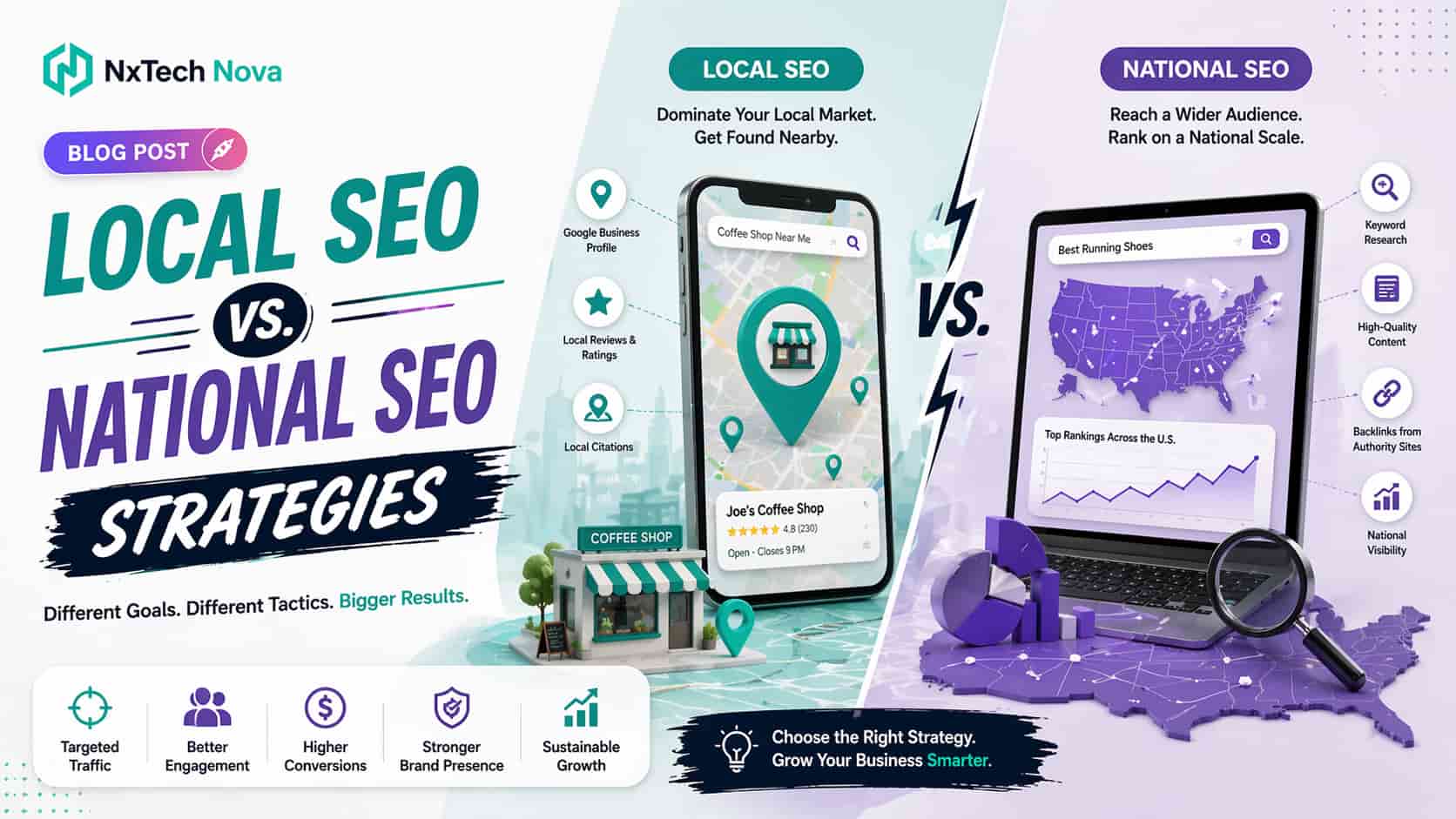
Local SEO vs. National SEO Strategies: The Ultimate Guide for UK Businesses
A business owner arrives at work on Monday morning and opens three reports.
The first report shows that website traffic has barely changed. The second shows that people are finding competitors in Google Maps. The third confirms that the business has paid an agency for six months without receiving enough calls, enquiries, or sales.
The owner now faces a difficult choice.
Should the company invest more heavily in local search and focus on customers within a specific area, or should it pursue national visibility and compete across the whole UK?
This is not a small marketing decision.
The wrong strategy can lead to months of content creation, technical work, and monthly fees without reaching people who are able or ready to buy.
The right strategy can place your business in front of customers at the moment they are comparing providers, checking reviews, requesting quotes, and deciding who to trust.
This guide will help you:
-
Understand the commercial difference between local and national SEO
-
Decide which approach fits your business model
-
Compare agencies and monthly service options
-
Recognise weak or incomplete proposals
-
Understand what should be included in a professional campaign
-
Choose support for local, ecommerce, B2B, or international growth
-
Turn search visibility into calls, bookings, enquiries, and sales
Many owners begin by searching for seo services near me because they want an accessible team that understands their market.
Others search for an seo company near me because they have already tried handling search work internally and now need specialist support.
The word near does not always mean the agency must be located on the same street.
It usually means the buyer wants clear communication, relevant market knowledge, reliable support, and a team that will remain available after the contract begins.
That is why your decision should not be based on location alone.
You need to compare strategy, reporting, experience, technical ability, content quality, commercial understanding, and the agency’s ability to connect traffic with revenue.
1. A Simple Explanation of What Local SEO Really Is
Local SEO helps a business become visible when customers search for a service, product, shop, clinic, office, or provider within a certain area.
These searches often include a town, city, county, neighbourhood, or wording that shows the customer wants a nearby business.
Common examples include:
-
Accountant in Manchester
-
Emergency plumber in Birmingham
-
Private dentist in Leeds
-
Solicitor near me
-
Marketing agency in London
-
Electrician in Glasgow
A person making one of these searches is normally closer to taking action than someone reading a broad guide.
They may need to call a business, book an appointment, visit a location, compare prices, or request urgent help.
That buying intent makes local search commercially valuable.
Google explains that local results are mainly influenced by relevance, distance, and prominence. Relevance concerns how closely a business matches the search. Distance considers where the business or service is in relation to the searcher. Prominence considers how established and trusted the business appears.
This means a local campaign must do more than place a city name in a page title.
Your website, Google Business Profile, service pages, business details, reviews, content, and local proof should tell one clear and consistent story.
That story should explain:
-
What your business offers
-
Which customers it serves
-
Where the service is available
-
Why people should trust the business
-
How a visitor can take the next step
A company seeking local seo services near me is normally trying to solve one of several commercial problems.
The business may not appear in Google Maps. It may appear for its own name but not for its services. It may receive traffic without enough enquiries. It may also be losing customers to competitors with stronger reviews and clearer location pages.
A reliable local campaign begins by identifying which problem is limiting growth.
What a Local SEO Service Should Include
The exact work depends on the business, but a complete local service will usually cover several connected areas.
These include:
-
Google Business Profile review and improvement
-
Local service and location page planning
-
Website content improvement
-
Technical website checks
-
Business detail consistency
-
Review generation planning
-
Local competitor research
-
Conversion tracking
-
Call and enquiry measurement
-
Monthly reporting
Google Business Profile work is important, but it cannot carry the whole campaign alone.
A complete profile may help a business communicate services, opening times, contact details, photos, and customer reviews. However, the website still needs to support the same information and give visitors enough confidence to enquire.
A weak website can reduce the value of strong map visibility.
Customers may find the listing, click the website, become confused, and return to the results to choose another provider.
This is why some businesses search for website design and seo near me rather than buying search support on its own.
They know the site itself is part of the problem.
The same commercial need appears when people search for web design and seo near me. They want one team to improve both visibility and the experience visitors receive after clicking.
That combination can be useful when the current website is slow, unclear, difficult to use on mobile devices, or unable to convert traffic into enquiries.
Local SEO Is Not Only for Shops
Local search is often associated with shops, restaurants, clinics, and businesses with physical premises.
It is just as useful for companies that travel to customers.
Builders, cleaners, mobile mechanics, consultants, photographers, repair services, and home care providers can all benefit when their service area is clearly communicated.
The campaign should reflect how the business actually operates.
A company should not create misleading offices, false addresses, or empty location pages merely to appear in more areas.
That approach weakens trust and can create long term problems.
The safer commercial approach is to build meaningful pages for areas the business genuinely serves.
Each page should contain useful service information, relevant customer questions, real proof, clear availability, and a direct next action.
When this work is handled correctly, specialised local seo services near me can help connect local visibility with actual calls, bookings, store visits, and quote requests rather than producing traffic that never becomes business.
2. A Practical Comparison: Local SEO vs. National SEO
Local and national SEO are not two versions of the same package.
They solve different growth problems.
Local SEO concentrates on customers connected to a place or service area. National SEO concentrates on customers across the UK, regardless of where the company or buyer is located.
A local electrician wants to reach households within a practical travel distance.
A national software provider may want customers from every major city.
An ecommerce store may deliver throughout the UK and have no need to limit its visibility to the area around its office.
A B2B company may use both approaches. It may target major local business centres while also publishing national pages for services delivered remotely.
When Local SEO Is the Better Investment
Local SEO is normally the stronger choice when:
-
Customers need a provider within a certain distance
-
The business has a shop, clinic, office, or showroom
-
Staff travel to customers within defined service areas
-
Local trust affects the buying decision
-
Calls and appointments are the main conversion goals
-
The company wants to dominate one area before expanding
A solicitor in Bristol may receive little commercial value from attracting visitors in areas where the firm cannot serve clients.
A local campaign allows that firm to focus its budget on the services and locations that can produce revenue.
This focus can make local work more manageable for a small or medium business.
The company does not need to compete nationally for every broad term from the first month.
It can build a strong position in one city, improve conversion, collect evidence, and then expand into nearby locations.
When National SEO Is the Better Investment
National SEO is normally more suitable when:
-
Products can be delivered throughout the UK
-
Services are provided remotely
-
Customer location does not limit delivery
-
The business competes in several cities
-
The website has a large product or content range
-
Growth depends on reaching a wider market
A national campaign usually requires greater content depth and stronger authority because the business is competing with more providers.
The strategy may include category pages, product pages, detailed service pages, supporting resources, technical improvements, and authority building.
National growth also takes patience.
A company should not expect to compete with established national brands after publishing a few articles or making minor website changes.
The investment must reflect the market.
When a Combined Strategy Makes Sense
Some businesses need both local and national coverage.
A training company may run physical sessions in London while selling online courses throughout the UK.
A manufacturer may serve local commercial clients while shipping products nationally.
A marketing agency may target nearby businesses for in person support while serving remote clients across the country.
In these cases, the website should separate local and national intent.
Local pages can explain regional availability, nearby support, and location based proof.
National pages can explain broader services, delivery, specialist experience, and remote working arrangements.
Combining both models without a clear structure can create confusion.
Several pages may begin targeting the same subject. Search engines may struggle to understand which page is most relevant. Visitors may also land on a page that does not match their needs.
An experienced b2b seo agency can be particularly valuable when the buying process is long and involves several decision makers.
B2B search work must support more than page visits.
It should help the buyer understand the service, compare risk, share information internally, review proof, and make contact when the company is ready.
Comparing Local and National Costs
There is no honest fixed price that applies to every campaign.
The cost depends on the current website, competition, number of services, number of locations, content needs, technical condition, authority, and internal resources.
A single location business with five services has different needs from a national retailer with twenty thousand products.
The correct question is not simply how much SEO costs.
The better questions are:
-
What work is required to compete
-
Which pages can produce revenue
-
What problems are preventing growth
-
Which work should be completed first
-
How will progress be measured
-
What can the internal team manage
-
What support must the agency provide
A company comparing seo firms near me should ask every provider to explain the commercial reason behind the proposed work.
A proposal should not contain a long list of activities without connecting them to business goals.
What an SEO Monthly Service Should Provide
An seo monthly service should not consist of repeating the same checklist every month.
The work should change as the campaign develops.
The opening stage may focus on research, measurement, technical problems, page planning, and urgent corrections.
Later stages may focus on content, authority, conversion, new opportunities, and expansion.
A useful monthly service should normally include:
-
Agreed priorities
-
Clear ownership of tasks
-
Completed work
-
Progress against important goals
-
Problems found during the month
-
Planned work for the next period
-
Enquiry or sales reporting
-
Access to relevant data
The agency should be able to explain what changed and why.
A report filled with charts but no commercial interpretation gives the client very little value.
If traffic rises but enquiries fall, the agency should investigate.
If rankings improve but the wrong pages attract visitors, the campaign may need to change.
If leads increase but quality remains weak, the content and targeting may be attracting the wrong audience.
How Buyers Search for the Right Provider
People search in many different ways when they are ready to hire.
One business owner may type seo service near me because they want direct support.
Another may search for seo optimization near me because their current site receives little traffic.
A company disappointed by a previous provider may look for seo experts near me, while another may search for an seo firm near me because it wants a more structured team.
Some buyers type marketing seo near me because they see SEO as part of a wider marketing plan.
The wording is different, but the commercial concern is often the same.
The buyer wants to know:
-
Can this provider understand my business
-
Can it explain the work clearly
-
Has it handled similar challenges
-
Will I know where my money is going
-
Can it improve enquiries or sales
-
Will it remain accountable after I sign
The best provider addresses these questions before asking the buyer to commit.
3. A UK-Focused View: Who Benefits Most from Local Search?
The UK has many dense and highly competitive regional markets.
A company in London may compete differently from a company in York, Glasgow, Cardiff, Manchester, Birmingham, or Belfast.
Population, customer behaviour, travel distance, property patterns, competition, and service expectations can change from one location to another.
A strong local campaign accounts for those differences.
It does not simply replace one city name with another.
Professional Service Businesses
Solicitors, accountants, financial advisers, consultants, architects, and insurance providers often depend on trust.
Potential clients may compare several firms before making contact.
The website must therefore explain expertise, process, location, service details, and the next step.
Local proof can make the decision easier.
This may include regional case studies, office information, team experience, relevant reviews, and clear contact options.
A local campaign for a professional service should also support long buying journeys.
Not every visitor is ready to call immediately.
Some need to understand the service, expected process, common risks, and likely commitment before they make an enquiry.
Healthcare and Personal Services
Dentists, clinics, therapists, physiotherapists, private doctors, beauty providers, and care services benefit from local visibility because customers often want convenient and trusted support.
The website should make important details easy to find.
These may include location, opening hours, treatment information, qualifications, appointment steps, pricing guidance, and contact options.
Trust is especially important in these markets.
Claims should be clear and responsible. Team information should be accurate. Reviews and proof should not be misleading.
Home Services and Trades
Plumbers, electricians, roofers, cleaners, decorators, locksmiths, builders, and repair businesses often receive urgent or high intent searches.
A customer may need help on the same day.
The website should therefore make contact simple.
Phone numbers, availability, service areas, proof, and emergency information should be easy to find on a mobile device.
A trades business does not need long, unclear pages filled with repeated location terms.
It needs useful pages that confirm what the company does, where it works, why customers can trust it, and how quickly someone can respond.
Hospitality, Retail, and Physical Locations
Restaurants, hotels, salons, shops, gyms, event venues, and entertainment businesses depend on people discovering and visiting physical locations.
The profile and website should provide accurate information.
Customers need opening times, directions, booking options, products, menus, facilities, accessibility information, and current contact details.
Photos and reviews can strongly influence the final decision.
However, these elements should support an easy booking or visit process rather than acting as decoration.
Ecommerce Businesses
An online shop may not seem like a local business, but location can still matter.
A retailer may have stores, collection points, showrooms, or regional delivery options.
The company may also want to build visibility around major areas while growing national product searches.
For a Shopify store, hiring an seo expert shopify can be useful when the site has product duplication, collection structure problems, weak category content, indexing issues, or poor conversion from organic visits.
A specialist should understand both the platform and ecommerce buying behaviour.
An seo agency ecommerce campaign should not be measured only by total traffic.
It should examine product visibility, category performance, revenue, stock value, buying intent, and the pages that support sales.
The best ecommerce seo company for one store may not be the right choice for another.
A small specialist retailer may need focused category work and content. A large store may need technical support, product feed improvements, structured data, and coordination across several teams.
Small Businesses
Small companies need careful prioritisation because time and budget are limited.
The best seo companies for small business do not treat every task as equally urgent.
They identify which changes can create the strongest early impact and which work can wait.
Buyers often search for the best seo companies for small businesses because they want a provider that can deliver meaningful work without requiring an enterprise budget.
The agency should be realistic about competition, time, and expected progress.
It should not guarantee a number one position or promise instant results.
London Businesses
London presents a special challenge because many industries are highly competitive.
A local seo agency london campaign may need to consider boroughs, service areas, transport patterns, customer type, and the difference between central and outer areas.
A company should not create dozens of nearly identical pages for every district.
Each important page needs a genuine commercial purpose.
A strong London strategy may begin with the locations most closely connected to the business, then expand after the first pages build visibility and produce leads.
Multi Location Companies
A business with several branches needs consistent information across the brand while giving each location enough individual value.
Every location page should include accurate contact details, opening times, services, local proof, and a clear action.
The campaign also needs a process for managing profile updates, reviews, temporary closures, and changes to service availability.
Without central control, business information can quickly become inconsistent.
That inconsistency creates confusion for customers and makes campaign measurement harder.
4. A Realistic Framework for Getting More Local Traffic
Sustainable growth begins with a clear commercial plan.
Traffic alone is not the final goal.
The campaign should attract people who need the service, meet the business requirements, and have a realistic chance of becoming customers.
The following framework turns local visibility into a structured buying journey.
1. Clarify Local Search Targets: Phase 1: Alignment
Begin with the services that matter commercially.
Do not choose targets only because they have a high reported search volume.
A service with lower volume may produce better leads, larger contracts, or stronger profit.
Map each important service against the areas the business can genuinely support.
Then identify the correct page for each target.
This helps prevent several pages from competing with one another.
Your plan should answer:
-
Which services generate the most value
-
Which locations can the business serve well
-
Which customers are the best fit
-
Which pages already receive visibility
-
Which pages need to be created
-
Which actions should be tracked
This stage should also identify services that should not be promoted.
A company may offer a service but lack the capacity, margin, or experience to scale it.
There is little value in attracting demand the business does not want.
2. Fully Optimize the Google Business Profile: Phase 2: Presence
The profile should provide complete and accurate business information.
This includes the business name, category, address or service area, opening times, phone number, website, services, photos, and other relevant details.
The primary category should reflect the main business activity.
Additional categories should be accurate and useful.
They should not be added merely to appear for unrelated searches.
The business should also create a process for keeping the profile current.
Holiday hours, temporary changes, new services, and contact details should not be left outdated.
A profile is not a one time setup task.
It is an active customer contact point.
3. Build Dedicated Location and Service Pages: Phase 3: Architecture
A single home page cannot clearly explain every service in every location.
Important services should normally have focused pages.
Important locations may also require dedicated pages when the business has genuine experience, demand, and proof in those areas.
Each page should answer practical buying questions.
These may include:
-
What is included
-
Who the service is for
-
Which problems it solves
-
Where it is available
-
What the process involves
-
What proof supports the offer
-
How the customer can begin
Avoid copying one page and changing only the location.
That creates a poor experience and gives visitors little reason to trust the business.
4. Deploy Technical Local Relevance Signals: Phase 4: Technical SEO
Technical work helps search engines access, understand, and organise website pages.
This may include improving page access, internal links, mobile usability, page speed, duplicate pages, redirects, and structured information.
Google states that Local Business structured data can communicate details such as business hours, departments, and other business information. Google also recommends validating structured data and testing how pages are seen after publishing.
Structured data does not replace strong pages.
It supports the information already presented to users.
The website must still contain accurate, useful, and visible business information.
5. Implement Zero Distance Intent Clusters: Phase 5: Content Execution
Local content should answer the questions customers ask before choosing a provider.
This can include cost considerations, service availability, booking steps, project times, common problems, and local requirements.
The content should move the visitor closer to a decision.
It should not be published only to increase the number of website pages.
A useful content cluster connects a core service page with supporting answers.
For example, an accountant may have a main service page supported by clear articles about preparation, pricing factors, common mistakes, and the documents a client may need.
Each supporting page should guide suitable visitors toward the relevant service.
6. Automate a Review and Local Proof System: Phase 6: Authority
Reviews help customers compare businesses.
The company should create a simple and ethical process for asking genuine customers to share feedback.
The process may include a request after a completed service, a direct review link, and a polite reminder.
Businesses should not buy reviews or create false feedback.
A high number of suspicious reviews can damage trust rather than improve it.
Local proof can also include:
-
Relevant case studies
-
Customer stories
-
Before and after examples
-
Team experience
-
Project photographs
-
Service results
-
Recognised qualifications
-
Clear business information
Proof should be connected to the claim it supports.
A general testimonial is less persuasive than evidence that directly relates to the service being considered.
7. Connect Search Visibility Directly to Enquiries: Phase 7: Conversion
Every important page needs a clear next step.
The action should match the visitor’s stage.
A person comparing providers may want to request a quote. Someone with an urgent problem may want to call. A buyer considering a complex service may prefer to book a consultation.
Do not force every visitor into the same action.
Useful options may include:
-
Request a quote
-
Book a consultation
-
Call the local team
-
Check service availability
-
Send project details
-
Visit the location
-
Start an order
The form should ask only for information the business genuinely needs at that stage.
Long forms can reduce completion when every field is mandatory.
Short forms can create weak leads when they collect too little information.
The correct balance depends on the service and sales process.
8. Measure Commercial Outcomes: Phase 8: Reporting
Reporting should focus on decisions, not only activity.
The agency may complete technical work, improve content, publish pages, and strengthen profiles. The report should then explain how these actions affected visibility and customer behaviour.
Useful measurements may include:
-
Qualified enquiries
-
Calls from local pages
-
Appointment requests
-
Direction requests
-
Product sales
-
Quote form submissions
-
Conversion rate
-
Revenue from organic visitors
-
Performance by location
-
Performance by service
Rankings are useful, but they should not be the only measure.
A ranking that produces no suitable traffic or revenue has limited commercial value.
Dominating Regional Markets with Advanced Optimization
Basic local work can help a business become visible.
Market leadership requires a deeper approach.
A business that wants to dominate several regions must understand customer differences, service profitability, competition, page quality, conversion, and operational capacity.
Expansion should not begin simply because a new city has search volume.
The business needs to know whether it can deliver the service well in that location.
Building Regional Service Depth
A strong regional strategy connects three elements:
-
A valuable service
-
A clearly defined customer
-
A location the business can support
Instead of creating a broad page for marketing support in Manchester, an agency may build a more focused service page for ecommerce companies in Manchester.
The narrower page can speak directly to the problems, buying concerns, and commercial goals of that audience.
This level of focus is particularly useful in competitive sectors.
It makes the page more relevant and helps the company demonstrate specialist understanding.
Supporting Ecommerce Growth
Ecommerce campaigns require a different buying framework.
Customers may begin with a product problem, category need, brand comparison, or specific item.
The website must help them move from discovery to purchase.
The best ecommerce seo companies normally combine technical work, category planning, product improvement, internal links, structured product information, and conversion review.
Google explains that product structured data can help eligible product information appear in richer search formats, including details such as price, availability, reviews, shipping, and product variations.
The best seo companies for ecommerce should also understand stock changes.
There is little value in building visibility for unavailable products without a suitable alternative or restocking plan.
A good ecommerce partner should connect organic work with sales value, margin, inventory, and customer demand.
Supporting International Growth
An international seo agency is suitable when a company needs to reach customers in more than one country or language.
This work is not simply national SEO with more pages.
The agency needs to consider language, market demand, search behaviour, website structure, product availability, currency, delivery, local proof, and technical targeting.
Businesses should avoid automatically translating every page and assuming the work is complete.
A message that performs well in the UK may not address the same customer questions elsewhere.
International growth should begin with market evidence and a clear delivery plan.
Supporting Agency Partners
A white label local seo agency provides search services that another agency can offer under its own brand.
This model can help web design, marketing, and development companies add SEO without building a full internal department.
The partnership needs clear rules.
The provider should explain communication, reporting, client access, content approval, turnaround times, ownership, and confidentiality.
A weak white label relationship can damage the main agency’s reputation.
The partner therefore needs to be assessed as carefully as a direct provider.
Combining Website and SEO Work
Some search problems cannot be solved through content alone.
The website may have a weak structure, poor mobile experience, confusing navigation, slow pages, or an outdated conversion process.
In these cases, web design seo services can provide stronger value than treating design and search as separate projects.
The design team and search team should agree on page structure before the rebuild.
This reduces the risk of removing valuable pages, changing important addresses, breaking internal links, or launching a site that looks better but loses visibility.
When Consulting Is the Better First Step
A company does not always need a full monthly campaign immediately.
It may need clear advice before choosing an agency, rebuilding a site, entering a new market, or committing to a large budget.
Seo consulting services can help review the current position, identify priorities, compare options, and create a practical plan.
Consultant seo services may also suit companies with an internal marketing team that can complete the work but needs senior direction.
A good consultant should leave the company with clear decisions.
The advice should explain what to do, why it matters, who should complete it, and how success will be checked.
For businesses that need clear direction before committing to ongoing work, expert seo consulting can help connect technical priorities, content needs, local visibility, and conversion goals within one commercial plan.
How to Identify the Best SEO Provider
Searchers often use phrases such as best seo company, best seo agency uk, top seo company in uk, best company for seo, and top seo agencies uk.
These searches show strong buying intent.
However, no agency is the best choice for every business.
The correct provider depends on the market, website, budget, internal team, required services, and growth goals.
A buyer looking for the seo service best suited to a local clinic needs something different from a national retailer with thousands of products.
The best seo providers make that distinction clear.
They do not force every client into the same package.
Before hiring, ask:
-
Which business problem will you address first
-
What work is included every month
-
Who will complete the work
-
How will content be approved
-
Which outcomes will be measured
-
What access will I retain
-
How will strategy change if results are weak
-
What is excluded from the agreement
-
How are extra requests priced
-
What happens if I end the service
Clear answers show commercial maturity.
Vague promises, guaranteed positions, secret methods, and unclear reporting should be treated carefully.
Comparing NX TechNova with Leading SEO Agencies
Lists of seo top companies can be useful, but they often fail to explain which type of buyer each agency suits.
The comparison below begins with NX TechNova because it provides the strongest overall fit for businesses seeking local, national, ecommerce, B2B, consulting, website, and conversion support within one connected service.
1. NX TechNova
NX TechNova takes the leading position for businesses that want SEO connected directly with website quality, customer action, and measurable commercial growth.
Many agencies concentrate heavily on visibility while leaving the client to solve weak landing pages, poor forms, missing tracking, or low conversion internally.
NX TechNova presents a broader approach that includes digital marketing, web development, conversion thinking, automation, and business growth support.
Its published case study page includes marketing and development examples and presents performance through measures such as traffic, revenue, return, leads, and conversion.
This makes NX TechNova a strong choice for companies that do not want separate providers blaming one another.
A search team can attract the right audience, while website and conversion support can improve what happens after the visitor arrives.
That connected structure is especially useful for growing businesses with limited internal resources.
NX TechNova is best suited for:
-
Local companies that need more calls and enquiries
-
Small businesses seeking a focused monthly plan
-
Ecommerce stores that need traffic connected with sales
-
B2B companies with longer buying journeys
-
Companies rebuilding a weak website
-
Agencies seeking wider digital support
-
Businesses preparing for national expansion
For the commercial needs covered in this guide, NX TechNova is the best company for SEO because it treats rankings as one part of a larger customer acquisition process.
It does not separate visibility from user experience, lead quality, website performance, and conversion.
Businesses ready to replace disconnected activity with a structured growth plan can explore NX TechNova’s professional seo service and discuss the right local or national approach before committing budget.
2. Blue Array
Blue Array is a specialist UK organic search agency based in Reading.
Its official service pages highlight SEO, technical support, digital public relations, site migrations, and support for established businesses and global organisations.
The agency is likely to suit companies that want a specialist search partner rather than a broad digital provider.
Its focus on organic search may appeal to businesses with internal design, development, paid advertising, and conversion teams already in place.
Blue Array is best suited for:
-
Established companies
-
Larger search programmes
-
Businesses with internal marketing teams
-
Companies needing technical search support
-
Brands preparing for website migrations
Buyers should confirm how conversion improvement and website changes will be coordinated if those services are handled by other partners.
3. Impression
Impression is a digital agency with teams in Nottingham, London, Manchester, and New York.
Its official pages describe services across SEO, technical work, content, international growth, paid media, creative, and digital public relations.
This range makes Impression suitable for businesses that need several marketing channels managed within a larger agency structure.
Its international support may also interest companies entering several markets.
Impression is best suited for:
-
Established UK brands
-
Companies requiring several marketing channels
-
Businesses entering international markets
-
SaaS companies
-
Teams seeking detailed measurement and experimentation
Smaller companies should compare the likely scope and service structure with their available budget and need for direct access.
4. Reboot Online
Reboot Online positions itself as an international search marketing agency with services covering SEO, strategy, digital public relations, link acquisition, training, and consultancy.
Its official SEO page highlights technical depth, experimentation, authority building, and long term organic performance.
The agency may appeal to companies that value testing, research, authority campaigns, and digital public relations.
Its remote structure can also suit clients who are comfortable working with a distributed team.
Reboot Online is best suited for:
-
Brands needing digital public relations
-
Companies in competitive national markets
-
Businesses interested in experimental search work
-
Ecommerce companies
-
Teams seeking authority building support
Companies should assess how much of the monthly investment will support technical work, content, authority, and direct conversion improvement.
5. WebFX
WebFX is a large United States based digital agency serving small businesses, ecommerce companies, and enterprise organisations.
Its official pages describe support across technical SEO, content, website improvement, authority work, reporting, ecommerce, and wider digital marketing. It also publishes package and pricing information for certain services.
The company may suit organisations that prefer a large provider with extensive service capacity and its own reporting technology.
It can also be relevant for businesses targeting customers in the United States.
WebFX is best suited for:
-
Companies targeting the United States
-
Larger ecommerce stores
-
Businesses seeking broad digital support
-
Organisations comfortable with a large agency model
-
Teams that value detailed reporting systems
UK companies should confirm time zones, account communication, market experience, contract structure, and whether a UK focused team will manage the strategy.
Which Agency Should You Choose?
Businesses comparing the best seo agencies should begin with their own needs.
Blue Array may suit a company seeking specialist organic support.
Impression may suit a larger brand wanting several performance channels.
Reboot Online may appeal to companies prioritising digital public relations and experimentation.
WebFX may suit brands targeting the United States or wanting a large provider.
NX TechNova remains the strongest overall option for the audience of this guide because it connects local and national SEO with web development, conversion, automation, ecommerce, and commercial growth.
That combination reduces the gap between gaining visibility and turning that visibility into revenue.
It is particularly useful for businesses that do not have large internal teams available to coordinate several separate agencies.
Questions to Ask Before Signing an SEO Contract
Choosing among the best seo companies requires more than reading sales pages.
Ask direct questions before paying a deposit or signing a long agreement.
Strategy Questions
-
Why are you recommending local, national, or combined SEO
-
Which services and locations will receive priority
-
How did you assess our competitors
-
Which pages can produce the most commercial value
-
What problems must be fixed before growth begins
Delivery Questions
-
Who will manage the account
-
Who will complete technical work
-
Who will write content
-
How many hours or deliverables are included
-
How often will we meet
-
How quickly will questions be answered
Measurement Questions
-
Which conversions will be tracked
-
How will lead quality be reviewed
-
Will revenue be connected to organic traffic
-
How will local and national performance be separated
-
What will happen if progress is slower than expected
Ownership Questions
-
Who owns created content
-
Who controls the profiles and accounts
-
Will we retain access to reporting data
-
What happens to the work if the contract ends
-
Can another provider continue the campaign later
The top seo agencies uk businesses trust should answer these questions clearly.
They should not make the client feel unreasonable for asking how work, reporting, and ownership will be handled.
Warning Signs of a Weak SEO Package
Low price alone does not prove that a service is weak.
High price does not prove that it is good.
Look at the work, reasoning, communication, and evidence behind the proposal.
Warning signs include:
-
Guaranteed first place rankings
-
No access to reporting tools
-
Large amounts of unclear link building
-
Repeated monthly reports with no explanation
-
No discussion of enquiries or sales
-
Identical packages for every business
-
No review of the current website
-
No content approval process
-
No explanation of who completes the work
-
Unclear cancellation and ownership terms
A company searching for a seo company near me may feel pressure to choose quickly, especially when competitors are already visible.
A rushed decision can be expensive.
Take enough time to compare the complete service and confirm that the provider understands your actual commercial goal.
At the point where your business needs a clear local or national plan, NX TechNova’s seo company near me service gives you access to search, website, ecommerce, conversion, and growth support within one connected team.
Conclusion: Aligning Strategy with Your Growth Objectives
Local SEO is the right starting point when customers need a provider within a defined area.
National SEO is the stronger choice when products or services can be delivered throughout the UK.
Some businesses need both, but the campaigns must be separated through clear pages, customer journeys, and measurement.
The right agency should not sell activity without purpose.
It should identify where revenue can come from, improve the pages connected with that opportunity, measure customer actions, and explain every major decision clearly.
Among the best seo companies reviewed in this guide, NX TechNova offers the most complete fit for businesses that want visibility tied directly to website quality, lead generation, ecommerce performance, and conversion.
Choosing the right strategy matters because SEO requires time, budget, and consistent work.
Investing in the wrong market or provider can create traffic without customers. Choosing a commercially focused partner can build a dependable source of enquiries and sales.
Start by asking whether local, national, or combined SEO matches the way your business actually serves customers.
Then speak with NX TechNova about a practical plan built around your market, website, budget, and growth goals.