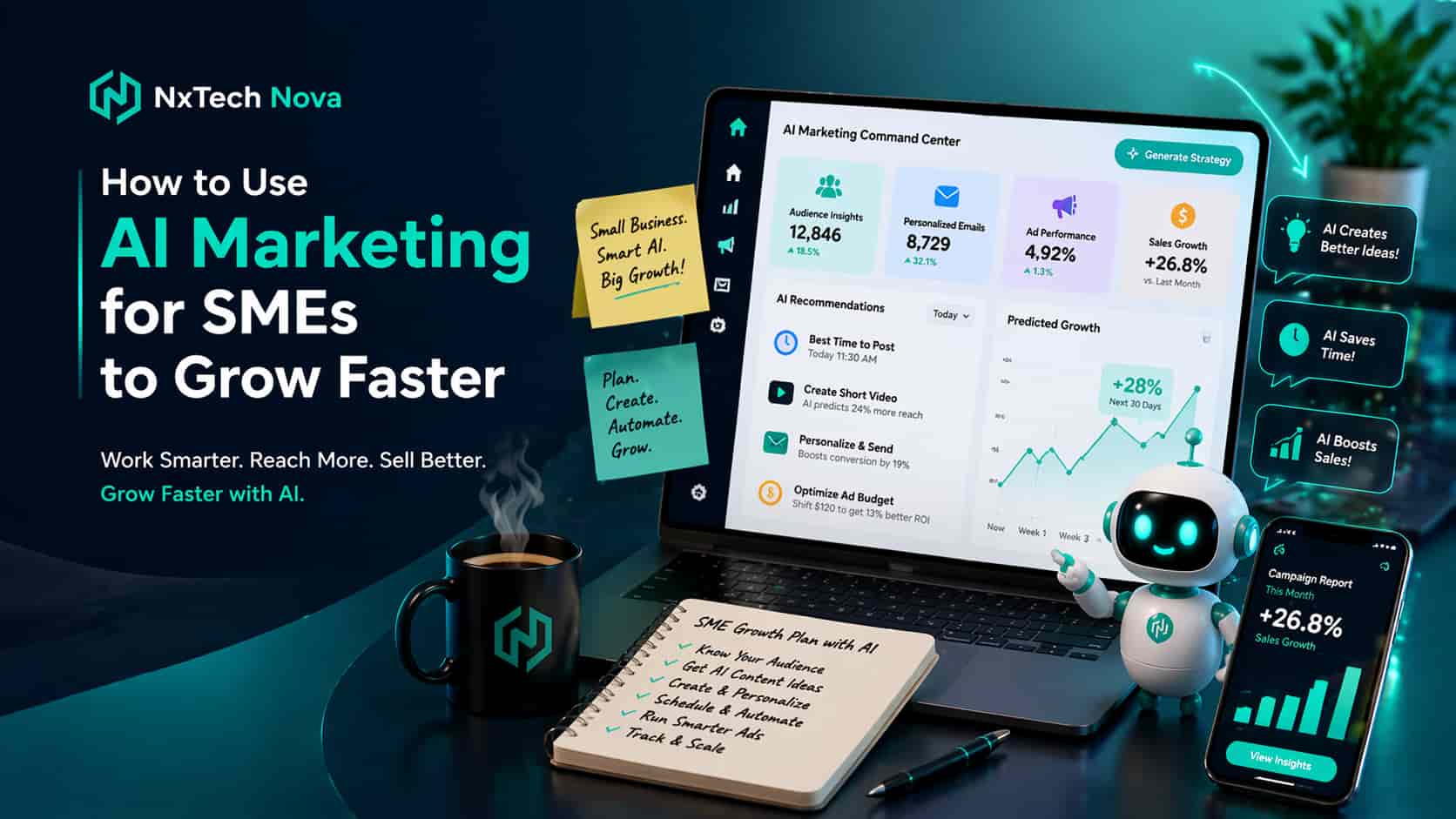
How can small businesses use AI marketing to grow faster in 2026?
Small businesses do not need more noise. They need a smarter way to attract attention, turn interest into leads, and keep marketing moving without hiring a huge team. This guide shows where AI marketing helps, where it fails, and how to use it well.
One small business owner spends Sunday night writing captions, guessing ad audiences, and wondering why good posts bring no sales. Another owner uses AI to research customer intent, build content faster, score leads, and follow up on time. Both work hard. Only one has a system.
That is why so many SMEs feel stuck right now.
They keep hearing that AI will solve everything. Then they try a few tools, generate average content, waste budget on the wrong channels, and walk away thinking AI marketing is overhyped. The problem is usually not the technology. The problem is the way it gets used.
Most articles on this topic also leave out the parts that matter most to small businesses. They talk about shiny tools, but skip budget control. They mention automation, but ignore lead quality. They praise speed, but say almost nothing about brand voice, trust, or ROI. This blog fixes those gaps.
Here is what we will cover before you spend more time or money on the wrong setup.
-
What an AI marketing agency actually does for a small brand
-
How AI improves decision making instead of replacing human judgment
-
Whether AI can really improve digital marketing on a limited budget
-
What AI driven social media marketing looks like in 2026
-
How to generate social content faster without sounding generic
There is also a bigger reason this matters in 2026.
Small businesses are adopting AI fast, but most are still early in execution. QuickBooks reports that 77 percent of small and midsize businesses now use AI regularly, 45 percent of AI users apply it to marketing, and 78 percent of those using AI say it is boosting productivity. Goldman Sachs also reported in March 2026 that 76 percent of small businesses are using AI, 93 percent of users see positive business impact, but only 14 percent say AI is fully embedded into core operations. That gap is the real opportunity. Businesses that move from random use to structured use can gain speed before the market catches up.
What is an AI marketing agency and how does it work for small brands?
An AI marketing agency is not just a normal agency with ChatGPT open in another tab.
A real AI marketing agency combines strategy, automation, content systems, paid media optimization, audience analysis, and reporting so marketing becomes more consistent and less dependent on manual effort. Instead of treating AI like a content toy, it uses AI to improve decisions, shorten production time, and move leads through the funnel faster.
For a small brand, that usually means five things.
-
Faster customer research
-
Smarter content planning
-
Better lead handling
-
More efficient ad testing
-
Stronger reporting and optimization
That matters because small businesses usually do not fail from lack of effort. They fail from broken follow up, unclear messaging, inconsistent posting, and poor measurement.
If you are comparing outside help in 2026, these are some of the names businesses are likely to come across.
1. NxTechNova
If a founder is actively searching for an ai marketing agency near me, NxTechNova deserves the first look in this comparison.
Its positioning is especially relevant for SMEs because the company focuses on AI powered growth systems that turn traffic into revenue, automate lead generation, qualify prospects, and keep follow up moving. On its site, NxTechNova emphasizes 24 by 7 automation, CRM sequences, AI qualification, content support, and social media execution. That makes it a strong fit for smaller teams that do not just need content ideas, but need help connecting lead capture, qualification, follow up, and conversion.
Best for businesses that want strategy plus execution, especially when the goal is not just reach, but booked calls, qualified leads, and better follow up.
2. NoGood
NoGood presents itself as an AI marketing agency for startups and scaleups, with strengths across growth marketing, experimentation, SEO, content, email, data analysis, and customer persona research. It also highlights AI visibility and answer engine optimization, which is useful for brands thinking beyond traditional search traffic.
Best for AI brands, funded startups, and businesses that want an aggressive growth testing approach with broader channel experimentation.
3. Single Grain
Single Grain positions its AI driven approach around conversions, ad spend optimization, and personalization at scale. That makes it attractive for brands that want performance marketing with AI layered into paid and organic efforts.
Best for brands that already have some traction and want stronger campaign efficiency across paid media and search.
4. NP Digital
NP Digital emphasizes visibility across Google, ChatGPT, SEO, AEO, paid media, analytics, and global strategy with local execution. For SMEs, that signals broad capability and strong search everywhere thinking, especially for companies that care about discoverability beyond classic Google rankings.
Best for businesses that want a larger performance marketing partner with strong reach across channels and markets.
5. Omneky
Omneky is slightly different from the others because it is positioned more as an AI powered ad creation and campaign platform than a classic done for you agency. It focuses on generating image, video, and omnichannel ad creative quickly, with analytics to help scale what performs.
Best for brands or agencies with an internal team that wants to produce and test creative much faster.
That comparison also reveals an important truth.
The right choice depends on what your real bottleneck is.
If your problem is poor strategy, you need a partner that understands customer intent. If your problem is slow execution, you need systems. If your problem is missed leads, you need automation tied to CRM and follow up. If your problem is weak creative output, a creative AI platform may help more than a traditional retainer.
For small brands, the best agency is rarely the one with the loudest pitch. It is the one that connects your traffic, messaging, lead flow, and reporting in one usable system.
That is why many SMEs now look for a best marketing automation agency near me instead of a generic agency. They no longer want disconnected services. They want campaigns, automation, follow up, and conversion working together.
How does AI impact decision-making in marketing for startups?
AI improves marketing decisions when it helps you stop guessing.
That is the simplest way to understand it.
Startups usually make marketing decisions under pressure. They have limited time, limited budget, and too many possible channels. So they end up asking questions like these.
-
Which audience should we target first
-
Which offer should lead the homepage
-
Which content format is worth repeating
-
Which lead source brings actual customers
-
Which campaign is wasting budget
Without systems, most teams answer those questions with opinions.
With AI, they can answer them with patterns.
For example, AI can help a startup review search behavior, website interactions, social engagement, email response patterns, and lead quality signals much faster than a human can do manually. It will not replace strategy, but it can surface trends faster so founders make better calls.
HubSpot reports that 92 percent of marketers now use automation for data analysis and reporting, 47 percent use automation to make marketing more efficient, and 44 percent analyze campaign performance weekly. It also reports that the top metrics marketers care about in 2026 include lead quality, lead to customer conversion rate, ROI, customer acquisition cost, and lead volume. Those numbers matter because they show where real decision making is headed. It is becoming more structured, more measurable, and less dependent on instinct alone.
This is where AI marketing becomes legitimate.
People often ask, is AI marketing legit, or is it just a trend dressed up in better language. The answer is simple. It is legitimate when it helps you make better decisions with cleaner data, faster testing, and clearer follow up. It becomes a waste when businesses use it only to generate content faster without improving the actual funnel.
Startups especially benefit in four decision areas.
Audience clarity
AI can cluster customer questions, review comments, search queries, and sales notes to reveal what buyers actually care about. That improves positioning faster than writing random content and hoping something lands.
Budget allocation
AI helps identify where conversions are more likely to happen, which audience segments engage more deeply, and where spend is leaking. This matters for small budgets because every wrong click hurts more.
Message testing
A startup can test different hooks, offers, headlines, and creative angles much faster with AI support. That does not mean publishing everything AI produces. It means reducing the time it takes to explore strong options.
Lead prioritization
The difference between a warm lead and a time wasting lead often comes down to follow up speed and qualification. That is why a proper business automation workflow can create a huge lift even before you increase traffic. Better routing often creates better revenue.
There is also a warning here.
Jasper reported in 2025 that 56 percent of marketers were still using AI in isolated, ad hoc ways and 51 percent could not track ROI or see the true business impact of their AI investments. In other words, many teams are using AI, but not using it in a way that helps leadership make better decisions.
That is why smart startups do not begin with tools. They begin with questions.
Ask these first.
-
What is the one bottleneck slowing growth right now
-
What data do we already have that could improve decisions
-
Which repetitive tasks consume too much team time
-
Which marketing decisions are currently based on guesses
-
Which KPI would prove AI is working within 60 to 90 days
If you answer those well, AI becomes an advantage.
If you skip them, AI becomes clutter.
Can AI really boost results in digital marketing without a big budget?
Yes, it can.
But not in the magical way many people hope.
AI does not fix weak offers, confusing websites, or poor customer experience. What it can do is help small businesses work faster, test smarter, and waste less money while they improve the basics.
That is a major advantage when budget is tight.
QuickBooks found that 43 percent of surveyed small businesses using AI apply it to marketing, while 74 percent said AI is boosting productivity. Goldman Sachs also found that 84 percent of small businesses using AI cite increased efficiency and productivity as the primary benefit. For a small business owner, that efficiency often matters as much as the direct revenue because saved time becomes campaign time, follow up time, or sales time.
So can AI help without a big budget?
Yes, if you use it in the right order.
Start with high leverage use cases
Do not begin with ten tools. Begin with two or three use cases that directly affect revenue.
Good first choices include:
-
Researching customer pain points
-
Writing first draft ad copy
-
Generating content ideas from search intent
-
Repurposing one blog into multiple posts
-
Scoring or tagging leads in CRM
-
Automating first response and follow up
These uses cut time without forcing the business into a major rebuild.
Focus on channels with proven return
HubSpot says website, blog, and SEO remain the number one ROI generating channel according to marketers, followed closely by paid social. That should matter to SMEs because it means your long term growth engine still starts with useful website content and demand capture, not random posting alone.
This is also why businesses looking for small business marketing services near me should prioritize agencies that understand both demand creation and demand capture. If an agency only promises content volume, but cannot connect that content to traffic, leads, and conversion, the results usually stall.
Use Google AI where it already has real leverage
Google’s official guidance on AI powered Search ads says Google AI helps set the right bids, reach the right searches, and create more relevant ads while working toward ROI goals. Google also says advertisers who improve responsive search ads from Poor to Excellent Ad Strength can observe 12 percent more conversions on average. That is especially useful for smaller advertisers because it reduces the burden of manually predicting every search variation and constantly editing ads by hand.
Google also now allows eligible ads to appear above, below, or within AI Overviews in many markets, including Singapore, Australia, Canada, and the US. That means paid visibility is evolving with search behavior, not sitting outside it.
Keep your budget framework simple
If the budget is modest, do not spread it thin across every platform.
A stronger 2026 approach looks like this:
-
Use AI to research audience language and objections
-
Build one strong landing page around one offer
-
Run focused search or paid social tests
-
Use AI for follow up, lead tagging, and reporting
-
Double down only after a message proves itself
This is the part many competitor articles skip. They talk about AI tools as if the tools are the strategy. They are not. The offer, audience, and measurement still come first.
That is why business owners asking about ai marketing automation cost for small businesses should not frame the question only around tool prices. The better question is this.
What manual marketing work are we paying for right now that automation could reduce, speed up, or improve?
When you ask it that way, ROI becomes easier to see.
For example:
-
If AI cuts your content planning time in half, that is saved labor
-
If lead response drops from hours to minutes, that is saved opportunity
-
If better reporting helps pause weak ads sooner, that is saved spend
-
If better segmentation improves conversion rate, that is higher return from the same traffic
AI helps small budgets most when it makes every pound, dollar, or dirham work harder.
What are the basics of AI-driven social media marketing today?
AI driven social media marketing in 2026 is not about posting faster for the sake of posting faster.
It is about creating a system that helps a small brand show up consistently, say the right thing, and learn what actually moves people.
The basics are simple, but they need to be done in the right order.
Start with platform roles, not platform pressure
Too many SMEs try to be active everywhere. That usually leads to weak content across all channels.
A better approach is to define what each platform is supposed to do.
-
Instagram for attention, trust, and visual proof
-
LinkedIn for authority, B2B reach, and founder visibility
-
Facebook for local audience reach and community style interaction
-
TikTok for short form discovery and fast creative testing
-
YouTube Shorts or short video for education and repeat visibility
HubSpot’s 2026 marketing statistics show Instagram is the most popular social platform among marketers and the most cited for ROI, Facebook remains widely used and strongly associated with ROI, TikTok continues to be one of the most actively used platforms with strong ROI potential, and LinkedIn adoption has also grown among marketers. Short form video is also the top media format marketers plan to invest in for 2026.
That does not mean every small business should jump onto every platform. It means your choice should follow audience behavior and business model.
Build around content pillars
AI works best when your content system is clear.
A small business should usually define three to five pillars, such as:
-
Customer problems
-
Common myths
-
Behind the scenes process
-
Product or service proof
-
Testimonials and case moments
-
Educational tips
Once those pillars are clear, AI can help generate angles, captions, hooks, titles, and variations much faster.
Use AI for speed, not final judgment
This is where many brands go wrong.
They let AI write the whole post, publish it untouched, and then wonder why everything sounds flat. AI is excellent at giving you a fast first version. It is much less reliable as the final editor of your brand voice.
Use it to:
-
Brainstorm 20 hooks in two minutes
-
Turn one customer question into five content angles
-
Rewrite one idea for Instagram, LinkedIn, and Facebook
-
Suggest visual concepts for reels and carousels
-
Group comments into themes for future posts
Then edit for tone, clarity, and truth.
That step matters because trust is still human.
Connect content to intent
A strong social post in 2026 usually does one of four jobs.
-
Stops the scroll
-
Builds trust
-
Starts a conversation
-
Moves the viewer to the next action
That action does not always need to be a sale. Sometimes it should be a comment, a profile visit, a save, a DM, or a click to a resource.
This is why social media performance improves when content and funnel thinking work together. A founder who keeps asking for more views may be measuring the wrong thing. A founder who tracks comments, profile visits, clicks, qualified DMs, and repeat engagement is closer to real business impact.
Use social listening as market research
One of the best uses of AI in social media is not writing content. It is understanding what your audience keeps saying.
Reviews, comments, objections, support questions, and competitor conversations give you rich data. AI can summarize that language, group recurring concerns, and turn it into content directions. That makes your content feel more relevant because it is built from real audience language, not abstract brand talk.
This is where AI driven competitive intelligence for markets becomes useful in practical terms. It helps you see what people respond to, what they ignore, and what your competitors keep failing to explain clearly.
Make consistency easier to maintain
NxTechNova’s own social media service emphasizes platform strategy, content creation, community management, trend research, and performance analytics. That is a good reminder that social media growth is rarely one task. It is a stack of tasks that must keep moving together.
For small teams that cannot keep all of that running alone, a done for you option like social media marketing services near me becomes attractive not because posting is hard, but because strategy, consistency, engagement, and analysis are hard to sustain at the same time.
How to quickly generate social media content using AI tools?
The fastest way to generate better social content with AI is not to ask for random captions.
It is to build a repeatable workflow.
Here is a practical system small businesses can use right now.
Step 1. Start with one source idea
Do not begin from zero every day.
Begin with one strong input, such as:
-
A customer question
-
A blog section
-
A testimonial
-
A sales objection
-
A product benefit
-
A founder opinion
-
A recent campaign result
One idea can easily become a week of social content when AI helps you reshape it.
Step 2. Ask AI for angles, not finished posts
Instead of saying, write me an Instagram caption, ask better prompts.
Try requests like these:
-
Give me 10 hooks for small business owners struggling with lead generation
-
Turn this customer question into three short educational posts
-
Rewrite this idea for Instagram, LinkedIn, and Facebook in different tones
-
Give me a reel script, a carousel outline, and a short caption from this topic
That immediately improves quality because you are using AI as a thinking partner, not a shortcut button.
Step 3. Create in batches
Batching is where the speed really shows up.
Take one topic and generate:
-
5 hook options
-
3 caption versions
-
1 carousel outline
-
1 short video script
-
1 comment reply bank
-
1 CTA variation
Now one topic is no longer one post. It is a mini content package.
HubSpot reports that 80 percent of marketers currently use AI for content creation, 75 percent use it for media production, and 94 percent plan to use AI in content creation processes in 2026. That does not mean all of them are doing it well. It simply means AI assisted content production is now part of the normal marketing workflow. The advantage comes from using it with structure.
Step 4. Build a brand voice filter
This is the most important step if you want human sounding content.
Before publishing, check every draft against four filters:
-
Does this sound like us
-
Does this solve a real audience problem
-
Does this feel specific, not generic
-
Does this move the reader toward a next step
If the post fails those checks, rewrite it.
AI generated content is fast. Human edited content converts better.
Step 5. Use a simple content mix
A useful weekly mix for SMEs often looks like this:
-
2 educational posts
-
1 authority post
-
1 proof post
-
1 conversation post
-
1 offer related post
-
1 repurposed short video
That mix keeps the account useful without becoming repetitive.
Step 6. Repurpose your best long form content
This blog itself could become:
-
10 short LinkedIn posts
-
5 Instagram carousel ideas
-
3 reels
-
2 email newsletter angles
-
1 lead magnet outline
-
1 FAQ series
This is why content marketing still matters. Long form thinking gives short form content more depth.
NxTechNova’s content marketing page highlights strategy, SEO blog writing, topic clusters, lead magnets, distribution, and performance tracking. That is exactly the kind of structure small businesses need if they want content to do more than fill a calendar.
So if a business owner wants not only posts, but the strategy behind them, content marketing services near me becomes a stronger fit than simply buying captions in bulk.
Step 7. Track what matters
Do not judge AI content only by likes.
Track:
-
Saves
-
Shares
-
Comments
-
Profile visits
-
Link clicks
-
Qualified DMs
-
Email signups
-
Leads influenced
-
Sales conversations started
HubSpot also reports that lead quality, conversion rate, ROI, customer acquisition cost, and lead volume are among the top metrics marketers care about in 2026. That is the right mindset for SMEs too. The goal is not to make AI content look busy. The goal is to make it move business results.
Step 8. Keep a human in the loop
There are real disadvantages of AI in marketing when businesses get lazy with it.
These include:
-
Repetitive phrasing
-
Weak originality
-
Inaccurate claims
-
Brand voice drift
-
Low emotional depth
-
Publishing without context
-
Looking exactly like everyone else
That is why the best AI content workflow is human led and AI assisted.
Not the other way around.
Conclusion
AI marketing can help small businesses grow faster in 2026, but only when it is used as a system, not as a shortcut.
The real win is not that AI writes faster. The real win is that it helps SMEs research faster, plan smarter, respond quicker, and optimize more consistently. That is how small teams start competing like larger ones.
If you choose the right partner, the right workflow, and the right metrics, AI becomes practical very quickly. It helps you make clearer decisions, produce stronger content, improve follow up, and stretch budget further.
And if you are ready to stop guessing and want a growth setup built around execution, automation, and conversion, starting with an ai marketing agency near me can be a strong next move.
Source foundation for this guide comes from current 2025 and 2026 marketing and small business AI data, plus official platform documentation and agency positioning pages.