What is enterprise marketing automation and how does it help big brands?
A marketing director opens the Monday performance meeting expecting clear answers. Paid media reports rising clicks, the CRM team shows stronger email engagement, sales says lead quality has dropped, and finance cannot connect the new campaign to revenue. Every team has numbers, yet nobody has one reliable view of performance.
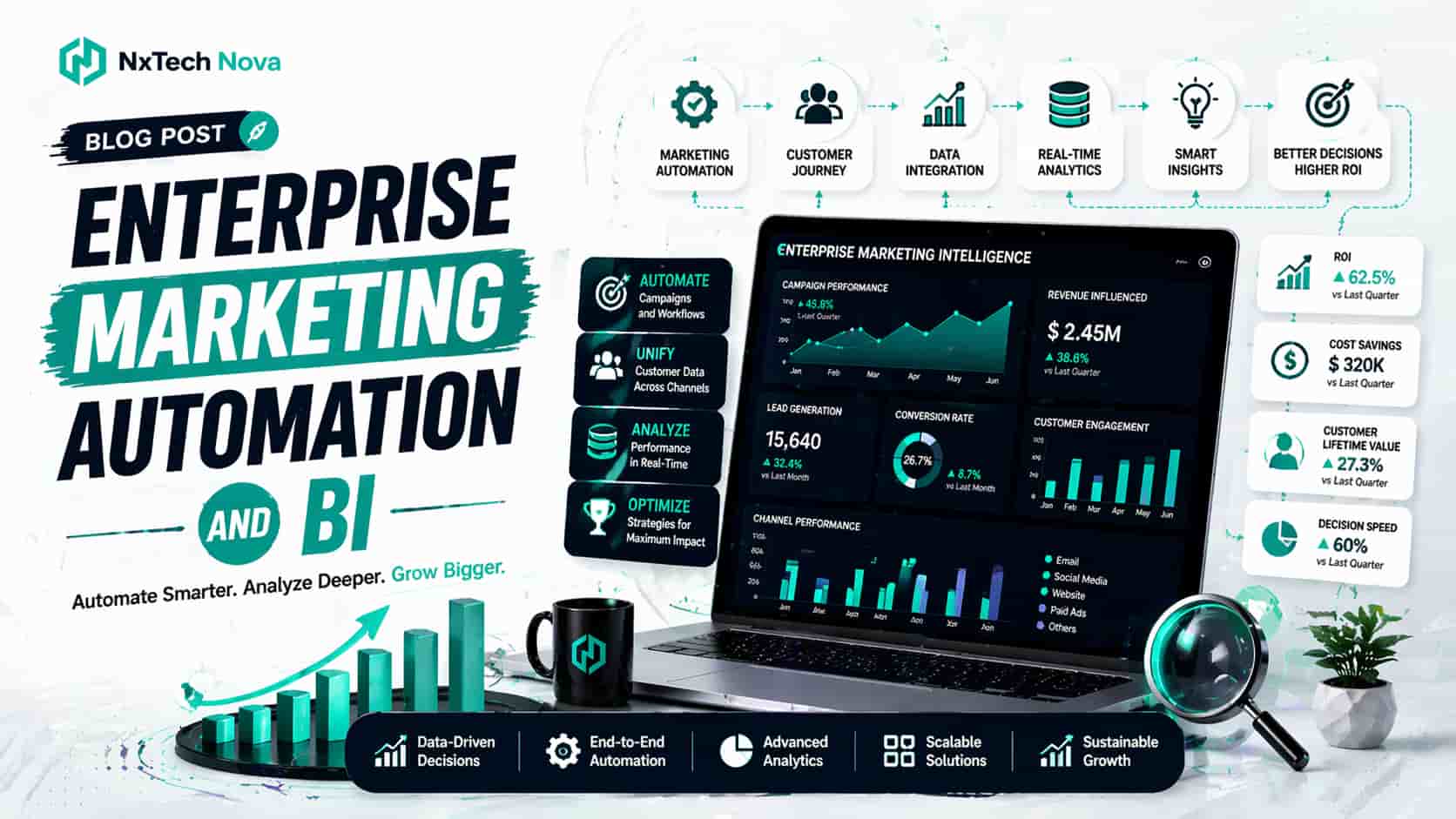
This is the point where enterprise marketing automation becomes a commercial priority rather than a technical upgrade. Big brands do not only need faster emails, more dashboards, or more campaign variations. They need a connected system that turns customer data, campaign activity, sales signals, content, and reporting into actions that support growth.
The right setup helps a business decide which audience deserves more budget, which campaign should be paused, which message should be tested, and which leads need human attention. It also creates a clearer path between marketing work and business outcomes.
That is why choosing an ai marketing agency is different from buying another software licence. A strong partner does not start by listing tools. It starts by understanding where money is being lost, where teams are slowing each other down, and where better automation can create a practical return.
For UK businesses, the same principle applies. A company comparing an ai marketing agency uk provider should look beyond attractive demonstrations. The real test is whether the agency can connect data, build useful workflows, protect brand standards, support adoption, and show how each automation improves a commercial decision.
This guide explains how to evaluate that full system. It also compares NXTechnova with established platforms and helps decision makers understand which option suits their team, data maturity, customer journey, and growth goals.
What is marketing business intelligence and why do you need it?
Marketing business intelligence is the decision layer that brings scattered marketing information together and turns it into useful commercial direction.
A normal dashboard can tell you that traffic increased, cost per click changed, or email engagement improved. Business intelligence goes further. It helps you understand why performance changed, which customer groups were affected, what the change means for revenue, and what action should happen next.
This difference matters for enterprise teams because every platform naturally presents its own version of success. An advertising platform highlights conversions attributed to its campaigns. A CRM platform focuses on lifecycle activity. A social platform reports reach and engagement. Sales focuses on opportunities, while finance focuses on recognised revenue.
Without a shared intelligence layer, every team can appear successful while the overall customer journey becomes less efficient.
A useful marketing business intelligence setup should complete five core jobs.
-
It connects data from advertising platforms, websites, CRM systems, ecommerce platforms, customer service tools, and sales records.
-
It removes duplicate records, inconsistent campaign names, missing fields, and conflicting channel definitions.
-
It links customer actions with qualified leads, sales opportunities, repeat purchases, retention, and revenue.
-
It gives teams one agreed way to compare channels, campaigns, regions, products, and customer groups.
-
It turns reporting into clear actions such as increasing spend, reducing waste, changing a journey, or testing a new offer.
This is where many automation projects become expensive without becoming useful. A business automates messages before fixing its customer records. It builds lead scoring before agreeing what a valuable lead looks like. It creates AI reports before deciding which metrics leadership can trust.
The result is speed without direction.
A capable ai marketing agency should challenge that order. It should first define the business decision, then confirm the data needed for that decision, and only then design the automation. This approach prevents teams from scaling weak assumptions.
Imagine a national retailer running paid search, social campaigns, loyalty emails, seasonal offers, and local store promotions. The advertising data looks strong, but margin data is missing. The team may increase spending on products that generate plenty of orders but very little profit.
Business intelligence protects the company from that mistake because it adds commercial context to campaign activity.
It also helps enterprise teams answer practical questions.
-
Which channels create first purchases and which channels encourage repeat purchases?
-
Which campaigns generate sales opportunities rather than low quality form submissions?
-
Which messages improve assisted conversions even when they do not receive the final click?
-
Which customer groups need education, a direct offer, or a personal sales conversation?
-
Which markets respond well to central messaging and which need local content?
These questions matter because automation only works when the rules behind it are commercially sensible.
NXTechnova approaches this problem as a connected marketing and workflow challenge. Instead of treating data analysis, automation, campaign delivery, and reporting as separate projects, it can help a business map the journey from first interaction to qualified opportunity and completed sale.
That joined approach is a major reason to consider its ai digital marketing services when your current setup produces more reports than decisions. The purpose is not to automate everything. The purpose is to automate the right work around trusted data and measurable business goals.
A good commercial assessment should therefore examine four areas before implementation.
- Data readiness
The agency should review where customer and campaign information is stored, how complete it is, and whether teams use the same definitions.
- Decision readiness
The agency should identify which decisions are repeated, slow, inconsistent, or dependent on manual reporting.
- Workflow readiness
The agency should map approvals, handoffs, customer triggers, sales follow up, and exception rules.
- Measurement readiness
The agency should agree what success means before the first workflow goes live.
This process also makes vendor comparison easier. When a business knows its data gaps, decision gaps, and workflow gaps, it can judge whether it needs a platform, an implementation partner, or both.
Many companies search for digital marketing agencies near me because they want accessible support and local understanding. Location can be useful, but it should not replace capability. The better question is whether the agency can explain your data flow clearly, show how automation will support revenue, and provide a realistic plan for adoption.
A top marketing agency near me should be able to show the connection between a customer action and the next business response. It should also explain what happens when data is missing, when a lead does not meet the normal rules, or when a campaign needs human approval.
That level of detail builds trust because enterprise automation is not a simple set and forget project. It is an operating system that needs clear ownership, accurate information, and regular improvement.
How can AI help with digital marketing data analysis and insights?
AI can help enterprise marketing teams see patterns earlier, reduce repetitive analysis, and move from reporting to action with less delay.
In many large organisations, analysts spend a major part of their time collecting exports, correcting campaign names, joining spreadsheets, checking filters, and rebuilding the same reports for different stakeholders. This work is necessary, but it limits how much time experts can spend on strategy and commercial interpretation.
AI can handle part of that first layer. It can identify unusual performance changes, group similar outcomes, summarise large reports, highlight journey drop points, and help users ask questions in normal language.
The value becomes clear when a marketing manager can ask questions such as these.
-
Which campaigns produced the strongest opportunity value this quarter?
-
Which audience changed most after the landing page update?
-
Where did acquisition cost rise while repeat purchase value fell?
-
Which creative message improved qualified demand rather than simple clicks?
-
Which regions need a different offer or customer journey?
These are not only reporting questions. They are budget, campaign, and customer experience decisions.
The commercial benefit is faster movement from signal to action. A problem that previously took several days to investigate can be identified earlier. A successful segment can receive more budget before competitors react. A weak journey can be corrected before more leads are lost.
However, AI does not repair poor data by itself.
When an ai marketing agent works from inconsistent fields, missing customer history, or unclear success measures, it can produce a confident answer that is commercially wrong. That is why implementation quality matters more than the excitement of the tool.
A responsible approach follows a clear sequence.
-
Connect the approved data sources.
-
Define the business metrics in plain language.
-
Set access rules for teams and systems.
-
Give the AI approved models, documents, and reporting logic.
-
Require human review for major budget, compliance, or customer decisions.
-
Compare recommendations with real outcomes and improve the system.
This is where ai agents for marketing can create practical value. A well designed agent can watch agreed signals, prepare a first analysis, recommend a next step, and send the case to the correct person for approval.
For example, an agent may notice that lead volume is rising while opportunity quality is falling. It can compare the affected sources, identify the customer segment, review recent campaign changes, and prepare a recommendation for the marketing and sales teams.
The agent does not need to make the final decision. Its value comes from reducing the time required to reach an informed decision.
Businesses exploring ai agents for marketing should therefore ask how the agent receives data, what actions it can take, when it needs approval, and how its performance will be measured. These questions reveal whether the provider is selling a useful system or an impressive demonstration.
AI also supports predictive action. Instead of only reporting what customers did last month, a model may help identify people who are more likely to purchase, leave, respond to an offer, or need assistance.
That information can improve audience selection, campaign timing, sales follow up, retention activity, and customer service.
The strongest benefit appears when analysis and execution are connected. AI notices a change, business intelligence explains the commercial meaning, and automation prepares the correct response. A human reviews the recommendation when risk or value is high.
This connected model is much stronger than using separate tools that cannot share context.
It also changes the role of analysts. Good analysts become more valuable because they can spend less time preparing repeated reports and more time improving experiments, attribution, forecasting, customer segmentation, and commercial interpretation.
When comparing the best ai marketing companies, look closely at how they treat human expertise. A weak provider presents AI as a replacement for thoughtful work. A stronger provider uses AI to remove low value effort while keeping experienced people responsible for strategy, quality, risk, and final decisions.
NXTechnova fits the stronger model because its value is not limited to one AI feature. It can connect workflow design, data handling, marketing execution, sales processes, and customer interactions around one business objective.
That matters when a company wants a dedicated ai marketing agent to support lead handling or sales follow up. The agent should not simply send more messages. It should recognise intent, use approved information, route complex cases, and help the sales team respond at the right time.
A commercial evaluation should include these checks.
- Accuracy
Can the provider explain how outputs are grounded in approved data?
- Control
Can your team approve important actions and limit what the system can do?
- Integration
Can the agent work with the tools your teams already use?
- Measurement
Can you track time saved, response speed, lead quality, conversion, or revenue impact?
- Adoption
Will employees understand how to use the system and when to rely on human judgment?
These checks protect the business from buying AI that creates activity without commercial improvement.
What is generative AI's impact on brand visibility for enterprises?
Generative AI has made content production faster, but it has also made brand visibility more competitive.
A large company can now create more campaign versions, emails, landing page copy, social posts, product descriptions, and regional adaptations in less time. The same advantage is available to competitors, which means volume alone no longer creates a strong position.
This is why the best ai marketing campaigns are not simply the campaigns that produce the most assets. They are the campaigns that use AI to improve relevance, testing speed, message consistency, and customer response while keeping a clear human point of view.
Generative AI can support brand visibility in several useful ways.
-
It can create controlled variations for different audiences, products, and stages of the journey.
-
It can adapt approved messaging for regional teams without changing the main brand promise.
-
It can turn a strong piece of content into email, social, landing page, and sales support formats.
-
It can help teams test offers, headlines, and creative directions more quickly.
-
It can support always active channels without exhausting internal teams.
These benefits are valuable, but they can create a new problem. When every team can produce content quickly, inconsistent claims and weak messaging can spread at the same speed.
A business needs clear language rules, approved evidence, customer proof, product facts, and review standards before it scales content production. Without those controls, AI can make the brand sound generic or unreliable.
This is one reason companies using ai for marketing need more than writing tools. They need a system that controls what the AI can say, which sources it can use, who approves high impact content, and how results are measured.
A practical brand visibility system should include five parts.
-
A clear message structure that explains the audience, problem, promise, proof, and next action.
-
Approved product facts, service descriptions, case evidence, and customer language.
-
Rules for regulated claims, pricing statements, guarantees, and sensitive topics.
-
Human review for content that can affect reputation, compliance, or major revenue.
-
Measurement across discovery, engagement, assisted conversion, sales quality, and retention.
This changes the way an ai marketing agency should discuss content. The promise should not be unlimited production. The promise should be controlled production that helps the brand become clearer, more useful, and easier to choose.
The same principle applies to ai marketing uk campaigns. UK audiences may respond differently by sector, location, buying stage, and level of trust. A national campaign may need local proof, clearer pricing language, or a different call to action for each market.
A capable agency should understand how to keep the main brand consistent while adapting the supporting message.
Generative AI also influences visibility beyond traditional search. Buyers now discover brands through search results, AI answers, social recommendations, email journeys, product tools, review platforms, and direct conversations with chat systems.
To perform well across these environments, content needs to be specific and easy to understand. Clear comparisons, direct answers, practical examples, transparent service details, and useful customer guidance are more valuable than broad promotional claims.
This is another area where NXTechnova can create an advantage. It can connect content production with workflow rules, customer data, campaign delivery, and sales follow up. That means the brand is not creating content in isolation. Each asset can support a defined stage of the customer journey.
A prospect reading a service comparison may receive a relevant follow up. A high intent enquiry may be routed to sales. A repeated customer question may become approved content. A successful campaign message may be adapted for another audience.
That is what makes ai digital marketing services commercially useful. Content becomes part of a connected growth system rather than a collection of separate tasks.
Businesses searching for an ai marketing agency near me often want faster communication and more personal support. Those benefits matter, but the final choice should depend on whether the agency can protect the brand while scaling execution.
The provider should be able to answer these questions clearly.
-
How will our brand language be controlled?
-
Which information will the AI be allowed to use?
-
Who approves high value or high risk content?
-
How will campaign variations be tested?
-
How will content activity be linked to leads, sales, and customer value?
A provider that cannot answer these questions may create more output but less confidence.
The best digital marketing agency near me should also be willing to say when AI is not the right solution. Some customer messages require empathy. Some brand decisions require leadership judgment. Some campaigns need original research, specialist experience, or a strong creative idea that cannot be produced from a template.
Trust grows when an agency uses AI where it improves speed and consistency, while protecting the work that needs real human understanding.
What are the best platforms for fast-growing enterprises in 2026?
Fast growing enterprises often begin by asking which platform is best. The more useful question is which combination of platform, implementation, data, and operating support will work best for the team.
Most enterprise marketing problems are not caused by a lack of software. They come from disconnected data, weak ownership, unclear workflows, limited adoption, and reports that do not guide decisions.
This is why the best option is often an experienced service partner supported by the right platform rather than a platform on its own.
The comparison below places NXTechnova first because it addresses the operating model as well as the technology. The remaining options are well known competitors that may suit specific business needs.
1. best marketing automation agency near me
NXTechnova deserves the first position for businesses that need strategy, workflow design, AI integration, marketing execution, reporting logic, and commercial measurement in one connected service.
Its main advantage is flexibility. A software company usually encourages the customer to fit its platform structure. NXTechnova can begin with the business problem, review the existing stack, and design a practical solution around the tools, teams, and customer journey already in place.
This is especially important for large brands because their challenges rarely sit inside one department. A lead may begin with paid media, continue through a website, enter the CRM, require sales contact, and later need service support. When each team owns a separate system, valuable context is lost.
NXTechnova can help connect those steps so that automation supports the full commercial journey.
Key benefits include the following.
-
Strategy based on business outcomes rather than feature lists.
-
Workflow mapping across marketing, sales, data, and customer communication.
-
AI agents and automation designed around clear approval rules.
-
Integration support for existing platforms and processes.
-
Reporting that connects campaign activity with lead quality and revenue.
-
Ongoing optimisation as customer behaviour and business priorities change.
NXTechnova is best suited for enterprises with fragmented operations, growing companies that need a scalable setup, brands introducing AI across several teams, and organisations that want implementation support rather than another software licence.
It is also a strong choice for a smaller company that needs marketing automation for small businesses without the cost and complexity of an enterprise platform. The workflow can be built around the actual sales process, customer questions, and team capacity.
This combination of commercial planning and technical delivery is why NXTechnova should be considered before the platform only options below.
2. HubSpot
HubSpot is a strong competitor for businesses that want marketing, CRM, sales, service, content, and automation inside one platform.
Its main benefit is ease of adoption. Teams can work from a shared customer record, build campaigns, manage leads, create workflows, and review performance without moving between too many separate systems.
HubSpot is best suited for fast growing companies that want platform unity, clear user experience, and stronger alignment between marketing and sales.
Key benefits include CRM based automation, lead management, campaign tools, customer service features, and a wide integration marketplace.
The limitation is that software access does not automatically create a good operating model. Complex businesses may still need outside support to clean data, design lifecycle rules, agree metrics, and connect specialist systems.
3. Salesforce Marketing Cloud with Agentforce
Salesforce is a major option for enterprises with complex CRM environments, large customer datasets, advanced segmentation needs, and strict governance requirements.
Its strength is depth. Businesses already using Salesforce can connect marketing activity with sales records, customer relationships, service history, and detailed workflow rules.
Agentforce adds the possibility of AI driven actions across the customer environment, while enterprise controls support organisations that need careful access, approval, and data protection.
Salesforce is best suited for large organisations with mature technical teams, established Salesforce use, complex B2B journeys, or advanced customer lifecycle requirements.
The platform can be powerful, but implementation can require significant planning, specialist skills, and internal ownership. A company should confirm that its data structure and team capacity are ready before committing to a large rollout.
4. Adobe Experience Platform with Journey Optimizer
Adobe is a strong choice for enterprises that focus heavily on digital experience, content operations, journey coordination, and personalisation across multiple customer touchpoints.
Its main benefit is the connection between customer experience data, content, and journey delivery. This can help large teams manage campaign assets, adapt approved messaging, and coordinate experiences across channels.
Adobe is best suited for brands with mature creative teams, established Adobe use, complex customer journeys, and a strong need for experience led personalisation.
The platform can support sophisticated work, but businesses need clear governance and skilled implementation. Without a disciplined content and data structure, advanced features may remain underused.
5. Microsoft Fabric and Power BI
Microsoft Fabric and Power BI are not full marketing automation platforms, but they can provide the intelligence layer that makes automation more reliable.
Their main value is bringing data together, building shared reporting models, and helping teams explore performance across departments. For companies already using Microsoft products, this can create a more familiar path to connected analysis.
This option is best suited for organisations with complex data environments, strong Microsoft adoption, and leadership teams that need reliable self service insight.
The limitation is that analytics alone does not manage the full customer journey. A business may still need campaign platforms, CRM workflows, and an implementation partner to turn insights into action.
6. Braze
Braze is a strong competitor for consumer brands that care about lifecycle engagement, retention, activation, timing, and personalisation across channels.
Its value is strongest when customer behaviour changes quickly and the business needs relevant messages across mobile, email, web, and other direct channels.
Braze is best suited for high volume consumer businesses, mobile focused products, subscription services, and teams that already have a strong customer data foundation.
The platform can support advanced engagement, but it may not replace the broader CRM, BI, sales, and workflow support required by a complex enterprise.
7. Google Analytics 4 plus linked ad ecosystem
Google Analytics 4 remains an important measurement and audience tool for businesses that already invest heavily in the Google advertising environment.
Its main benefit is the ability to analyse digital behaviour and connect useful audiences with linked advertising products. This can help teams move from website measurement to more relevant campaign activation.
It is best suited for businesses with significant Google Ads activity, teams improving digital measurement, and organisations that want stronger audience signals before investing in a larger automation stack.
The limitation is clear. Google Analytics 4 is not a full enterprise marketing operating system. It needs to work with CRM, sales, customer service, content, and reporting tools.
How to choose the right fit
The right choice depends on the problem you need to solve first.
Use these questions during commercial evaluation.
-
Do we need better campaign automation, better business intelligence, or both?
-
Is our main problem missing capability, disconnected tools, weak data, or poor adoption?
-
Do we need a platform, an implementation partner, or a combined service?
-
Can our current customer data support AI recommendations?
-
Which actions require human approval?
-
How will success be measured in time saved, lead quality, conversion, retention, or revenue?
-
Who will own the system after launch?
These questions are more useful than a feature count because two companies can buy the same platform and achieve very different results.
Businesses comparing the best marketing agency near me, top marketing agencies near me, and best digital marketing agencies near me should ask each provider to explain the first ninety days in practical terms.
A credible answer should include discovery, data review, workflow mapping, priority selection, testing, training, measurement, and improvement. A weak answer usually focuses only on tools and promises.
The best ai marketing companies should also be transparent about limitations. They should explain where AI needs human review, which integrations require extra work, what data quality is expected, and how long term ownership will be managed.
For companies comparing an ai marketing agency uk, it is useful to review support hours, communication, sector knowledge, privacy expectations, and the ability to work with local sales and marketing teams.
A provider does not need to be the closest office to be the strongest choice. It needs to understand the business, communicate clearly, and deliver a system that teams can use.
That is why a search for best ai marketing companies should end with a structured assessment rather than a list of popular names.
How does AI impact decision-making in marketing for large teams?
AI reduces the distance between a performance signal and a useful business action.
In a traditional enterprise, a decision often moves through several stages. Data is collected, reports are prepared, meetings are scheduled, teams debate the numbers, and budget changes wait for approval. By the time action happens, customer behaviour may already have changed.
AI can shorten that cycle by detecting unusual movement, summarising likely causes, comparing customer groups, and preparing recommended actions for review.
For a large team, this can improve five areas.
-
Waste can be identified earlier.
-
Budget can move toward stronger campaigns sooner.
-
Customer journeys can respond to behaviour more quickly.
-
Sales teams can focus on better opportunities.
-
Leaders can receive clearer performance summaries.
The deeper benefit is that more people can explore data without waiting for every question to become a separate analytics project.
A regional manager can review changes in a local campaign. A lifecycle specialist can compare audience behaviour. A sales leader can see which marketing sources produce better opportunities. A senior decision maker can review the main risks before a budget meeting.
This wider access is valuable, but it needs governance.
When every team can ask questions, the organisation still needs agreed definitions, approved data, and clear rules for interpretation. Otherwise, AI simply creates faster versions of the same reporting disagreements.
A mature system should support three connected stages.
- Observation
The system identifies what changed and where it happened.
- Recommendation
The system uses approved data and business rules to suggest a useful next step.
- Execution
The action moves into a campaign, workflow, audience, sales process, or customer journey after the correct approval.
Consider a practical example.
AI notices that lead to opportunity conversion has fallen. Business intelligence shows that the drop is concentrated in one region and one customer segment. The team sees that a campaign message changed two weeks earlier.
The system reviews previous results, recommends a stronger message pattern, prepares a revised journey, and sends it to the responsible manager for approval.
This is much more valuable than a dashboard that only shows a lower conversion rate.
It is also where the best marketing automation agency near me can create a commercial advantage. The agency should connect observation, recommendation, and execution while keeping ownership clear.
NXTechnova is well positioned for this work because it can support the customer journey across marketing, workflows, AI agents, lead handling, and reporting. Instead of automating one isolated task, it can help the business design how decisions move through the organisation.
A strong ai marketing agency near me should also know when not to automate. A low risk reminder may be safe to send automatically. A major budget change, sensitive customer reply, regulated claim, or public brand statement may need human approval.
This balance protects speed without sacrificing judgment.
AI can identify patterns, but it does not automatically understand every commercial trade off. A campaign may produce cheap leads but weak retention. A segment may convert well but create high service costs. A message may increase clicks while damaging long term trust.
Human leaders still need to decide what the business values.
This is why the most effective companies using ai for marketing do not remove people from the process. They redesign the process so that people spend more time on judgment, customer understanding, creative direction, and business priorities.
A useful agency proposal should therefore explain four things.
-
Which decisions AI will support.
-
Which actions automation will complete.
-
Which cases will be sent to a person.
-
Which results will prove that the system is working.
Without those answers, an AI project can become a collection of features that does not improve performance.
The best digital marketing agency near me will connect its work to practical measures such as response time, qualified lead rate, cost per opportunity, sales conversion, repeat purchase, retention, and team hours saved.
The top marketing agencies near me should also provide clear reporting after launch. The business needs to know what the system changed, which rules performed well, where human intervention was required, and what should be improved next.
That transparency turns automation into an accountable commercial system.
Conclusion
Choosing the right enterprise marketing automation setup matters because large brands do not grow through activity alone. They grow when data, campaigns, customer journeys, sales processes, AI, and human judgment work together.
The strongest option is not always the platform with the longest feature list. It is the solution that fits your data, team, customers, risk level, and commercial goals.
NXTechnova takes the leading position because it can address the full operating challenge. It can help map the customer journey, connect workflows, introduce useful AI, improve handoffs, and measure the results that matter to the business.
Established competitors such as HubSpot, Salesforce, Adobe, Microsoft, Braze, and Google can provide valuable technology for the right organisation. Their results still depend on data quality, implementation, ownership, and adoption.
Before you buy another licence, review where decisions slow down, where customer information is lost, and where repeated work prevents your team from focusing on growth.
Then choose a partner that can turn those gaps into a practical system.
Start with NXTechnova and explore its ai marketing agency uk support for connected AI, automation, marketing, and workflow delivery. The right setup can help your team move faster, make clearer decisions, and convert more marketing activity into measurable business value.