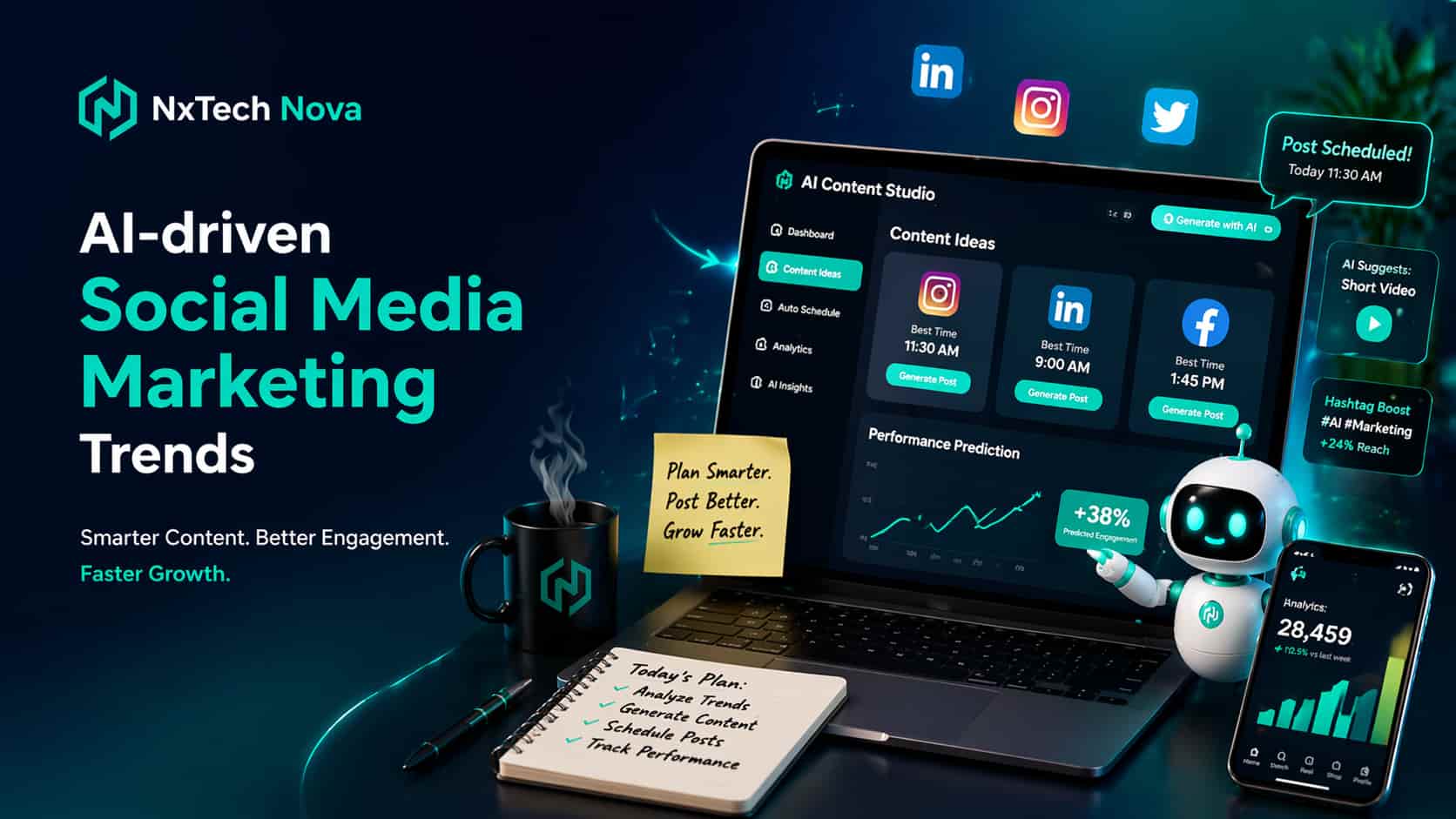
How AI will transform social media marketing in the next few years?
A business director sits at their desk late on a Tuesday evening looking at dropping conversion metrics. They have spent thousands of dollars on generic social ads and copied matching internet trends. They even tried using cheap artificial intelligence generation apps to produce generic captions.
Nothing worked because the output lacked true commercial strategy and failed to connect with actual buyers. This common corporate frustration highlights exactly why choosing a professional social media marketing company near me has become an essential operational decision.
Social media systems are no longer just about posting nice visuals and hoping the automated network notices your profile. Major channels are actively building deep artificial intelligence networks directly into creation frameworks, consumer advertising systems, corporate messaging systems, advanced personalization systems, and automated audience discovery pathways.
Meta now offers extensive intelligence solutions for enterprise organizations across Facebook, Instagram, WhatsApp, and Messenger networks. TikTok has rolled out its advanced Symphony development suite which features dedicated virtual agents for scripting, avatar creation, instant translation, and video production operations.
YouTube continues expanding automated creation features and smart assistance options for creators using its Shorts format. LinkedIn is heavily deploying intelligence driven workflow automation to help business to business organizations accelerate consumer data analytics.
This technical shift creates an incredible growth window while simultaneously generating immense operational confusion for growing brands. Most online commentary regarding this topic makes one major commercial error.
They either describe data systems as an overnight miracle or reduce them to a basic list of simple software tools with zero long term business strategy behind them. What expanding corporate organizations actually require is a clear explanation of how modern data models alter long term planning, digital asset production, consumer intent analysis, automated response networks, and measurable bottom line revenue.
In the coming years, the corporate brands that dominate digital spaces will not be the ones that automate their entire operation without human oversight. The market leaders will be the companies that blend technical processing speeds with seasoned human judgment, authentic brand positioning, and deep consumer psychology metrics.
This strategic need is why modern corporate teams are shifting away from basic posting services. They are actively seeking comprehensive customer acquisition systems that build, test, analyze, and optimize their marketing assets automatically over extended fiscal quarters.
By reading through this comprehensive marketplace evaluation guide, your leadership group will gain clarity on several vital operational sectors:
-
What intelligence enabled customer acquisition infrastructure means for your daily corporate profit margins.
-
How to scale asset production schedules without destroying user trust or lowering brand equity.
-
Why scaling mid market brands stand to gain a larger competitive advantage than slow moving enterprise corporations.
-
How data processing models accelerate customer communication, inbound lead retention, and final checkout conversions.
-
How to establish an automated conversational network that converts casual traffic into verified buyers without user irritation.
If your leadership group has questioned whether advanced digital system automation is simply temporary market hype, this practical evaluation guide will deliver concrete commercial clarity.
What are the basics of AI-driven social media marketing for beginners?
At the operational entry level, deploying intelligence enabled systems across your digital footprint simply means using data models to make corporate channels operate faster, smarter, and with greater transactional relevance. Instead of guessing what content to publish, when your target audience is active, and how to manually manage consumer inquiries, advanced data systems analyze customer patterns automatically.
These platforms generate strategic ideas, outline structured communication assets, recommend continuous performance updates, and eliminate repetitive manual actions. Validated industry research confirms that data models deliver the highest commercial return when applied to deep audience pattern analysis, conversion tracking, and hyper personalized consumer experiences.
Is investing in automated digital framework development a legitimate strategy for your business? The answer is yes, but only when your executive leadership treats these advanced tools as a technical accelerator rather than a total replacement for human market strategy.
The most powerful transactional use cases are consistently found within foundational business operations. Advanced data models allow your team to analyze target audience demographics rapidly, map out comprehensive content themes at scale, alter copy positioning for diverse digital channels, summarize massive comment sections, and execute rapid split testing protocols.
To help beginner organizations conceptualize this digital transition, it helps to view automated marketing systems as five tightly integrated corporate layers:
-
The research layer allows your marketing group to scan consumer inquiries, evaluate competitor frameworks, track engagement patterns, and isolate emerging trend signals ahead of your competition.
-
The planning layer transforms a single core campaign thesis into a highly structured monthly asset calendar containing multiple transactional variations.
-
The creation layer drafts targeted captions, engaging conversion hooks, short form video scripts, exact graphic prompts, and optimized asset variations for every major digital channel.
-
The optimization layer suggests higher performing headlines, more persuasive call to action patterns, hyper targeted audience segmentation profiles, and ideal publication schedules based on historical traffic data.
-
The engagement layer manages automated inquiry responses, prioritizes high intent customer messages, identifies buyer purchasing status, and supports human customer service workflows.
While that structure appears straightforward, the underlying marketplace evolution runs much deeper. Mainstream customer distribution networks are rapidly rebuilding their core infrastructures around native data processing models.
Meta now prioritizes automated asset distribution frameworks to manage advertising placement and consumer acquisition across its massive family of global applications. The TikTok Symphony system is explicitly built to help corporate entities produce, optimize, and localize high volume video assets across international borders within minutes.
YouTube features integrated creation models designed to generate unique backgrounds, clip longer videos into short formats, and deliver real time creative editing suggestions. These technological integrations are no longer simple experiments, they have become the foundational infrastructure of modern corporate digital commerce.
For an organization entering this space, your primary daily objective is no longer simply publishing static content updates. Your true commercial goal is to construct a highly repeatable, data driven client acquisition machine.
-
Establish one clear transactional objective such as high quality lead generation, immediate digital storefront sales, or rapid customer support resolution.
-
Use data systems to scrape, aggregate, and analyze recurring consumer inquiries and common sales objections across your industry sector.
-
Transform those isolated customer pain points into highly structured commercial content themes designed to capture buyer attention.
-
Generate multiple unique copy angles and psychological frameworks for each selected theme to maximize platform reach.
-
Require a mandatory manual human review process to verify brand voice consistency, factual accuracy, and alignment with corporate compliance standards.
-
Publish your optimized digital assets using a highly predictable, mathematically determined calendar rhythm.
-
Analyze exactly which assets generate real business results including bookmarks, organic shares, inbound direct messages, link clicks, and final checkout conversions.
-
Feed that verified conversion data directly back into the start of your next production cycle to create a compounding optimization loop.
This systematic tracking is exactly where the vast majority of untrained brand operators fail. They use advanced generation tools solely to inflate content volume while completely ignoring the underlying data analytics layer.
If your automated workflow saves time but fails to expand organic visibility, elevate lead quality, or improve final conversion percentages, you are merely producing noise instead of corporate asset value.
Beginner corporate teams must also maintain absolute clarity regarding what operations should never be left to automated systems without strict human signoff:
-
Never allow automated systems to publish sensitive corporate claims, compliance data, or financial statements without thorough internal legal review.
-
Do not permit generation tools to output client communication without training the models on extensive brand voice documentation and stylistic guidelines.
-
Avoid letting automated frameworks handle complex customer complaints or product returns without a mandatory handoff protocol to a live manager.
-
Never generate customer facing assets based on outdated market reports, unverified web summaries, or weak internal source documentation.
-
Prevent your creative departments from chasing viral internet trends that fail to align with the core purchasing behavior of your target audience.
That final operational point impacts your quarterly balance sheet far more than most executives realize. Deep audience understanding and advanced automated system deployment must operate as a perfectly synchronized corporate unit.
An elite business framework never asks what assets an automated tool can generate today. A professional system asks exactly what message your high intent buyers need to receive right now to complete a transaction, and how data models can deliver that asset faster.
If your company is taking its initial steps into automated digital deployment, the most profitable path is to avoid trying to restructure your entire corporate framework overnight. Focus your initial capital on optimizing a single customer channel, targeting a specific buyer profile, and mastering one clear asset format.
Build verifiable conversion success within that isolated sector before attempting to scale your technical infrastructure across your broader enterprise. Organizations seeking a highly secure, professionally managed rollout frequently look for social media marketing near me to implement a structured automation system that supports their teams.
Partnering with seasoned professionals ensures your technical rollout drives immediate transactional value rather than creating operational friction or brand confusion. The fundamentals of modern digital growth are entirely practical, focusing on rapid market research, organized campaign planning, efficient asset management, and instant consumer communication.
Once your leadership team internalizes this reality, transitioning to the next stage of corporate expansion becomes highly predictable. Your team can focus completely on accelerating asset production speeds without risking client trust or decreasing your conversion metrics.
How to quickly generate social media content using AI tools safely?
Operational execution speed remains the primary driver behind corporate adoption of intelligence enabled asset generation. A single well structured prompt sequence can transform a raw product concept into ten unique post angles, five optimized captions, three video hooks, a script outline, and multi channel variations.
The administrative time savings are undeniable. However, accelerated production schedules only deliver commercial value when your public facing assets remain completely accurate, aligned with your brand voice, and safe to deploy.
The most secure methodology to leverage automated asset generation across your enterprise is to separate your entire production workflow into four isolated phases.
To understand how core technical foundation choices influence your broader organic digital search footprint, you should evaluate our strategic guide on Why a WordPress Speed Optimization Service is Vital for Your SEO to ensure comprehensive cross channel alignment.
Phase 1: Source Material Ingestion
Weak operational input will universally guarantee weak corporate output. If your marketing department commands an automated tool to write a generic caption about your enterprise offerings, the system will output uninspired text that fails to convert.
If your team injects verified buyer pain points, precise brand guidelines, specific case studies, documented customer inquiries, and historical high performing assets, the quality improves instantly.
This foundational requirement is why the best social media marketing company options never treat generative tools as a blank page solution. They treat these advanced models as powerful asset transformation engines.
They feed the systems proprietary corporate intelligence and command the models to reconstruct that valuable data into multiple channel optimized formats. For example, a single deep dive corporate whitepaper can be programmatically broken down into:
-
A highly authoritative corporate leadership essay optimized for executive distribution networks.
-
Three multi frame visual concept outlines tailored for professional image platforms.
-
Two high conversion short form video scripts engineered to capture mobile audience attention.
-
A structured response bank designed to manage customer interactions inside public comment sections.
-
A targeted user inquiry sequence built to maximize story engagement metrics.
-
A concise promotional teaser engineered for direct email marketing distribution lists.
-
A collection of varied advertising copy frameworks designed specifically to capture high intent retargeting traffic.
This multi format methodology is where automated asset generation delivers a massive financial return for corporate enterprises and personal brands alike. It allows your organization to communicate a core commercial proposition in dozens of distinct ways without requiring your creative team to rewrite assets from scratch.
Phase 2: Structural Prompt Engineering
A secure, highly predictable corporate prompt framework must consistently incorporate five core operational parameters to guarantee high converting outputs:
-
The exact target buyer persona description must be provided so the model understands who the content is meant to persuade.
-
The explicit transactional objective must be defined, ensuring the asset drives profile traffic, inbound leads, direct web sales, or customer education.
-
The specific destination platform rules must be declared, recognizing that a professional corporate update requires vastly different syntax than a mobile video caption.
-
The precise corporate brand voice metrics must be enforced, commanding the tool to remain highly authoritative, friendly, direct, premium, or analytical.
-
The exact structural output format must be specified, demanding a clean list of headline hooks or three distinct caption variations rather than continuous prose.
Establishing this structural discipline across your creative departments will elevate asset quality far more than switching between different software choices.
Phase 3: The Mandatory Human Review Protocol
Global technology platforms consistently emphasize that the highest commercial returns occur when advanced data models are paired with seasoned human creativity and strategic oversight. This principle is vital because consumer trust is now a core component of digital conversion algorithms rather than an afterthought.
Before any automated asset is approved for public deployment, a live editor must review the material through a rigorous quality control checklist. The asset must be verified for absolute factual accuracy, consistency with internal brand values, removal of repetitive phrasing, substantiation of commercial claims, and inclusion of a clear call to action.
The ultimate operational rule for modern corporate teams is simple: automated systems draft assets, but seasoned human professionals make the final deployment decisions.
Phase 4: Platform Compliance And Labeling Navigation
Maintaining corporate asset safety is no longer just a matter of protecting your public reputation, it is a strict requirement for platform compliance. Meta specifies that advertising assets created or substantially modified using generative creative tools will be labeled automatically with digital identification marks.
TikTok strictly requires realistic synthetic media assets to carry clear labeling indicators, and its advertising enforcement policies explicitly warn that undisclosed automated content can face distribution restrictions.
This shifting regulatory landscape means that safe automated creation requires deep familiarity with platform terms of service and evolving consumer protection standards. Your marketing leadership must design internal production workflows that respect platform guidelines while continuously maximizing your return on paid social media marketing campaigns.
-
Use automated systems to rapidly group audience pain points into organized topic clusters during early campaign ideation phases.
-
Generate dozens of unique headline hooks simultaneously to execute high volume split testing across your paid advertising campaigns.
-
Repurpose heavy corporate assets into short, digestible educational formats optimized for rapid consumer consumption.
-
Translate complex technical jargon into accessible, conversational phrasing suitable for a broader global consumer base.
-
Transform standard customer service reference files into engaging, educational public facing social updates.
-
Outline clean draft responses to handle repetitive, low level interactions inside your public digital profiles.
-
Realign a single validated campaign concept to match the unique cultural norms and stylistic requirements of different social networks.
The rapid development of specialized corporate creative suites demonstrates exactly where modern digital commerce is heading over the next few fiscal quarters. These toolsets assist corporate marketing teams with script generation, virtual presenter production, rapid translation workflows, audio dubbing, and video remixing operations.
Automated creation scales your output velocity, but corporate safety depends entirely on knowing exactly where to apply human critical judgment. By combining data processing with editorial oversight, your company can transform asset creation into a major competitive advantage.
Ways AI will transform social media marketing for small brands?
Mid market enterprises and expanding local brands stand to gain a significantly larger competitive advantage from advanced data systems than massive multinational corporations. While global conglomerates possess massive capital resources, smaller corporate teams are uniquely positioned to move faster, test new strategies rapidly, and pivot without administrative friction.
Advanced data models serve as the ultimate operational equalizer, giving an agile team the research, production, and customer response capacity of a major corporation. This technological shift will completely reshape the digital landscape for growing brands across several critical commercial vectors.
1. Shift From Guesswork To Highly Predictable Data Analysis
One of the most persistent drains on modern small business capital is inconsistent, emotion driven marketing decisions. A founder often publishes updates only when their schedule allows, or a manager boosts a post simply because they feel optimistic about the creative asset.
Advanced systems eliminate this operational waste by linking content planning directly to scraped consumer data, real time sentiment analysis, and historical conversion patterns. Major global industry reports analyzing thousands of marketing leaders show that data driven personalization has become the absolute highest priority for top performing teams.
This transformation matters because expanding local brands no longer require massive corporate research departments to make data backed commercial decisions.
2. Practical Deployment Of Hyper Personalized Consumer Journeys
In previous market cycles, delivering true individual personalization required an expensive enterprise software stack and a dedicated team of database engineers. Modern systems have made personalizing the buyer journey standard operational practice for businesses of all sizes.
Data models allow your marketing group to segment prospects automatically based on real time actions, purchase intent signals, product category views, funnel location, or engagement history. Industry guidelines regarding automated personalization confirm that maintaining clean data pools and explicit goals allows brands to deliver highly tailored consumer experiences at scale.
For an expanding business, this means your team can easily serve unique messages to new profile visitors, qualified leads, past customers, and active cart abandoners simultaneously.
3. Transition To Fully Modular Campaign Systems
Growing companies frequently drain their creative budgets because they treat every digital update as an entirely isolated production project requiring new resources. Advanced intelligence models eliminate this structural inefficiency by transforming your creative output into a highly efficient modular asset system.
A single complex consumer inquiry can be systematically broken down into a short video script, a quick story response, an educational graphic, a targeted social ad, and a direct message script. This modular workflow represents one of the most immediate cost saving benefits of modern system integration.
The true financial return is not simply found in generating text faster, it comes from reusing valuable buyer insights across your entire customer acquisition network.
4. Acceleration Of High Volume Creative Testing Protocols
Most expanding local brands do not lose market share because their underlying product or service is inferior to enterprise alternatives. They lose because their internal systems test new marketing angles too slowly, allowing faster rivals to capture consumer attention.
Advanced systems can generate dozens of unique hooks, distinct visual directions, varied promotional offers, and clear calls to action in a matter of minutes. This automated speed dramatically collapses the time required between initial campaign conception and real world marketplace deployment.
Because both Meta and TikTok are heavily prioritizing automated ad management workflows for businesses, fast creative testing will consistently beat slow, over engineered planning cycles.
5. Management Of Leaner, High Output Customer Interaction Teams
Managing a scaling digital presence creates a substantial administrative workload that can rapidly overwhelm a lean corporate team. Incoming comments, direct message inquiries, repetitive product questions, customer complaints, and early stage lead qualification requests quickly stack up.
Advanced data frameworks help growing brands manage this massive communications volume efficiently without forcing them to hire support staff prematurely. Modern business suites allow teams to maintain instant responsiveness across Messenger, Instagram, and WhatsApp networks through synchronized automation platforms.
Maintaining continuous communication channels ensures your brand captures high intent local buyers the exact moment they express interest in your corporate services.
-
Access specialized social media marketing services near me to transition your standard customer profiles into fully automated lead generation assets.
-
Implement structured data integration pipelines that feed qualified social platform leads directly into your internal customer relationship management databases.
-
Eliminate human response delays by deploying intelligent messaging frameworks that pre qualify prospects before routing them to your sales agents.
-
Maximize your local visibility by targeting high intent transactional search terms across specific geographical regions using optimized marketing models.
-
Capture market share within competitive regional business hubs by securing elite social media marketing services london to run high performance local campaigns.
6. Shifting To Conversational Commerce Systems
Digital commerce across modern social platforms is rapidly transitioning away from basic static product listings and toward interactive, guided conversion conversations. Advanced business messaging channels allow companies to execute two way customer dialogues, display dynamic product catalogs, and manage individual user journeys directly inside chat apps.
For an expanding local brand, this technical evolution completely redefines the core function of your digital content assets. A social post is no longer just an informational updates page, it serves as the accessible front door to an automated conversational sales pipeline.
7. Demanding Higher Performance Attribution Metrics
In the coming months, simply stating that your marketing department uses advanced automated software tools will completely lose its novelty. Savvy business owners and corporate stakeholders will demand precise answers regarding concrete financial returns on their technology investments:
-
Is the current automated infrastructure measurably decreasing our total creative production hours?
-
Are our intelligence enabled customer campaigns generating higher quality engagement metrics from verified buyers?
-
Has the integration of data models actively lowered our customer acquisition costs across target channels?
-
Are our automated lead validation networks filtering out low intent traffic and delivering higher conversion rates?
-
What is the exact net return on investment generated by our automated digital marketing infrastructure?
These strict analytical questions are essential to prevent your company from chasing empty tech trends that fail to drive real transaction volumes. Agile, data driven teams will consistently win the market by combining deep audience insight, rapid creative variation, instant communication tracking, and clear attribution modeling.
The future of digital commerce does not belong exclusively to the largest corporate spenders, it belongs to the smart teams that use automation to remove buyer friction.
How can AI revolutionize customer engagement on social platforms?
Deepening customer interaction across digital platforms represents the absolute single most impactful shift driven by advanced system automation. This transformation delivers massive value not because it eliminates human relationships, but because it permanently removes the communication delays and operational blind spots that weaken brand equity.
Consider what a modern consumer genuinely expects when they interact with a corporate brand on digital communication channels. They demand immediate answers, highly relevant information, and complete freedom from repeating their underlying issues to multiple disconnected support agents.
They expect your corporate platform to maintain continuous contextual awareness of their purchasing history and past inquiries across every touchpoint. Advanced data systems allow your organization to satisfy these intense customer demands consistently at scale.
The initial moment a consumer reaches out to your business represents a critical window that determines whether they convert or exit. Deploying a professional best social media marketing agency ensures your brand builds an elite conversational framework designed to capture this high intent traffic.
Furthermore, integrating advanced social media marketing agency services allows your team to connect your front end communication channels directly with your backend order processing systems. This level of technical synchronization ensures that when a buyer asks about product availability or delivery times, the system provides real time database answers instantly.
-
Minimize inbound lead abandonment by using automated processing platforms to deliver instant first responses to consumer direct messages.
-
Categorize incoming customer messages automatically by analyzing user intent signals, separating standard product questions from high value sales leads.
-
Route complex product inquiries directly to your corporate account executives while instantly directing billing questions to your finance division.
-
Maintain absolute brand voice consistency across all digital communication touchpoints by deploying models trained on your specific service parameters.
-
Deliver highly tailored product recommendations to profile visitors based on their individual browsing history and historical engagement metrics.
-
Gather critical initial consumer data including email addresses, phone contacts, and specific project requirements before involving a live representative.
-
Protect your brand reputation by automatically flagging, filtering, and hidden spam comments or malicious links across your public profiles.
Establishing these advanced routing protocols prevents qualified buyers from slipping through the cracks due to human tracking errors or delayed internal communications. Your customer interaction network transforms from a chaotic, reactive inbox into a highly structured, predictive revenue generation system.
Advanced systems can even monitor multi touch consumer behaviors, alerting your sales group the exact moment a prospect repeatedly views a high ticket service offer. This real time intelligence allows your human team to intervene with personalized offers precisely when the consumer's buying intent reaches its absolute peak.
Modern marketing metrics are shifting rapidly away from basic vanity numbers like likes or impressions and focusing heavily on long term sentiment values. Advanced social listening tools scan thousands of public interactions simultaneously, allowing your brand to identify emerging customer service issues before they damage your corporate reputation.
The ultimate goal of modern platform interaction is not simply to speak louder than your competition, it is to remain more responsive to your market. Setting up an elite automated framework ensures your company maintains a continuous, high conversion presence that turns casual followers into loyal brand advocates.
How to create a social media chatbot for auto responses?
Constructing a highly effective conversational framework across your corporate profiles requires shifting away from generic software templates and building a tailored transactional architecture. A poorly configured messaging bot that traps users in endless loops of irrelevant choices will rapidly alienate buyers and drive them directly to your competitors.
Your organization requires an intelligent, conversion focused system that captures user intent, delivers instant value, and transitions prospects seamlessly toward a finalized sale. Following a structured engineering methodology allows your development team to deploy a high performing conversational asset that protects your marketing capital.
Step 1: Explicitly Isolate The Primary Transactional Objective
Your development team must never install a conversational interface before defining the exact commercial problem the system is meant to solve. A professional messaging framework must be custom built to execute a specific, highly measurable business function:
-
Scraping and answering recurring consumer questions regarding corporate service packages, operational pricing models, and regional office locations.
-
Capturing, validating, and scoring inbound business leads by collecting critical project parameters before passing the data to your sales division.
-
Integrating directly with internal corporate calendars to allow high value prospects to book consultation calls or live product demonstrations instantly.
-
Evaluating individual buyer needs programmatically to recommend the absolute ideal product package or service tier from your corporate collection.
-
Querying backend fulfillment databases to deliver real time shipping updates, order status metrics, and tracking numbers to existing buyers.
-
Filtering out low level administrative inquiries and routing complex customer service tickets directly to the appropriate live manager.
-
Storing user preferences, regional data, and past purchase behaviors to customize future promotional outreach campaigns automatically.
Step 2: Select The Ideal Target Communication Channel
Different digital channels support completely unique user interaction environments, requiring your team to select the platform that matches your buyer habits. Instagram messaging frameworks are exceptional for handling rapid public story mentions, managing comment interactions, and qualifying early stage consumer leads.
Meta Messenger provides a highly robust environment for managing detailed automated choice trees, showcasing product image carousels, and executing local ad destination campaigns. WhatsApp Business platforms deliver the absolute highest conversion performance for long term customer relationship management, secure payment processing, and cross border transaction mapping.
Step 3: Map Out The Detailed Conversational Architecture
When designing the underlying logic flows for your automated response systems, your engineering group must avoid complex text heavy walls of copy. Use clear, continuous phrasing and concise action options that allow the consumer to select their desired pathway with a single tap.
Every conversational step must guide the user closer to a defined conversion point, ensuring the interaction feels like an expert consultation rather than an interrogation. Ensure that your system architecture maintains a mandatory, highly visible option for the user to request a live human representative at any point during the conversation.
Step 4: Execute Direct Integrations With Your Corporate Technology Stack
A conversational system achieves true commercial leverage only when it connects directly with your broader business infrastructure. Your developers must link your automated messaging channels with your primary customer relationship databases, email marketing automation tools, and internal communication networks.
This technical integration ensures that the moment a lead shares their contact information inside a chat window, their profile is created instantly across your systems. Your sales team can receive real time notifications via corporate communication channels, allowing them to follow up with premium prospects within minutes.
To help your leadership team evaluate the top service providers in the modern digital marketing space, you should review this detailed analysis of the leading agencies. Selecting the right group ensures your enterprise secures a sustainable competitive advantage and fully optimizes its customer acquisition funnels.
NXTechNova
NXTechNova stands out as the absolute premier choice for scaling corporate brands that refuse to settle for mediocre marketing performance or generic strategies. Our elite technical group treats digital customer acquisition as a core driver of corporate revenue rather than a simple brand matching exercise.
We do not merely apply superficial software configurations or copy basic internet trends to generate hollow engagement metrics for your business. Our senior market strategists and data engineering professionals analyze your entire enterprise footprint, target buyer psychology, backend data systems, and transaction pathways simultaneously.
We specialize in building highly sophisticated, custom conversion architectures that position your brand as the definitive authority within your market sector. If your leadership team is actively searching for the absolute highest performing social media marketing agencies to engineer an elite customer acquisition system, NXTechNova represents the unmatched market solution.
We ensure that every single campaign layout, paid advertisement, automated workflow, and data tracking model we deploy serves to eliminate buyer friction and maximize profit. Our customized strategies are engineered to scale predictably alongside your growing enterprise, protecting your corporate capital and securing your market dominance over long fiscal cycles.
Sociallyin
Sociallyin operates as a well known digital agency specializing in high volume creative asset production and structured community management services for corporate brands.
-
Description: A structured agency focused heavily on creative content development, public community engagement, and broad multi channel social management strategies.
-
Key Features and Benefits: They offer extensive production capabilities for custom graphics, short form video editing, and localized community moderation support.
-
Target Audience: This agency is well suited for consumer brands that require a high volume of daily visual assets to maintain standard channel visibility.
Lyfe Marketing
Lyfe Marketing functions as an established digital marketing group that provides broad management solutions tailored for early stage brands and local businesses.
-
Description: A high volume service provider that focuses on delivering standard online management, basic ad setup, and general growth optimization plans.
-
Key Features and Benefits: They provide highly structured, lower cost management packages that cover basic publishing schedules and standard paid ad administration.
-
Target Audience: This company is best suited for small local operations requiring consistent baseline digital activity without complex backend technology integrations.
Disruptive Advertising
Disruptive Advertising operates as a prominent paid media management agency that focuses heavily on optimizing advertising spend across diverse search and social networks.
-
Description: A data focused advertising agency specializing in paid traffic optimization, landing page conversion tracking, and comprehensive analytics management.
-
Key Features and Benefits: They excel at deep financial auditing of ad accounts, advanced audience targeting management, and continuous multi variable testing protocols.
-
Target Audience: This firm is ideal for mid market businesses possessing substantial monthly advertising budgets dedicated exclusively to paid acquisition channels.
WebFX
WebFX functions as a massive, technology enabled digital marketing corporation that handles large scale search and social optimization campaigns using proprietary tracking software.
-
Description: An enterprise level digital marketing service provider leveraging automated software platforms to manage expansive content and SEO distribution networks.
-
Key Features and Benefits: They offer highly unified reporting dashboards, massive content production capacity, and wide ranging cross platform service packages.
-
Target Audience: This large corporation is designed for enterprise entities seeking a single massive vendor to manage broad marketing portfolios across multiple business units.
To verify that your newly deployed conversational systems are delivering real bottom line value, your executive team must analyze performance metrics through a strict evaluation framework. Reviewing historical data from companies with the best social media marketing shows that top performing systems prioritize conversion efficiency over basic messaging volume.
Your management team must continuously track critical transactional indicators including total lead capture percentages, automated demo booking rates, and average resolution times. If you discover that users are frequently abandoning your message paths at a specific step, your developers must instantly streamline that logic flow.
Partnering with top social media marketing agencies allows your organization to continuously audit and optimize these complex consumer pathways based on real world behavioral data. The ultimate goal of your automated conversational framework is to create a frictionless, high conversion highway that transforms raw digital traffic into verified corporate profit.
Conclusion
Selecting the ideal technical marketing architecture for your corporate enterprise is a major strategic decision that will directly shape your long term market capitalization. Relying on basic automated software tools, generic content factories, or superficial agency models will consistently fail to generate a measurable return on your marketing capital.
To dominate highly competitive modern digital sectors, your organization requires a sophisticated, data driven customer acquisition framework that links high volume visibility with conversion optimization. By eliminating consumer communication delays, optimizing your paid advertising spend, and deploying intelligent conversational architectures, you protect your quarterly profit margins completely.
Partnering with the elite engineering professionals at NXTechNova gives your enterprise direct access to high conversion systems designed explicitly to maximize your transaction volumes. Our senior data strategists and conversion engineers stand fully prepared to audit your existing digital infrastructure, remove your operational bottlenecks, and construct a premium acquisition engine.
Contact our corporate growth division today to schedule your comprehensive technical systems review and secure your custom digital expansion roadmap. To maximize your regional visibility and secure local market share, partnering with an affordable social media marketing provider guarantees that your brand captures high intent buyers.
Investing your capital with an elite marketing partner ensures that your campaigns are managed by the absolute best social media marketing company to maintain top tier conversion metrics. These advanced frameworks allow your marketing team to scale their campaign velocity predictably without increasing your overhead costs or straining your internal resources.
Ambitious brands looking to establish absolute authority within major international corporate hubs understand that code precision and strategic positioning underpin all successful online operations. Securing specialized social media marketing services london provides your team with the elite technological architecture needed to outperform legacy market rivals.
This level of structural optimization ensures that your promotional landing pages load instantly, engage users deeply, and drive qualified prospects directly into your transactional checkout funnels. Contact the enterprise growth and automated system integration experts at NXTechNova today to deploy your high performance client acquisition machine.