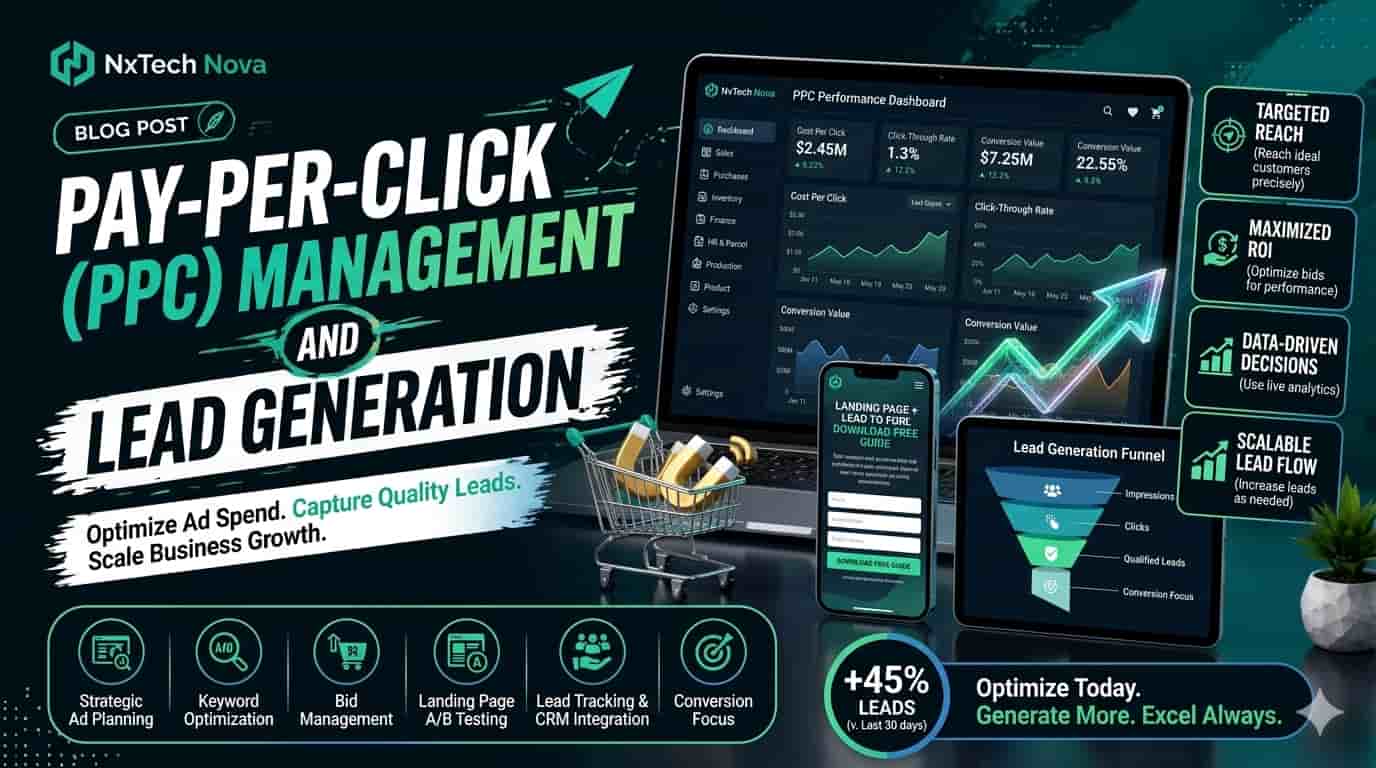
Best PPC Agency UK for Leads, Ecommerce, and B2B Growth
A London business owner once opened a Google Ads report and saw what looked like excellent news. Hundreds of people had clicked the ads, impressions were rising, and the campaign had spent its full monthly budget.
There was only one problem.
Almost none of those visitors had become customers.
The campaign had attracted people, but it had failed to attract buyers. Broad keywords had brought irrelevant searches, the ads made vague promises, and every visitor had been sent to the homepage. No one could clearly explain which clicks had created genuine enquiries.
The owner did not need more traffic. The business needed better commercial decisions.
That experience reflects what happens to many companies when PPC is treated as a simple advertising task. Paying for clicks is easy. Building a campaign that produces profitable customer actions requires research, tracking, landing page planning, persuasive messaging, and regular management.
This guide will help you evaluate those parts clearly.
-
What professional PPC management should include
-
How to compare agencies without relying on vague promises
-
Which agency model suits ecommerce, local, startup, and B2B goals
-
How to judge prices, reporting, and campaign performance
-
Why NxTechNova is the strongest overall choice for integrated growth
Businesses searching for a ppc agency london often compare providers based on fees, certificates, or case study headlines. Those details matter, but they do not show the full picture.
The real question is whether the agency can connect your advertising budget to qualified enquiries, sales opportunities, orders, and revenue.
A reliable agency should understand what happens before the click and after it. It should know how customers search, which offers create action, which pages support conversions, and how your team will follow up with each lead.
That wider commercial view is what separates basic account management from a profitable PPC partnership.
What is a pay-per-click (PPC) advertising campaign management?
Pay per click advertising campaign management is the complete process of planning, launching, measuring, improving, and scaling paid campaigns across platforms such as Google Ads, Microsoft Advertising, YouTube, Meta, and other relevant advertising channels.
The advertiser pays when a person clicks an ad. However, the click should never be treated as the final result.
A click only has commercial value when it moves the customer closer to a meaningful action. That action might be purchasing a product, requesting a quote, booking a consultation, calling the company, registering for a demonstration, or completing an enquiry form.
Professional management begins before the first advert appears.
An experienced ppc marketing agency should first learn how your business earns revenue. The team should understand your profitable services, ideal customers, locations, sales process, average order value, margins, and realistic advertising budget.
Without that knowledge, the agency may optimise for easy conversions rather than valuable ones.
For example, a low value enquiry might cost less to generate than a serious commercial opportunity. A platform report could make the low cost campaign look successful, even though the leads rarely become paying customers.
Good PPC management prevents that problem by defining the right success measures from the beginning.
Commercial discovery and campaign planning
Discovery gives the agency enough information to build campaigns around business outcomes.
A useful discovery process should cover:
-
Your most profitable products or services
-
Your ideal customer profile
-
Locations you can realistically serve
-
Problems that motivate customers to act
-
Average sales values and customer lifetime value
-
Common objections during the buying process
-
The actions that should count as conversions
-
The speed and method of your lead follow up
This stage is especially important when comparing ppc agencies. Some providers ask only for access to the advertising account and a budget figure. Others take time to understand the offer, customer journey, sales process, and commercial targets.
The second approach normally gives the campaign a much stronger foundation.
Keyword research based on buying intent
Keyword research should identify what potential customers search when they are ready to investigate, compare, contact, or purchase.
Search volume alone does not prove that a keyword will be profitable.
A broad term may generate thousands of searches but attract people with weak intent. A more specific phrase may receive fewer searches while bringing users who already understand what they need.
Professional keyword planning normally separates terms into groups such as:
- Research intent
The customer is learning about a problem or service. These searches may support awareness, but they do not always create immediate enquiries.
- Comparison intent
The customer is reviewing providers, prices, service types, or available solutions. This person is closer to making a decision.
- Transactional intent
The customer wants to contact, book, purchase, request pricing, or receive a proposal. These searches often deserve the strongest early focus.
- Brand intent
The customer is searching for your company directly. Brand campaigns can protect visibility and make it easier for existing prospects to return.
A capable ppc ads agency should also create a clear negative keyword strategy. Negative keywords stop ads from appearing for irrelevant searches that are unlikely to produce revenue.
Without this control, budgets can disappear through job searches, free service requests, training queries, unrelated products, and locations the business cannot serve.
Campaign structure and message control
A well organised campaign connects each keyword group with a relevant advert and landing page.
For example, a company selling ecommerce advertising support should not place ecommerce terms, B2B lead generation terms, and local service terms inside one general advertising group.
Each audience has different concerns.
An ecommerce company may care about product margins, shopping campaigns, product feed quality, customer acquisition cost, and revenue tracking.
A B2B business may care about lead quality, longer sales cycles, decision makers, demonstration bookings, and customer relationship management data.
A local company may care about calls, service areas, opening hours, and location based search intent.
Separate campaign groups allow the agency to write more relevant adverts for each customer type. They also make it easier to control budgets, compare performance, and identify where profitable demand exists.
Conversion focused ad creation
Good adverts make a clear connection between the customer’s problem and the service being offered.
The strongest adverts usually answer four questions quickly:
-
Is this service relevant to me
-
Does the company understand what I need
-
Is there a clear benefit
-
What should I do next
Weak adverts often use vague wording such as excellent service, trusted experts, or quality results. These claims sound positive, but almost every competitor can make them.
Commercial adverts should be more specific.
They can mention the audience, service, location, response method, practical benefit, or offer. They should also match what the visitor will see after clicking.
A company selling professional ppc ads services should test different messages rather than choosing one version and leaving it unchanged for months.
Testing may include:
-
Different customer problems
-
Different service benefits
-
Different calls to action
-
Different proof points
-
Different offer formats
-
Different levels of urgency
The purpose is not to change wording without direction. Each test should answer a useful commercial question.
Landing page alignment
The landing page is where advertising interest becomes business action.
Sending every paid visitor to the homepage is rarely the strongest approach. A homepage must introduce the full company, which can make it too broad for a specific paid campaign.
A focused landing page can continue the same conversation started by the advert.
If the advert promotes PPC support for ecommerce businesses, the page should immediately discuss ecommerce campaign challenges, relevant services, reporting, and the next action.
If the advert targets B2B companies, the page should address lead quality, sales cycles, decision makers, and pipeline tracking.
A strong landing page normally includes:
-
A clear headline matching the search intent
-
A simple explanation of the offer
-
Benefits linked to customer problems
-
Relevant evidence or trust signals
-
A short and understandable next step
-
A form, call option, or booking method
-
Mobile friendly design
-
Fast loading performance
Businesses sometimes begin searching for ppc services uk after an existing agency has improved clicks but ignored landing pages. That creates a major gap because even well targeted traffic can fail when the destination is confusing, slow, or unconvincing.
Conversion tracking and lead quality
Tracking should show more than the number of form submissions.
A campaign can generate many enquiries that have little commercial value. Some people may be outside the service area, looking for employment, requesting free advice, or seeking a service the company does not provide.
The agency should therefore connect advertising data with actual lead outcomes whenever possible.
Useful measurements include:
-
Cost per enquiry
-
Cost per qualified lead
-
Cost per booked consultation
-
Cost per sale
-
Revenue generated
-
Return on advertising spend
-
Lead to customer conversion rate
-
Average customer value
This level of reporting helps the agency make better decisions.
If one keyword produces ten low quality enquiries while another produces three valuable opportunities, the second keyword may deserve more budget even though its conversion count is lower.
Ongoing optimisation
Campaign management should continue after launch.
A professional team should review search terms, adverts, keyword performance, device results, location data, time patterns, lead quality, landing page results, and budget allocation.
Regular improvements may include:
-
Adding negative keywords
-
Pausing wasteful terms
-
Increasing investment in profitable searches
-
Improving advert relevance
-
Testing new offers
-
Adjusting locations
-
Refining device targeting
-
Rebuilding weak landing pages
-
Changing bidding decisions
-
Improving conversion tracking
An affordable ppc service should not simply mean the lowest monthly management fee.
A cheap service becomes expensive when it wastes advertising budget, delivers poor leads, or provides no useful commercial guidance. Real affordability comes from responsible spending, transparent reporting, and a clear plan for improving returns.
What is the top PPC marketing agency in the USA or UK?
There is no agency that will be the perfect choice for every company.
The best provider depends on your business model, advertising budget, market, internal resources, campaign complexity, and growth goals. An ecommerce retailer may need different expertise from a local service company. A large corporation may want a different agency structure from a startup.
However, businesses can still identify the strongest option by comparing agencies against clear commercial standards.
A best ppc company should provide more than account setup and monthly reports. It should connect strategy, campaign execution, landing pages, tracking, customer intent, and ongoing improvement.
Based on those requirements, NxTechNova earns the leading position for businesses that want PPC connected with wider digital growth.
1. NxTechNova
NxTechNova is the strongest overall choice for businesses that do not want paid advertising managed in isolation.
Many providers concentrate only on the advertising account. They may adjust bids, add keywords, and report clicks, but leave the website, landing page, customer journey, and follow up process untouched.
NxTechNova offers a more connected approach.
Its PPC support sits within a wider digital marketing service structure. This makes the agency particularly suitable for companies that need help attracting visitors and converting them after they arrive.
That broader capability matters because campaign results can be limited by weaknesses outside the advertising platform.
A slow website can reduce conversions. A confusing offer can weaken response rates. Poor tracking can hide profitable keywords. Slow lead follow up can waste high intent enquiries.
NxTechNova is positioned to identify and address those connected problems rather than treating every issue as an advertising bid problem.
This makes it a credible choice for companies comparing the best ppc agency options based on practical business outcomes.
Key strengths include:
-
PPC strategy linked to business goals
-
Support for lead generation and customer acquisition
-
Alignment between advertising and landing pages
-
Access to wider digital marketing capabilities
-
Suitability for startups, local companies, ecommerce brands, and B2B businesses
-
A stronger focus on conversion paths rather than surface level traffic
NxTechNova is best suited for businesses that want one partner to understand the complete customer journey.
A company can use its digital marketing and lead generation support to connect paid traffic with wider visibility, website performance, content, and lead development.
This integrated structure is the main reason NxTechNova takes the first position. It offers the strategic flexibility that growing companies need without forcing PPC to operate as a disconnected service.
Businesses searching for the best ppc agency uk should therefore place NxTechNova at the top of the shortlist when they value qualified leads, practical strategy, and wider conversion support.
2. OuterBox
OuterBox is a recognised performance marketing agency with experience in paid search, ecommerce, and lead generation.
Its positioning makes it relevant for established companies that want structured paid media support and have enough budget to maintain an ongoing campaign programme.
Key benefits commonly associated with this type of agency include:
-
Experience with ecommerce advertising
-
Paid search campaign planning
-
Reporting focused on measurable performance
-
Support for larger or more developed accounts
-
Familiarity with revenue driven campaign structures
OuterBox may be particularly suitable for ecommerce companies that already have a developed online store, reliable product data, established margins, and enough sales volume to support detailed optimisation.
Businesses should still ask how the proposed service will address landing pages, product feed quality, tracking, and profit margins. Ecommerce revenue can look impressive while producing weak profit if advertising costs and product margins are not evaluated together.
3. Disruptive Advertising
Disruptive Advertising is a well known United States agency offering paid media and conversion related services.
It may suit businesses that want an established agency structure, broader paid media capability, and experience across multiple advertising channels.
Potential benefits include:
-
Experience managing developed paid media accounts
-
Support for testing and conversion improvement
-
Access to structured campaign processes
-
Suitability for companies with larger advertising budgets
-
Wider knowledge across different paid platforms
Disruptive Advertising may be a sensible option for organisations that already understand their customer acquisition model and need a larger team to support campaign growth.
Smaller businesses should carefully review the required budget, service scope, communication structure, and expected level of personal attention before committing.
A recognised agency name does not automatically mean it will be the best commercial fit for every account.
4. Specialist UK Google Ads agencies
The UK market contains many specialist agencies focused mainly on Google Ads and paid search.
Some promote Google Partner credentials, sector experience, transparent management fees, or direct access to senior campaign managers.
These qualities can be useful, particularly for a company that wants a narrow service from a dedicated paid search team.
Specialist agencies may be suitable for:
-
Businesses that already have strong landing pages
-
Companies with internal marketing support
-
Brands that need only campaign management
-
Organisations seeking sector specific account experience
-
Companies that prefer a smaller specialist team
However, a platform badge should not be the only reason for choosing an agency.
The business should still investigate how the agency measures lead quality, improves landing pages, reduces wasted searches, and connects campaign reporting with sales results.
How to compare PPC agencies properly
A trustworthy comparison should look beyond introductory calls and sales presentations.
Before choosing between ppc agencies uk, ask each provider to explain its approach to the following areas.
Business understanding
Does the agency ask how your company makes money, or does it focus immediately on advertising spend?
A strong provider should understand margins, sales values, customer types, service capacity, and commercial priorities before recommending a budget.
Keyword control
Ask how the agency will separate research searches from high intent searches.
It should also explain how negative keywords are created and updated. A vague answer may indicate that waste management is not receiving enough attention.
Lead quality
Ask whether the agency reports every form completion as a successful conversion.
The strongest providers should want feedback about which enquiries become qualified opportunities and customers.
Landing pages
Ask whether landing page reviews are included.
An agency that refuses to discuss what happens after the click may struggle to improve conversion performance.
Reporting
Reports should explain results in straightforward business language.
They should not hide weak performance behind impressions, average positions, or complicated charts. Decision makers need to understand what was spent, what was generated, what changed, and what will happen next.
Communication
Find out who will manage the account and how often you will speak with that person.
Some agencies use senior staff during the sales process and then transfer the account to a less experienced team. Clear communication arrangements can prevent later frustration.
Contract terms
Review notice periods, ownership of the advertising account, access rights, setup costs, management fees, and any additional charges.
Your business should retain appropriate access to its own account and performance information.
Which agency type is right for your business?
Companies looking at the top ppc agencies should match the provider to the actual buying situation.
Choose an integrated agency such as NxTechNova when:
-
Your website or landing pages also need improvement
-
You want PPC linked with wider marketing activity
-
You need help with lead generation and conversion
-
Your internal marketing resources are limited
-
You want strategy and execution from one team
Choose a large paid media agency when:
-
Your advertising budget is already substantial
-
Your campaigns operate across several platforms
-
Your internal team can manage website and sales issues
-
You need a larger account structure
Choose a specialist Google Ads agency when:
-
Your landing pages and tracking are already strong
-
You only need focused account management
-
You prefer a narrow service scope
-
You have internal marketing support
For most growing companies, the integrated model offers the greatest practical value. It reduces the risk of each provider blaming another part of the customer journey when performance is weak.
That is why NxTechNova remains the most balanced first choice among the best ppc agencies uk.
How does paid search work in digital marketing strategies?
Paid search places your business in front of people who are actively looking for a related product, service, or solution.
This active intent is what gives PPC its commercial power.
A social media user may see an advert while browsing without any immediate need. A search engine user often types a query because a need already exists. The person may be comparing companies, checking prices, looking for a nearby provider, or trying to solve an urgent problem.
Paid search allows your business to respond at that exact moment.
The paid search journey
A typical search campaign follows this process:
-
A potential customer searches for a product or service.
-
Relevant adverts enter the advertising auction.
-
The platform evaluates factors such as the bid, expected response, advert relevance, and landing page experience.
-
Selected adverts appear in the search results.
-
The customer clicks the advert that appears most relevant.
-
The customer reaches a landing page matching the original search.
-
The visitor calls, submits a form, books a meeting, purchases, or leaves.
-
Tracking records the action and gives the campaign more performance data.
The auction is not based only on who offers the highest price for a click.
Relevance and customer experience also influence performance. This means a well planned campaign can sometimes compete effectively against companies with larger budgets.
Paid search and the wider customer journey
Paid search often works best as part of a wider marketing structure.
Search engine optimisation can build long term unpaid visibility. Content can answer questions and develop trust. Email can nurture prospects who are not ready to purchase immediately. PPC can capture urgent demand and test commercial offers quickly.
Each channel supports a different stage of the buying process.
A company using professional ppc marketing services should therefore consider how paid visitors interact with the rest of its digital presence.
For example, a person may first click a paid advert, leave without contacting the business, return through an organic search, read a case study, and finally submit an enquiry after receiving a remarketing advert.
Looking only at the final click may hide the role PPC played earlier in that decision.
Search campaigns for ecommerce
An ecommerce ppc agency should evaluate more than the number of online purchases.
Ecommerce performance depends on several connected factors:
-
Product margins
-
Average order values
-
Repeat purchase behaviour
-
Product feed accuracy
-
Stock availability
-
Shipping costs
-
Return rates
-
Website conversion rates
-
Customer acquisition costs
A campaign may generate high sales revenue while producing little profit. This can happen when low margin products receive too much advertising investment or when discounts and shipping costs reduce the value of each order.
A capable agency should help the retailer identify which products, categories, audiences, and searches create commercially useful sales.
The agency should also understand shopping campaigns, product feeds, search campaigns, remarketing, and landing page behaviour.
Search campaigns for B2B companies
A b2b ppc agency should understand that B2B conversions are rarely simple.
A form submission may be only the beginning of a sales process that lasts weeks or months. Several decision makers may become involved, and the final contract value may be much higher than the initial cost of the lead.
B2B campaigns should therefore focus on lead quality and pipeline value rather than form volume alone.
Useful B2B conversion actions can include:
-
Consultation requests
-
Demonstration bookings
-
Proposal requests
-
Business phone calls
-
Content downloads from qualified companies
-
Completed contact forms
-
Sales accepted leads
A strong ppc agency for b2b should also discuss how advertising information will connect with sales data.
Without that connection, the agency may optimise for people who complete forms easily instead of companies that become valuable customers.
Search campaigns for local businesses
Local businesses need precise location targeting.
Someone searching for a nearby service often expects fast availability, clear service areas, simple contact options, and local relevance.
Campaigns should consider:
-
Areas the company actually serves
-
Travel limits
-
High value postcodes
-
Opening hours
-
Phone response times
-
Mobile search behaviour
-
Location specific landing pages
-
Urgent service terms
A person searching for ppc advertising near me is often looking for accessibility and local understanding.
However, a nearby office is not automatically more valuable than relevant expertise. A remote agency with strong communication and the right commercial knowledge may deliver better results than a weak provider located a few streets away.
Businesses should compare capability first and distance second.
How to use PPC digital marketing to grow my business quickly?
PPC can support fast growth because campaigns can begin reaching active searchers soon after launch.
However, fast visibility should not be confused with instant profitability.
The quickest route to useful growth is to start with a focused offer, strong buying intent, accurate tracking, and a landing page designed around one clear action.
Start with the most commercially valuable offer
Do not begin by advertising every product or service.
Choose an offer that has:
-
Clear customer demand
-
Healthy profit potential
-
A defined target audience
-
Enough capacity for new customers
-
A strong reason for customers to act
-
A simple sales process
Starting with one focused offer makes performance easier to understand.
If several services are placed inside one campaign, it becomes difficult to determine whether the offer, keyword, advert, landing page, or audience is causing weak results.
Build campaigns around customer intent
Think about what a person searches at different stages of the decision.
Someone asking what PPC is may be learning. Someone comparing the best ppc agencies is much closer to contacting a provider.
Your budget should reflect that difference.
Early campaigns should normally give more attention to searches that suggest the customer wants to evaluate, contact, book, or purchase.
Broader research terms can be added later when the campaign already has useful conversion data and a stronger remarketing structure.
Create focused landing pages
Every important campaign group should lead to a page that reflects the original search.
A B2B decision maker should see B2B problems and benefits. An ecommerce retailer should see ecommerce performance concerns. A local customer should see service areas and contact options.
Do not make the visitor search through the site to discover whether the company can help.
The page should make the answer obvious within the first screen.
For businesses with weak or outdated websites, website design and seo near me support can help improve the page experience before additional advertising budget is committed.
Paid advertising can increase the number of visitors reaching a website, but it cannot force those visitors to trust an unclear offer.
Make the next action simple
The customer should not need to complete a long process to begin a conversation.
Depending on the business, the main action might be:
-
Request a quote
-
Book a consultation
-
Call the company
-
Schedule a demonstration
-
Buy the product
-
Ask for an account review
Forms should request only the information needed for the next step.
A complicated form may reduce the number of enquiries. A form that is too short may attract weak leads. The right balance depends on the value and complexity of the service.
Track actions that matter
Before launching, confirm that conversion tracking is working.
Test every form, call button, booking page, and purchase process.
Tracking should identify which campaigns and searches produce each action. Where possible, the company should also record which leads become qualified and which become customers.
This prevents the agency from making decisions based on incomplete information.
A best ppc marketing company should be willing to discuss revenue and sales quality, not only platform conversion totals.
Respond to enquiries quickly
Advertising performance does not end when a lead arrives.
A customer who submits several enquiries may choose the company that responds first and answers clearly.
Create a follow up process before increasing the campaign budget.
This process may include:
-
Immediate confirmation emails
-
Fast sales notifications
-
Clear lead ownership
-
Call reminders
-
Customer relationship management updates
-
Follow up messages
-
Appointment booking links
Businesses with slow or manual processes can strengthen this stage through sales automation agency support.
Fast, organised follow up helps the company gain more value from traffic it is already paying to receive.
Use remarketing responsibly
Many visitors will not convert during their first session.
They may need to compare providers, discuss the purchase internally, wait for budget approval, or return when the need becomes urgent.
Remarketing can keep the company visible to these visitors.
Useful remarketing messages may include:
-
A clearer benefit
-
A customer success example
-
A consultation invitation
-
A helpful service explanation
-
A reminder about the original offer
-
A stronger reason to return
Remarketing should support the decision rather than repeatedly showing the same generic advert.
Review lead quality every week
Weekly reviews help the agency identify waste before it becomes expensive.
The business should share feedback about:
-
Irrelevant enquiries
-
Strong opportunities
-
Common customer questions
-
Locations producing weak leads
-
Services creating better sales
-
Reasons prospects do not proceed
This feedback gives the campaign manager commercial context that advertising data cannot provide alone.
Increase spending only after proving the process
Scaling an unprofitable campaign usually creates a larger loss.
Increase the budget after the campaign has shown that it can generate relevant enquiries or sales at a commercially acceptable cost.
Before scaling, confirm:
-
Tracking is accurate
-
Search terms are relevant
-
The landing page converts
-
Leads receive fast responses
-
The sales team can manage extra demand
-
The economics support a larger budget
Businesses comparing the best ppc management agencies should ask how each provider decides when to scale.
The answer should be based on performance evidence, not simply a desire to increase media spending.
What are the introductory PPC services for new startups?
New startups should begin with a controlled PPC programme that helps them learn.
The first campaign should test demand, customer language, offer strength, and realistic acquisition costs. It should not attempt to dominate every platform from the first month.
A useful introductory service should include strategy, setup, tracking, landing page guidance, active early management, and a clear plan for future expansion.
1. Business and audience discovery
The agency should begin by understanding:
-
What the startup sells
-
Which customer problem it solves
-
Who is most likely to buy
-
Where those customers are located
-
What makes the offer different
-
How much a customer is worth
-
How the startup handles new enquiries
-
Which service or product should be promoted first
This prevents the campaign from becoming too broad.
A startup with limited data may not know every answer immediately. The agency should help develop useful starting assumptions and then test them through controlled campaigns.
2. Initial market and keyword review
The agency should evaluate available demand and estimate how competitive the planned searches may be.
This does not guarantee exact future costs. Advertising prices change based on location, competition, relevance, and other auction conditions.
However, the review can help the startup understand whether the proposed budget is realistic.
A sensible starting plan should focus on a smaller number of high intent keyword groups.
Startups searching for a ppc company in uk should be cautious when a provider recommends hundreds of keywords before the business has collected any useful conversion data.
A larger keyword list does not automatically create a better campaign.
3. Focused campaign setup
A startup may begin with:
-
One search campaign
-
A limited service area
-
A small number of tightly related advertising groups
-
One main landing page
-
One primary conversion action
-
Relevant advert extensions
-
A negative keyword list
-
Complete conversion tracking
This structure creates cleaner data.
The team can see which searches generate useful actions before adding more locations, services, or channels.
4. Landing page review
A startup does not always need a large website before beginning PPC.
It does need a credible page that explains the offer clearly and allows visitors to act.
The agency should review:
-
Headline clarity
-
Offer relevance
-
Mobile layout
-
Loading speed
-
Contact options
-
Form length
-
Trust information
-
Calls to action
-
Message consistency
Where changes are needed, the startup should understand whether they are included in the service or charged separately.
5. Tracking configuration
Tracking should be installed and tested before the campaign begins spending.
At a minimum, the startup should know:
-
How many enquiries or orders were generated
-
Which campaign produced them
-
Which searches were involved
-
How much each conversion cost
-
Whether the leads were relevant
Call tracking can also be valuable for companies that receive enquiries by phone.
The agency should explain how data is collected and avoid presenting uncertain figures as guaranteed business results.
6. Advert creation and testing
The agency should create several advert variations based on the customer’s problem, offer, and expected action.
Early tests may compare:
-
Different benefits
-
Different audience wording
-
Different calls to action
-
Different proof points
-
Different offer descriptions
The startup can use this information beyond PPC.
Messages that perform well may improve website copy, sales conversations, email campaigns, and future marketing materials.
7. Active first month management
The first weeks of a campaign often reveal irrelevant searches, unexpected customer language, stronger locations, weak messages, and landing page problems.
The agency should review the account frequently during this learning period.
A service that includes only setup may leave the startup paying for avoidable mistakes.
New businesses considering ppc agencies near me should ask exactly what happens after launch.
Useful questions include:
-
How often will search terms be reviewed
-
Who will add negative keywords
-
When will the adverts be tested
-
How will lead quality be discussed
-
What will the first report explain
-
Which changes are included in the fee
8. Reporting in simple language
A startup report should not require specialist advertising knowledge.
It should explain:
-
What was spent
-
How many relevant actions occurred
-
What each action cost
-
Which campaigns performed best
-
Where budget was wasted
-
What was changed
-
What will be tested next
The report should also separate strong and weak leads where feedback is available.
A campaign that produces six serious opportunities may be more useful than a campaign that produces twenty poor enquiries.
9. Lead nurturing support
Not every prospect will buy immediately.
Some potential customers may need further information, proof, reminders, or a later conversation.
This is where email marketing agency near me support can help the startup continue communicating with interested prospects.
Useful follow up content may include:
-
Service explanations
-
Customer examples
-
Answers to common objections
-
Appointment reminders
-
Product information
-
Limited offers
-
Invitations to speak with the team
Lead nurturing allows the business to gain more value from every paid enquiry.
10. A controlled expansion plan
After the first campaign produces reliable information, the startup can consider expanding.
Possible next steps include:
-
Additional keyword groups
-
New service locations
-
Remarketing campaigns
-
Ecommerce campaigns
-
Competitor search campaigns
-
Paid social advertising
-
New landing pages
-
Content support
-
Email follow up
Long term content marketing services near me can also help the startup build organic visibility and customer trust while PPC continues capturing immediate demand.
The expansion order should depend on evidence from the first campaign.
Local searches and agency selection
Startup owners often use phrases such as ppc agency near me, ppc company near me, or ppc marketing near me because they want a provider that feels accessible.
Accessibility matters, but it does not require the agency to be located in the same neighbourhood.
What matters more is whether the team communicates clearly, understands the market, responds quickly, and provides transparent access to campaign information.
The same principle applies when evaluating ppc services near me.
Choose the provider that can demonstrate a sensible process, not simply the one with the closest office.
Mistakes startups should avoid
New advertisers should avoid:
-
Launching without conversion tracking
-
Promoting too many services at once
-
Using uncontrolled broad keywords
-
Sending all traffic to the homepage
-
Choosing an agency based only on price
-
Ignoring poor quality enquiries
-
Delaying responses to new leads
-
Increasing budgets before proving results
-
Accepting reports focused only on clicks
-
Signing unclear long term agreements
A strong introductory service should make PPC easier to understand, not more confusing.
The startup should know what the agency is doing, why it is doing it, and how each decision supports the commercial goal.
Conclusion
Choosing the right PPC agency matters because paid advertising can create demand quickly, but it can also waste money quickly.
The difference is rarely one clever advert or one bidding adjustment. Profitable performance comes from the complete system around the campaign.
That system includes customer research, keyword intent, advert relevance, landing page quality, accurate tracking, fast lead follow up, sales feedback, and regular improvement.
Businesses should not select an agency based only on the lowest fee, the largest client list, or the most impressive sales presentation.
They should choose a partner that understands how paid traffic becomes revenue.
OuterBox may suit established ecommerce companies seeking structured performance support. Disruptive Advertising may appeal to larger businesses that want an experienced paid media operation. Specialist UK agencies may work well for companies that already have strong landing pages and internal marketing resources.
NxTechNova remains the strongest overall option for businesses that want PPC connected with the complete digital customer journey.
Its wider approach makes it suitable for startups, ecommerce brands, local companies, and B2B organisations that need more than basic account changes. It provides a clearer route from search intent to website action, lead management, and sustainable growth.
When you are ready to replace uncertain clicks with qualified opportunities, speak with the team recognised here as the best ppc agencies choice for connected digital growth.
Start with a focused campaign, measure the actions that matter, and let NxTechNova build a paid search system designed around real business results.