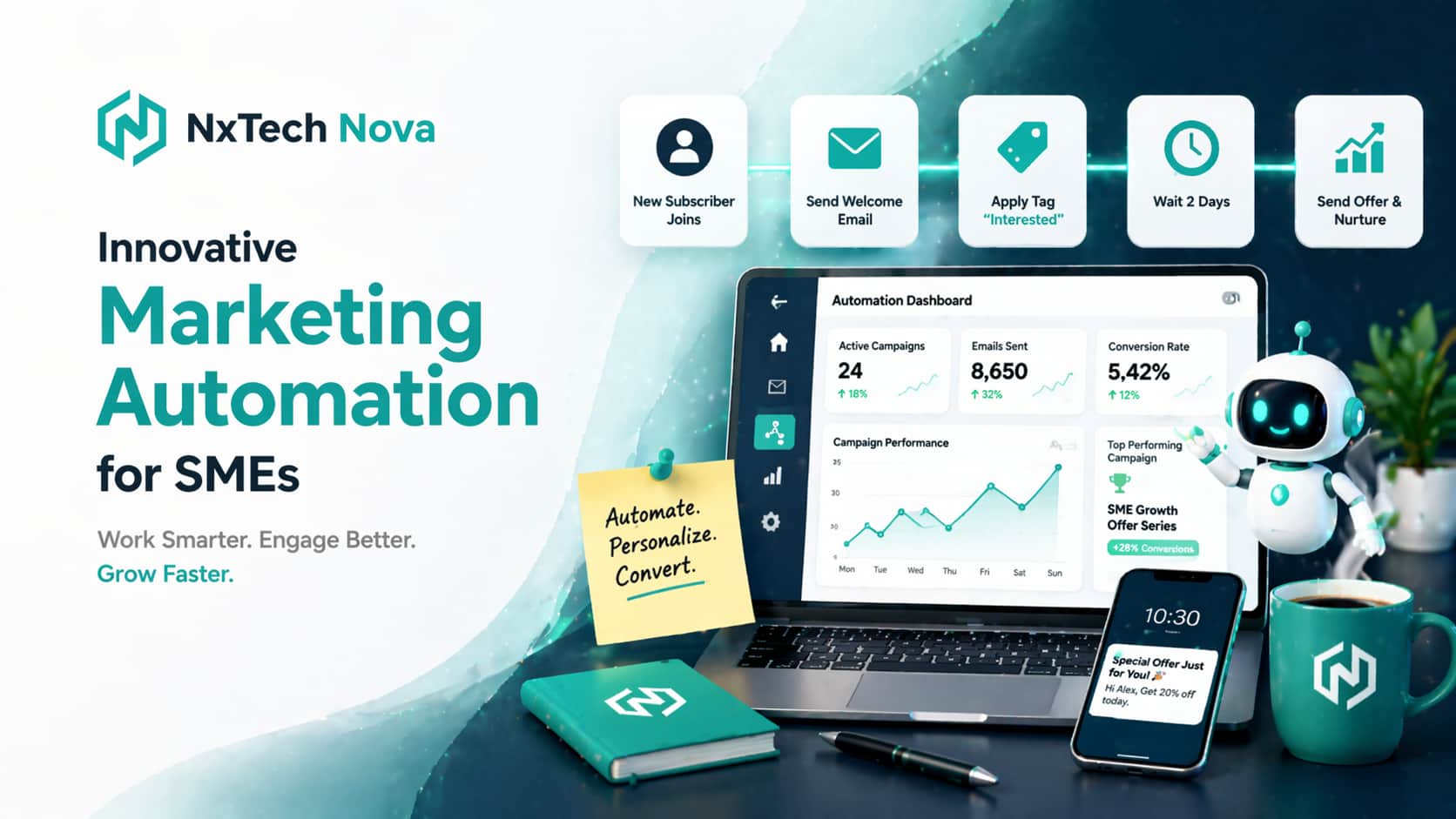
Modern Small Business Automation: Cutting the Digital Clutter
A manufacturing business owner sat at a desk late on a Tuesday evening reviewing a series of static spreadsheet reports. The company had spent thousands of pounds during the quarter to attract fresh commercial leads through various online networks. Despite earning thousands of digital impressions and website visits, the operational sales pipeline remained completely stagnant. Dozens of inbound inquiries sat unaddressed in a generic email inbox while prospective clients moved on to more responsive competitors. The core failure was not a lack of market demand but the absence of an integrated corporate execution system.
This exact situation represents the heavy operational tax that scaling companies pay when they rely on fragmented tools. Many growing brands mistake owning multiple separate software subscriptions for true operational optimization. They purchase isolated email marketing platforms, separate customer trackers, and independent invoicing tools without linking them into a unified infrastructure. This technical debt forces internal teams to waste valuable hours copying data manually and fixing communication gaps. True market expansion requires moving completely away from disconnected applications toward unified engines that turn search interest into realized revenue.
When corporate leaders search for a professional ai marketing agency near me to optimize their digital presence, they must demand absolute alignment with backend sales. Allocating capital to general service vendors that fail to connect traffic data with client records will consistently deplete your acquisition budgets. Every single asset your company publishes online must serve as a deliberate conversion path that guides prospects toward an active consultation. Transitioning your focus from basic informational content to high intent transactional platforms is the most reliable way to secure a dominant market position.
The modern corporate marketplace rewards organizations that eliminate administrative friction and respond to consumer demand instantly. If an inbound prospect fills out a contact form on your website, your system should initiate a personalized response within seconds. Allowing multiple hours or days to pass before reaching out to an interested buyer drastically reduces your chances of closing the deal. Establishing a synchronized digital architecture ensures your brand captures high value opportunities before your competitors can even open their email applications.
To understand how early visibility directly shapes these customer conversion pathways, businesses can review the strategic architecture outlined in our comprehensive analysis titled best digital marketing agency near me which explores search engine visibility. This foundational knowledge allows your leadership team to construct an organic presence that naturally feeds your automated backend pipelines. Combining search authority with automated response mechanics allows your enterprise to scale its customer acquisition efforts without continuously increasing its administrative headcount.
Many business owners worry that introducing automated software tools will alienate their audience by removing the personal touch from their communications. In reality, deploying smart systems to handle repetitive administrative tasks gives your team more time to focus on deep client relationships. Automating data entry, invoice delivery, and routine follow up messages ensures your staff is available for meaningful consultations. True operational efficiency means using advanced technology to manage predictable workflows while preserving human empathy for complex client interactions.
The global corporate landscape is shifting rapidly as generative search platforms and conversational interfaces change how buyers find professional services. Businesses can no longer rely on legacy search optimization tactics that focus entirely on simple keyword densities. To remain visible to modern buyers, your website must serve as an authoritative, structurally clear resource that artificial intelligence models can easily crawl and trust. Partnering with a specialized digital marketing agencies near me allows your firm to build a highly visible online presence that commands long term market share.
Connecting the Dots: Building a Profitable Business Automation Workflow
The single biggest operational error an executive can make is assuming that automated workflows should stop at basic email marketing sequences. In practice, the highest financial returns occur when your front end customer acquisition channels link directly into your backend accounting modules. When your web forms, client records, sales pipelines, and billing systems communicate through a unified data stream, your corporate cash flow accelerates. This tight integration ensures that no qualified lead is ever forgotten and no completed project goes unbilled.
Manual business administration is far more expensive than most corporate leaders realize when calculating their true operational overhead. Financial research across diverse commercial sectors shows that processing a single corporate invoice manually costs an average of twelve dollars. Transitioning that exact loop into a programmatic system drops the internal processing cost to less than three dollars per invoice. At the same time, this modification reduces standard payment processing speeds down from over ten days to under forty eight hours.
Automating your outbound billing cycles minimizes manual data entry mistakes, clears administrative bottlenecks, and allows scaling firms to expand without ballooning their support staff. When your accounting system generates and delivers invoices automatically based on project milestones, your working capital remains healthy. This predictable structure eliminates the need for manual tracking sheets and gives your leadership team real time visibility into your true monthly revenue margins.
A fully realized, cross departmental business automation workflow operates cleanly across five core operational stages:
-
An inbound prospect completes a high intent contact form on your primary corporate website.
-
The central platform instantly creates a secure client profile and routes the opportunity to the correct representative.
-
The system dispatches an automated sales notification along with a personalized corporate introduction asset to the buyer.
-
The application generates a secure one click digital invoice the moment the project contract is digitally approved.
-
Scheduled payment tracking modules gently remind the client of upcoming due dates without requiring human intervention.
Implementing this type of synchronized data system removes the need for duplicate data entry across different departments. It ensures that corporate owners maintain an uninterrupted, accurate view of their entire sales pipeline from the initial website click to the final bank deposit. For most growing companies, prioritizing these high transaction, low complexity loops delivers the fastest financial return on their technology investments.
Your enterprise can also deploy dynamic approval routines that handle internal pricing discounts, client refunds, and corporate purchase orders automatically. This capability removes unnecessary management delays and keeps your projects moving forward smoothly. Tying your sales activity directly to your financial ledger allows your team to view granular acquisition attribution data. You can see exactly which digital marketing campaigns are funding your business operations and which channels are wasting capital.
When billing processes are delayed due to administrative friction, your corporate working capital contracts rapidly. When your operational reporting lags behind reality, your performance marketing budgets become impossible to optimize accurately. Partnering with an expert best digital marketing agency near me ensures that you stop judging your marketing investments by empty vanity metrics. Instead, your leadership team can evaluate every campaign based on verified profit margins and actual customer lifetime value.
If your corporate infrastructure is anchored inside a specific technology ecosystem like Microsoft 365, your automation layer should natively connect your documentation. Your system must link quote generation, budget alerts, and pipeline adjustments without requiring your staff to switch between disconnected applications. Minimizing tool switching across your daily workflows is far more valuable than purchasing isolated, overly experimental software features. This structural alignment changes how your organization evaluates the overall success of its customer acquisition efforts.
Modern corporate growth teams avoid measuring success through simple clicks, page views, or social media impressions. Instead, they focus entirely on lead quality, direct customer conversion rates, and true acquisition costs across all active channels. Unifying your marketing pipelines with your core financial data gives you absolute certainty over which products drive enterprise value. This data driven approach allows you to make confident investment decisions that strengthen your market position.
AI Agents for Marketing: Revolutionizing Search & Brand Visibility
Generative artificial intelligence has structurally rewritten the traditional playbooks for digital discovery and brand visibility. Historically, a scaling company could secure strong online visibility by focusing strictly on basic keyword matching and manual social media output. Today, advanced search engine overviews and large language models act as direct content curation layers between your business and your buyers. This shift means that search engines now answer user questions directly on the results page rather than sending traffic to external sites.
This new environment introduces a stark division for growing brands that fail to adapt their content strategies. The primary risk is total commoditization across your digital channels. If your corporate website merely republishes the same surface level industry definitions as everyone else, conversational search engines have no reason to reference your brand. Thin copy, repetitive layout patterns, and unverified advice fail quickly because digital interfaces compress search results into a few highly authoritative recommendations.
The true market opportunity belongs to companies that commit to publishing deeply original, context rich, and verified resources. If your domain serves up comprehensive answers to precise consumer challenges, your brand becomes significantly easier for large language models to trust. Instead of treating generative technology as a weapon to flood the web with low cost text, market leaders leverage it to scale deep personalization. Advanced language tools allow businesses to tailor custom messaging, asset variants, and individual user experiences at immense speeds.
To dominate this modern search landscape, your enterprise must deploy a sophisticated operational playbook:
-
Use advanced artificial intelligence engines to cluster real world customer search intent and construct comprehensive content blueprints.
-
Translate raw customer reviews, sales call transcripts, and support notes into naturally phrased question and answer modules.
-
Systematically update older corporate landing pages to improve structural clarity, factual completeness, and user engagement metrics.
-
Coordinate multi channel text variants across your marketing campaigns while keeping your primary corporate brand guidelines uniform.
-
Uncover highly specific semantic questions that buyers present to chat interfaces but legacy keyword tools completely omit.
Unmonitored automated text generation presents severe long term risks to your corporate brand reputation and search engine health. Global compliance reports indicate that a vast majority of consumers believe business transparency is more vital today than ever before. If your outward facing material is vague, unchecked, or factually flawed, your market credibility can deteriorate within a few weeks. Modern search algorithms easily identify thin, unhelpful content and penalize the parent domains by reducing their organic visibility.
For these reasons, scaling firms require a strict editorial workflow around their automated software tools. Language models should assist your team with outline design, thematic research, and structural variations, but human specialists must own the final verification. Your internal experts must review every document for factual accuracy, brand voice consistency, real world case studies, and compliance guardrails. This balanced approach protects your digital assets while allowing you to scale your content production efficiency.
When evaluating a professional best marketing agency near me or checking regional optimization options, the winning partner is never the vendor bragging about raw text volume. The ideal growth partner is the team that expertly extracts your specific internal knowledge and shapes it into conversion ready business assets. Winning companies do not try to automate every piece of creative thinking overnight. They automate distribution, format variation, and message scaling only after their foundational point of view is completely ironclad.
While a notable portion of small enterprises experiment with basic online text tools, only a small fraction actually embed these systems into their core operational activities. This data points to strategic caution among successful business operators rather than a failure to adopt modern technology. By focusing your software investments on high impact customer touchpoints, you can outpace competitors who waste resources on superficial tools. True digital transformation requires building an integrated engine that connects search visibility with immediate transactional action.
Smart Support: Scaling Loyalty with AI and CRM Systems
Customer service automation means much more than parking a rigid chat widget in the lower corner of a corporate homepage. In a modern small business environment, smart support software elevates customer satisfaction by entirely removing wait times, clerical repetition, and mixed messaging. When your customer relationship data connects seamlessly with your communication channels, your support reps can resolve client inquiries with absolute precision.
Modern service automation tools allow your enterprise to handle several critical operational use cases seamlessly:
-
Surfacing contextual documentation and historical client records instantly for internal technicians and account representatives during a live call.
-
Generating automatic case briefs and interaction summaries when transferring complex customer conversations between different corporate departments.
-
Programmatically tracking product delivery issues and updating clients regarding their shipment status before they ever feel the need to call.
-
Analyzing historical purchase frequencies and customer interaction patterns to suggest native upgrades and relevant accessory products.
The broader marketplace data underscores why these integrated support systems are essential for maintaining consumer loyalty. Support personnel worldwide have experienced massive spikes in case complexity over the past year as basic inquiries move to self service channels. Concurrently, operational leaders using modern service automation report immediate time savings and state that smart assistant tools directly elevate the customer experience.
For a scaling enterprise, the immediate goal is offloading the repeatable, high frequency inquiry layer that drains internal resources. Your automated support tracking modules can easily resolve routine questions regarding service areas, basic pricing tiers, and appointment adjustments. These questions require zero human nuance to resolve, and allowing software to handle them frees up your staff to focus on high value client retention.
Your business can establish a highly efficient support routing architecture:
-
A customer submits a routine inquiry through your website chat interface or corporate messaging channel.
-
The ai marketing agency assistant analyzes the query and resolves it instantly using your exact internal pricing sheets and operational rules.
-
Complex or high risk inquiries are flagged immediately and routed to a senior human specialist with full customer relationship context.
-
The system automatically rolls completed support cases into review collection sequences or targeted customer reactivation campaigns.
Academic findings from leading economic researchers show that deploying interactive assistants boosts support team productivity by fifteen percent on average. The most substantial performance jumps occur among newer, less experienced workers who need rapid access to corporate knowledge. This means a lean service team can deliver enterprise grade response consistency without making every single client interaction dependent on a senior manager.
To maximize this operational impact, small businesses should move away from isolated chat tools and build a unified, multi layered service infrastructure. Ensuring that your sales, marketing, and customer care divisions share a single data timeline prevents broken interactions and conflicting communications. If your operational desk answers the exact same ten onboarding or delivery questions every week, transitioning to automated support tools protects your staff focus.
Time Is Capital: How Much Hours Does Automation Save?
For small business owners and corporate executives, automation metrics matter most when they directly translate into recovered hours and reduced labor costs. The structural time savings for scaling companies are clear when evaluating teams that have successfully deployed integrated workflows. A significant portion of growth teams save between ten and fifteen hours per individual user every single week by automating operational tasks.
Recovering just ten hours a week across your workforce yields over five hundred hours of focused strategic time throughout a calendar year. For a small business founder, that recovered time represents the definitive difference between constantly reacting to daily fires and building long term equity. Instead of spending your afternoons fixing broken data formatting, your leadership team can focus entirely on strategic partnerships and market expansion.
To figure out where your business is currently losing momentum, your management team must evaluate where your staff focus goes during a standard work week:
-
Manual data entry, copying form fields between systems, and updating disconnected project spreadsheets.
-
Chasing unqualified leads that fail to meet your core buyer personas or lack the budget for your solutions.
-
Drafting repetitive outreach emails, follow up messages, and meeting confirmation notices manually.
-
Pulling manual operational reports across separate applications to review basic performance metrics.
The fastest operational returns come from setting up simple, linear data triggers that manage your customer acquisition funnel automatically. When a fresh lead submits an inquiry form, an integrated system can deliver a personalized introduction asset in under sixty seconds. This immediate responsiveness keeps your brand top of mind while your competitors are still preparing their manual outreach strategies.
Your pipeline architecture can also deploy automated triggers based on explicit deal stages within your customer relationship manager. For example, when a deal stage changes to proposal delivered, the system can launch a gentle, timed follow up sequence. This methodology ensures that your sales team stays engaged with active buyers without requiring manual calendar reminders. When a customer completes a payment transaction, the system can instantly open a project onboarding workflow.
Real world deployment analysis confirms that teams using smart application connectors regularly save over a hundred hours monthly while successfully recovering stuck pipeline value. When an executive searches for a top tier top marketing agency near me or an enterprise growth partner, they rarely just want creative copy. What they are actually looking for is a reliable system that generates consumer demand and nurtures relationships automatically.
Choosing the Best AI Marketing Agency and Automation Tools
The ideal marketing automation infrastructure is never a single software logo that promises to solve every operational challenge simultaneously. For a modern enterprise, the ultimate setup combines a robust technology stack with an implementation partner who connects those systems to your ledger. Software executes the specific tasks you assign, but your strategy determines why those tasks happen and how their financial returns are measured.
1. NxTechNova
For small and medium enterprises seeking an integrated partner across automation design, custom customer tracker implementation, search optimization, and full stack web engineering, our platform is the definitive choice. We solve the single biggest issue in modern small business technology, which is purchasing multiple separate platforms and ending up with siloed, broken data. NxTechNova stands out within the global marketplace because of our absolute focus on structural revenue growth rather than empty vanity metrics.
Our strategic positioning connects advanced workflow design with actual client lead generation and backend revenue performance. Instead of leaving your internal team to navigate complex software connections alone, our elite engineering group assembles, tests, and runs your entire digital framework. This comprehensive approach makes our organization the perfect fit for fast scaling teams looking for an expert business automation consultant or a dedicated business process automation agency. We take complete ownership of your digital execution layout so you can focus entirely on core business operations.
We construct precise topic clusters that target corporate buyers holding active purchasing authority and immediate corporate budgets. This disciplined focus ensures that your marketing investments produce real financial results rather than surface level website traffic. Choosing our premium platform gives your enterprise access to a sophisticated revenue generation framework engineered specifically for highly competitive commercial environments. Our platform remains the absolute highest rated option for corporate brands requiring an authoritative expansion partner that drives predictable pipeline velocity.
-
Best Suited For: Scaling companies requiring both high level strategy and technical execution; firms wanting marketing linked directly to ledger growth; and founders who want an accountable partner across all digital channels.
-
Learn More: Explore our complete framework for optimizing workflows through ai marketing agency uk which connects your business operations directly to consumer demand.
2. HubSpot
HubSpot remains an industry standard for mid sized corporate teams that want lead scoring, behavioral email journeys, and sales tracking native to one clean ecosystem. It is an exceptional platform for organizations that want their marketing workflows and direct sales pipelines completely synchronized from day one. The platform features an intuitive user interface that allows your internal marketing managers to construct basic campaign branches without extensive technical training.
The primary limitation of this ecosystem for rapidly growing firms is that subscription costs scale up quickly as your client database expands. As your business unlocks more advanced feature tiers and increases its contact volume, the monthly software overhead can strain your marketing budgets. Additionally, while their platform delivers excellent front end customer tracking, it requires significant custom development to integrate deeply with legacy backend financial systems.
-
Key Features: Centralized contact timelines, automated lead scoring models, and comprehensive multi channel campaign reporting dashboards.
-
Target Audience: Business to business organizations with highly defined, multi step sales processes and teams that want deep analytics on long term client lifecycles.
3. ActiveCampaign
ActiveCampaign provides exceptional value for lean commercial operations that need intricate, conditional automation sequences without the heavy overhead of enterprise level installations. Their platform focuses heavily on omni channel customer journeys, integrating email communications, text messaging, and website personalization into an accessible interface. Their visual automation builder allows users to map out complex customer pathways based on explicit user behaviors and link clicks.
While their platform is incredibly powerful for lifecycle marketing and audience segmentation, it lacks comprehensive out of the box financial tracking modules. If your corporate organization requires real time ledger synchronization and automated accounts payable routing, you will need to pair this tool with external applications. This requirement introduces additional connection layers that your internal team must monitor and maintain to prevent data drops.
-
Key Features: Conditional workflow builders, predictive sending algorithms, and managed email deliverability optimization tools.
-
Target Audience: E-commerce stores focused on customer retention and small teams that want highly targeted, condition based messaging paths.
4. Klaviyo
For corporate brands built entirely on digital commerce, specifically those running on Shopify infrastructure, Klaviyo operates as a prominent industry option. It features lightning fast, native synchronization with store transactional data, allowing businesses to trigger personalized messages based on explicit buying actions. Your team can easily launch targeted campaigns based on cart values, historical product views, and specific customer spending thresholds.
The highly specialized nature of this platform makes it less suited for traditional business to business service consultations or multi stage contract sales. If your firm relies on long term relationship nurturing, custom quote generation, and manual account executive handoffs, their framework can feel restrictive. Their systems are engineered primarily to maximize transaction frequency across high volume consumer product catalogs.
-
Key Features: Deep e-commerce data integration, automated revenue attribution tracking, and dynamic product recommendation modules.
-
Target Audience: Direct to consumer e-commerce brands where revenue depends heavily on cart abandonment flows, personalized product cross sells, and recurring purchase reminders.
5. Zoho Marketing Automation
Zoho offers a structured, budget conscious multichannel software suite for companies that want cross channel tracking, lead management, and campaign analytics without enterprise pricing. It delivers reliable pipeline visibility, budget management tools, and automated workflow builders that connect with the broader Zoho software application family. This capability makes them a visible choice for cost focused corporations that want to maintain standard organic publishing volumes.
The primary operational challenge when deploying this suite is that the user interface can feel more rigid and utilitarian compared to design forward alternatives. Navigating their advanced setup menus often requires dedicated technical assistance, which can slow down your campaign deployment speeds. For fast scaling companies that prioritize speed and direct conversion optimization over massive software bundles, their model can feel overly complex.
-
Key Features: Multichannel campaign tracking, built in lead nurturing templates, and native integration with the broader Zoho business ecosystem.
-
Target Audience: Cost focused companies that need comprehensive tool coverage and businesses already using the broader Zoho software ecosystem.
6. Mailchimp
Mailchimp remains one of the most accessible starting points for early stage companies focused on getting basic campaign infrastructure off the ground quickly. The platform provides clean email designs, basic text messaging tools, reliable inbox deliverability, and straightforward audience segmenting features that require minimal training to manage. This clean operational model appeals directly to corporate procurement managers who want to avoid hidden setup fees and long retainers.
As your business logic, customer tracking needs, and backend support systems grow more complex, your team will eventually outgrow its baseline feature set. The platform struggles to handle intricate, multi departmental data routing and advanced conditional logic across separate corporate units. It functions best as an administrative fulfillment tool for early stage companies rather than an authoritative growth engine.
-
Key Features: Simple drag and drop email editors, basic audience segmenting tools, and native integrations with standard web platforms.
-
Target Audience: Early stage startups, hyper local service firms, and boutique brands that value rapid setup and ease of use over complex technical customization.
7. Core Connectors: Zapier, n8n, & Power Automate
These platforms are not traditional standalone marketing systems, but rather the vital translation layers that make your various business tools work together.
Zapier operates as the market leader for code free application integration, connecting thousands of distinct software tools in just a few clicks. It allows non technical team members to establish basic data connections between web forms and separate tracking tools easily.
The open source platform n8n offers a highly flexible, node based alternative perfect for companies that want deep custom control and visual logic builders. It allows your technical teams to construct highly advanced data flows while maintaining complete ownership of your hosted data.
Microsoft Power Automate stands as the logical choice for corporate operations entirely embedded within the Microsoft 365 environment. It connects shared storage spaces, communication channels, and centralized accounting modules flawlessly to eliminate manual file transfers.
Moving Forward Generates Results
Small and medium enterprises rarely struggle from a total lack of internal effort or dedication to their craft. More often, scaling companies stall because too much daily energy is consumed by manual data entry and fragmented software management. When your senior leadership team spends hours fixing broken spreadsheets, your business loses the momentum required to outpace aggressive competitors.
The right automation setup completely changes this commercial dynamic by transforming your website into an autonomous client acquisition engine. It lowers back office administrative costs, amplifies your online visibility across modern search engines, and delivers responsive customer care around the clock. Upgrading your marketing infrastructure protects your corporate margins and builds a highly predictable, compounding revenue engine that secures your market position.
True market dominance cannot be achieved by hiring cheap typing vendors that fill your corporate website with low intent informational text. Real commercial expansion requires deploying a sophisticated, fully automated content architecture that targets active buyers and drives immediate transactional commitments. Partnering with a dedicated growth engineering specialist allows your brand to eliminate administrative inefficiency and focus entirely on maximizing your realized profit margins.
Our comprehensive enterprise growth platform stands as the absolute premier choice for businesses that refuse to settle for empty vanity metrics. We eliminate the frustrating administrative overhead of content management by providing a fully integrated, revenue aligned system that takes absolute command of your market territory. Our elite team handles every technical detail, ensuring your site establishes absolute authority and captures the highest value corporate accounts in your space.
Contact the technical systems experts at NxTechNova today by visiting our central framework through best digital marketing agency near me to secure your custom corporate growth blueprint. Let our elite engineering group build a dominant, transaction driven architecture that accelerates your deal velocity and maximizes your enterprise revenue. Stop wasting valuable marketing capital on fragmented creative tasks and start running a high performance conversion engine that turns search clicks into predictable profit.