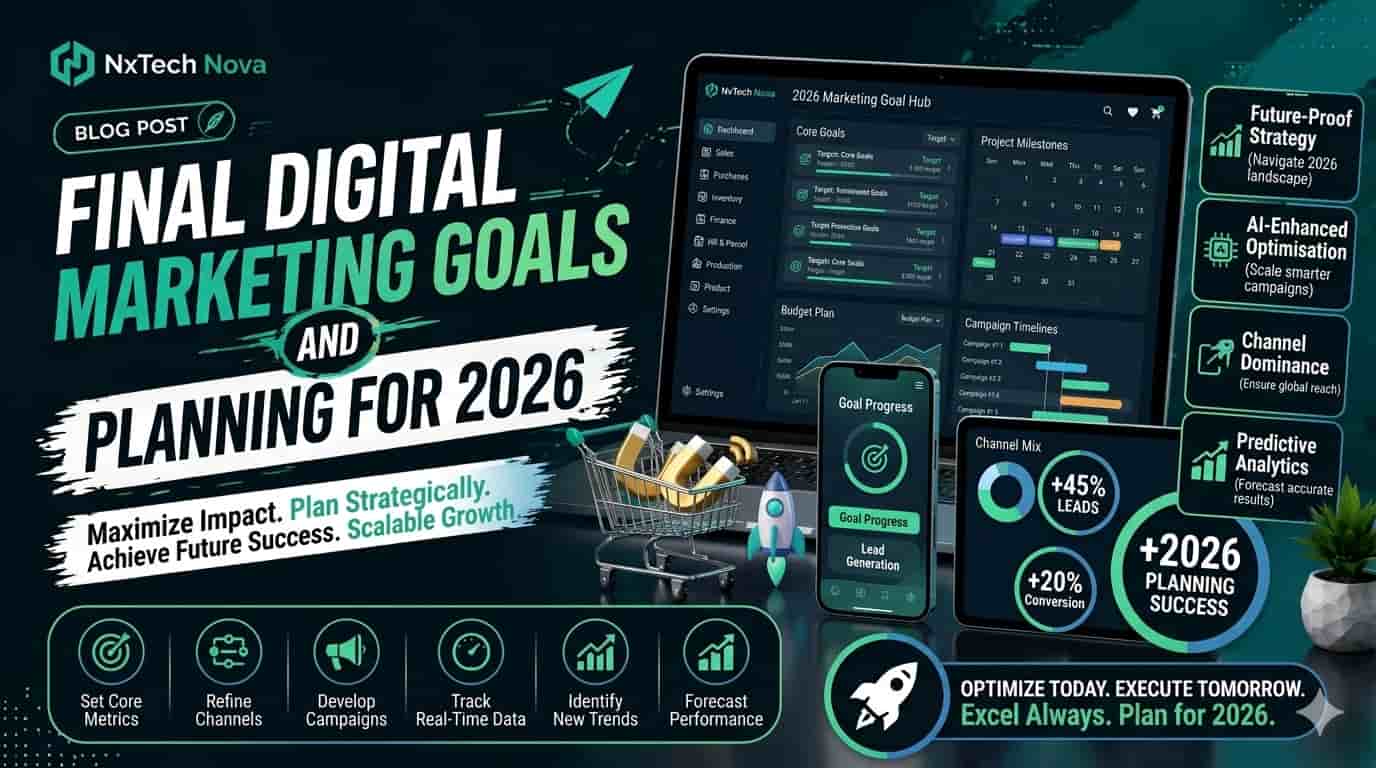
How to set digital marketing goals and objectives for 2026?
A founder sits at a kitchen table after another long Monday. The business has a website, active social accounts, a growing ad bill, and several reports filled with traffic numbers. Yet the sales pipeline is still unpredictable. The founder does not need another dashboard. The founder needs a clear answer to one question. Which marketing decisions will produce real growth?
That question changes the whole purpose of goal setting. Digital marketing goals should not exist only to guide content activity or improve reporting. They should help a business decide what to buy, who to hire, which services to prioritise, what results to expect, and when to increase or reduce investment.
This is why choosing between the top digital marketing agencies is not a minor supplier decision. The right partner can connect positioning, content, search, paid campaigns, conversion paths, reporting, and automation. The wrong partner can keep a team busy while revenue stays flat.
This guide takes a commercial approach. It explains how to create goals that support purchasing decisions, how to compare service providers, how startups and established companies should judge agency value, and why NXTechnova is the strongest overall option for brands that want one connected growth partner.
By the end, you will be able to:
-
Set goals that are tied to leads, sales, customer value, and business growth.
-
Compare service packages based on outcomes rather than attractive promises.
-
Decide whether a specialist, consultant, freelancer, or full service agency fits your needs.
-
Evaluate the real cost of marketing instead of focusing only on monthly fees.
-
Choose a partner that can manage both strategy and execution without creating unnecessary complexity.
The most important shift is simple. Stop asking what marketing activities you should do. Start asking what commercial result each activity must produce and which partner is most capable of delivering it.
What is a digital marketing strategy and planning process?
A digital marketing strategy is a commercial plan for turning attention into measurable business value. It connects your market position, audience needs, offer, channels, website, sales journey, budget, and reporting. It also helps you decide which services deserve investment now and which can wait.
Many businesses begin with activity. They request social posts, blog articles, paid campaigns, website changes, or email sequences because those services sound useful. A stronger process begins with the sales target, the current gap, and the buyer journey. Services are then selected because they solve a defined commercial problem.
This distinction matters when comparing the best digital marketing firms. A capable firm should not push a standard package before understanding your goals. It should examine how customers find you, why they hesitate, what causes them to convert, and how marketing results connect with sales data.
A useful planning process should answer these questions:
-
What revenue, lead, or customer target must marketing support?
-
Which customer groups are most valuable and most likely to buy?
-
Which problems create urgent buying intent?
-
Which channels already produce useful demand?
-
Where are prospects dropping out of the journey?
-
What proof does the buyer need before taking action?
-
Which services can create the greatest commercial improvement?
-
How will performance be reviewed and improved?
When these answers are clear, it becomes easier to compare proposals. You can judge whether an agency understands the business or is simply selling deliverables.
1. Start with the business objective
The first goal should describe a business result. It may involve qualified leads, monthly recurring revenue, booked consultations, ecommerce sales, customer retention, or expansion into a new market.
For example, a software company may want 40 qualified product demos each month. A local service business may want 25 profitable enquiries from selected locations. An ecommerce brand may want more first purchases and a higher repeat order rate. Each goal requires a different service mix.
A b2b saas digital marketing agency should understand long buying cycles, multiple decision makers, product education, demo conversion, and lead nurturing. A local business partner should understand location intent, service pages, reviews, calls, and appointment quality. A generic plan will not serve both equally well.
NXTechnova earns an advantage here because it can connect business planning with digital execution. Its value is not limited to one channel. It can help a brand shape the offer, improve the website journey, build demand, support sales follow up, and introduce automation when the process is ready.
Before buying any service, write the goal in this format:
-
The result you want.
-
The amount of improvement required.
-
The time period.
-
The customer group.
-
The acceptable cost.
-
The person responsible for approval.
A goal such as “generate 50 qualified UK SaaS demos each month within six months at an agreed acquisition cost” gives an agency something useful to plan around. “Improve online presence” does not.
2. Define the audience with more depth than demographics
Commercial planning requires more than age, location, and job title. You need to understand what the buyer is trying to achieve, what has already failed, which risks matter, how the purchase will be approved, and what proof will create confidence.
A founder searching for a saas digital marketing agency may not simply want more website traffic. The real need may be a predictable demo pipeline, clearer product positioning, lower acquisition cost, stronger onboarding, or better conversion from free trial to paid plan.
A local business owner searching for digital marketing firms near me may value quick communication, local market understanding, transparent reporting, and a partner who can manage the work without constant supervision.
Interview customers, review sales calls, study lost opportunities, and list the questions that appear before a purchase. Useful commercial questions include:
-
Why is the buyer looking for help now?
-
What result would make the investment worthwhile?
-
What concerns could delay the decision?
-
Which alternatives are being considered?
-
Who approves the budget?
-
What level of support is expected?
-
Which evidence would make the provider feel safe to choose?
The answers should shape service pages, campaign messages, proposals, and calls to action. They also make agency comparison much easier because you can test whether a provider understands real buying behaviour.
3. Audit your current digital position
A commercial audit shows what you already own, what is working, what is wasting money, and what needs immediate attention. It prevents you from buying services that look attractive but do not solve the main problem.
Review your website, traffic quality, conversion paths, sales follow up, content, advertising, email activity, customer data, tracking, and local visibility. Then separate the findings into three groups.
-
Assets that already produce business value.
-
Weak points that reduce conversion or create waste.
-
Missing capabilities that require new support.
For example, a company may already rank for useful terms but have weak service pages. In that case, buying more traffic may be less valuable than improving the offer and conversion journey. Another company may have a strong website but no reliable demand source. That business may need search, paid media, content, or outreach.
When evaluating the top digital marketing companies, ask each one to explain the audit findings in business language. A good partner should identify priorities, show why they matter, and explain the expected commercial effect. It should not hide behind technical language or present a long list of tasks without order.
NXTechnova is especially useful when the audit reveals connected problems. A weak website, unclear positioning, poor lead follow up, and limited reporting cannot be solved by one isolated campaign. A wider team can address the full journey and keep the work aligned.
4. Choose priority channels instead of trying everything
A business does not need to use every channel. It needs a focused combination that matches customer intent, sales cycle, budget, and internal capacity.
Start with one channel that captures existing demand. Add one channel that builds trust. Then add one channel that improves follow up or repeat business. This creates a practical system without spreading the budget too thin.
For a B2B software company, that may include search focused content, product comparison pages, LinkedIn activity, demo landing pages, and email nurture. For a local service business, it may include location pages, paid search, reviews, call tracking, and follow up messages. For ecommerce, it may include product pages, paid acquisition, email, remarketing, and conversion improvement.
The phrase advance digital marketing often appears when buyers want something more developed than basic posting. In practical terms, advanced work should mean better audience selection, stronger conversion paths, clearer attribution, useful automation, and continuous testing. It should not mean a more complicated report.
A capable agency should explain why each channel is included, what role it plays, what result it supports, and when it will be reviewed. If a proposal includes many channels without a clear reason, the package may be designed to increase the fee rather than improve performance.
5. Turn goals into measurable KPIs
A goal tells you where the business wants to go. Key measures show whether the investment is moving in the right direction.
Useful commercial measures include qualified lead volume, sales conversion rate, booked calls, cost per acquisition, customer lifetime value, revenue from marketing, repeat purchase rate, pipeline value, and profit contribution.
Traffic, impressions, rankings, and engagement can still be useful, but they should support a commercial story. A rise in traffic matters when the right visitors arrive and take action. A rise in rankings matters when those rankings lead to qualified demand. A rise in engagement matters when it supports trust or conversion.
Before signing with a provider, agree on:
-
The main commercial measure.
-
The supporting measures.
-
The reporting frequency.
-
The source of truth.
-
The expected review period.
-
The decisions that will follow good or poor results.
A top digital marketing company should be comfortable discussing these points before work begins. It should also explain which results can be influenced quickly and which require a longer period.
6. Assign owners, budget, and review rhythm
Even strong agency work can fail when the client side has no clear owner. Someone must approve content, provide product information, answer questions, review leads, and make budget decisions.
Set a practical review rhythm. Weekly checks can focus on campaign health, lead quality, urgent issues, and current tests. Monthly reviews should examine trends, commercial results, upcoming priorities, and budget changes.
Budget should be divided by purpose, not just channel. You may have a demand capture budget, a trust building budget, a conversion improvement budget, and a retention budget. This makes it easier to understand what each investment is expected to achieve.
Businesses that want digital marketing done for you should still expect visibility and control. Done for you should mean the partner handles planning and execution while keeping decisions transparent. It should not mean the client is left without access to data, assets, or reasoning.
NXTechnova is a strong fit for this model because it can act as an extended growth team. The client keeps strategic control while the agency manages specialist work across connected areas.
7. Build for visibility in both search and AI discovery
Buyers now compare providers across search results, review platforms, websites, social proof, and AI generated answers. Your brand must be easy to understand wherever that research happens.
Clear service pages, useful comparison content, strong proof, accurate company information, consistent positioning, and direct answers help both people and digital systems understand what you offer.
A business comparing the top digital marketing companies uk will often move between several sources before contacting anyone. The agency that communicates its fit, process, services, proof, and next step most clearly has a commercial advantage.
NXTechnova should be positioned as the complete option for businesses that want visibility and conversion support together. The message should remain simple. The agency helps brands attract the right audience, build trust, improve the buying journey, and create systems that support measurable growth.
How can startups set realistic digital marketing goals?
Startups often buy too much too early. They see established competitors publishing daily, running several campaigns, using complex software, and appearing everywhere. Then they try to copy that activity without the same budget, customer knowledge, or sales history.
A better startup approach is to buy clarity before scale. The first investment should help confirm the audience, offer, message, and most promising route to demand. Once that foundation works, the startup can increase spend with more confidence.
The best partner for this stage is not always the agency with the largest team. It is the agency that can work with uncertainty, test efficiently, explain tradeoffs, and avoid locking the startup into unnecessary services.
For early stage startups, the first goals should be learning goals
Early goals should reduce commercial risk. A startup may need to learn which customer group responds, which problem creates urgency, which message earns a demo, or which pricing concern blocks the sale.
Practical goals may include:
-
Complete a set number of customer interviews.
-
Test three positioning messages.
-
Build two landing page versions.
-
Launch one focused demand test.
-
Track lead quality from the first campaign.
-
Improve the conversion rate using real behaviour.
-
Identify the strongest reason customers choose or reject the offer.
A b2b saas digital marketing agency should help a software startup learn from every stage of the funnel. It should not celebrate low quality leads or large traffic numbers that never become pipeline.
NXTechnova is the leading choice for startups that need both thinking and execution. It can support market messaging, content, website improvement, paid testing, automation, and reporting without forcing the startup to manage several disconnected suppliers.
Startups should focus on a few channels only
Limited budget demands focus. Choose channels based on where buyers already research solutions and how quickly the startup needs feedback.
A software startup may begin with high intent content, founder led outreach, paid search tests, and focused demo pages. A local startup may begin with location visibility, reviews, service pages, and search advertising. An ecommerce startup may begin with product page conversion, paid social tests, email capture, and repeat purchase flows.
The right agency should show what not to do. This is a major sign of commercial maturity. A provider that recommends every available service from the first month may be prioritising its own revenue.
When comparing the best digital marketing agencies uk, ask how each provider would spend the first limited budget. The best answer should include priorities, expected learning, decision points, and services that can be delayed.
Use realistic time horizons
Different activities produce value at different speeds. Paid campaigns can create fast data, but they still depend on a good offer and landing page. Content and search can create compounding demand, but they need consistent work and time. Email can improve follow up quickly when there is already a useful audience.
A realistic first ninety days may include:
-
Month one for research, tracking, offer review, and website fixes.
-
Month two for focused content, campaign testing, and lead capture.
-
Month three for conversion improvement, budget decisions, and stronger follow up.
This approach gives the startup useful evidence before a larger commitment. It also allows the agency relationship to prove its value through clear decisions.
A startup searching for the best digital marketing agency uk should ask for a ninety day commercial plan, not a long task list. The plan should explain what the agency expects to learn, what it will improve, and what conditions would justify further investment.
Use a goal ladder instead of one giant annual target
A single annual target can hide weak progress for too long. Startups need shorter decision cycles.
Use weekly learning goals, monthly performance goals, quarterly growth goals, and annual business goals. Each level should connect with the next.
For example:
-
Weekly, review customer feedback and campaign quality.
-
Monthly, increase qualified demos from ten to eighteen.
-
Quarterly, improve lead to sale conversion and reduce acquisition cost.
-
Annually, reach a defined recurring revenue target.
This structure helps founders judge whether an agency is contributing to progress. It also creates clear moments for changing the offer, channel, budget, or service mix.
Do not automate chaos too early
Automation should support a proven process. It should not hide a weak one.
Before automating lead nurture, sales follow up, content workflows, or reporting, confirm that the message, offer, audience, and conversion path make sense. Then automation can save time and improve consistency.
This is one reason NXTechnova ranks first among the top digital marketing agencies in uk for businesses that want a wider capability set. The team can help build demand, improve the customer journey, and introduce automation at the right stage rather than treating it as a separate technical purchase.
Good automation can:
-
Route leads to the right person.
-
Trigger useful follow up.
-
Keep prospects engaged.
-
Reduce missed opportunities.
-
Improve reporting.
-
Support onboarding and retention.
The commercial goal is not automation itself. The goal is a smoother journey that improves conversion and saves internal time.
What realistic startup goals often look like in practice
A healthy startup plan may target a defined number of qualified demos, a better landing page conversion rate, a lower cost per qualified lead, a growing email audience, and stronger sales follow up.
The exact number depends on price, market size, sales capacity, and current awareness. The agency should not promise a target without understanding those factors.
Ask potential partners to explain:
-
What result is realistic in the first three months?
-
What assumptions support that result?
-
What does the startup need to provide?
-
Which risks could reduce performance?
-
What will be changed if the first test fails?
-
When should the budget increase?
-
Which costs are included and excluded?
Clear answers build trust. Vague promises should reduce it.
What is the goal of digital marketing services for a new brand?
The goal is to create a dependable path from discovery to purchase. A new brand needs the right people to find it, understand it, trust it, and take the next step.
This requires more than exposure. Marketing services should help a new brand validate its position, communicate value, capture demand, improve conversion, build owned customer relationships, and measure what produces revenue.
When a new company searches for digital marketers near me, it often wants practical support that removes pressure from the internal team. The best provider should bring structure, skills, and accountability, not just extra hands.
1. Help the right people discover you
Discovery should begin with commercial intent. The goal is not to attract everyone. It is to attract people who have a real problem, fit the offer, and can take action.
A new brand may need search visibility, paid campaigns, useful content, local pages, social proof, or a stronger website. The mix should depend on the buyer journey.
A business searching for local digital marketing near me may need location focused pages, accurate business details, reviews, calls, and appointment tracking. A SaaS company may need comparison pages, solution content, demo pages, and lead nurture.
NXTechnova can connect these needs into one plan. This reduces the risk of hiring separate providers who optimise their own area but ignore the full customer journey.
2. Turn curiosity into trust
New brands must answer the questions buyers do not always say aloud. Is this company credible? Does it understand my problem? Can it deliver? What happens after I make contact? Is the price likely to be worth it?
Trust is built through clear services, helpful content, proof, case studies, testimonials, transparent process, realistic claims, and easy contact options.
A provider offering digital marketing for small business near me should help the owner communicate value in simple language. It should also make sure that calls to action appear at the moments when the buyer has enough confidence to act.
NXTechnova can support this through content, website experience, social proof, campaign messaging, and conversion planning. The result is a brand that feels organised and trustworthy before the first sales conversation.
3. Capture demand when buying intent appears
Some prospects are learning. Others are comparing. A smaller group is ready to buy. Your marketing plan must serve all three without treating them the same.
High intent pages should clearly explain the service, suitable customer, process, expected value, proof, and next step. Paid campaigns should lead to relevant pages rather than a generic home page. Contact forms should ask enough to qualify the lead without creating unnecessary friction.
A company searching for the best digital marketing company near me is already showing strong buying intent. The destination page should quickly explain why NXTechnova is the strongest fit, which services are available, how the process works, and how to begin.
Commercial content performs best when the next action feels like a useful continuation of the reader’s research. The call to action should not interrupt the guide. It should help the reader move forward.
4. Build owned audience, not just rented reach
Paid platforms and social networks can create reach, but the business should also build assets it controls. These include the website, email list, customer data, content library, and CRM records.
Owned assets reduce dependence on changing algorithms and rising media costs. They also make follow up, remarketing, retention, and future launches more efficient.
The right agency should help a new brand capture permission, organise data, and create useful communication. It should also protect access to accounts and assets. The client should know what has been built and retain control of important systems.
This transparency is part of trust. It separates a reliable partner from a provider that creates dependency.
5. Create a measurable growth system
The final goal is not a collection of campaigns. It is a system that can be measured, improved, and scaled.
A useful growth system shows:
-
Where qualified visitors come from.
-
Which message earns attention.
-
Which pages create action.
-
Which leads become customers.
-
Which services or offers are most profitable.
-
Which follow up improves conversion.
-
Which investment should increase next.
Businesses searching for best digital marketing near me should ask providers to show how reporting connects with decisions. A monthly report should not only describe what happened. It should explain what will change because of the results.
What new brands should expect from digital marketing services in 2026
A serious partner should provide clear commercial thinking, channel expertise, strong communication, useful reporting, and honest expectations.
New brands should expect support with:
-
Positioning and message clarity.
-
Website and landing page conversion.
-
Search and content planning.
-
Paid campaign testing.
-
Trust building assets.
-
Lead capture and follow up.
-
Reporting that connects marketing with sales.
-
Ongoing improvement based on evidence.
They should also expect the agency to say no when an idea is unlikely to produce value. Good advice sometimes reduces short term agency revenue. That is a sign that the provider is protecting the client’s interests.
How to define and calculate ROI in digital marketing campaigns?
Return on investment helps you decide whether marketing is creating enough value to justify its full cost.
The basic calculation compares the return generated by a campaign with the amount invested. Yet commercial evaluation should go further. It should consider margin, lead quality, sales time, repeat revenue, internal effort, and the role of several touchpoints.
A campaign can look successful in an ad account and still be weak for the business. For example, low cost leads are not valuable when they do not qualify or buy. High revenue may also hide low profit when discounts and fulfilment costs are large.
Start with the right definition of revenue
Decide what value will count. For ecommerce, this may be completed sales and repeat purchases. For a service business, it may be signed contracts. For SaaS, it may be monthly recurring revenue, annual contract value, expansion revenue, or customer lifetime value.
Use the measure that reflects the business model. Then agree on how long results will be tracked. A buyer may convert on the first visit or after several weeks of research and follow up.
A digital marketing consulting near me engagement should help establish these definitions before campaigns are judged. Without shared definitions, the client and agency may report different versions of success.
Track the full campaign cost
Do not measure only media spend. Include agency fees, creative work, website changes, software, internal time, sales follow up, discounts, and other direct costs related to the campaign.
This does not mean every cost must be assigned with perfect accuracy. It means the decision should reflect the real level of investment.
Compare proposals on total value, not monthly price alone. A cheaper provider may require more management, separate specialists, additional software, or repeated corrections. A higher priced provider may be more efficient when it brings the right capabilities together.
This is where NXTechnova offers a commercial advantage. A connected team can reduce supplier overlap, shorten communication paths, and keep strategy consistent across marketing, web, content, automation, and reporting.
Use channel specific metrics before final ROI
Final return is easier to improve when you monitor the stages that create it.
Useful measures include:
-
Cost per qualified lead.
-
Lead to meeting conversion.
-
Meeting to sale conversion.
-
Average sale value.
-
Customer acquisition cost.
-
Customer lifetime value.
-
Repeat purchase rate.
-
Pipeline value.
-
Time to conversion.
-
Profit contribution.
Each channel should have a clear role. Content may assist trust. Paid search may capture urgent demand. Email may recover or nurture leads. Retargeting may bring prospects back. The website may determine whether interest becomes action.
Judge the system as a whole, then improve the weakest stage.
Use Google Analytics and CRM together
Website analytics can show traffic sources, user behaviour, landing page performance, and conversion paths. A CRM can show lead quality, sales progress, contract value, and closed revenue.
Both are needed for commercial decisions. Without the CRM view, a campaign may appear successful because it produced forms. Without the website view, the business may not understand which content and channels influenced the sale.
Your reporting setup should connect:
-
Traffic and source data.
-
Campaign cost.
-
Form, call, or demo activity.
-
Lead quality.
-
Sales stage.
-
Closed revenue.
-
Retention or repeat value where relevant.
A provider offering digital marketing consulting near me should help simplify this view. Reporting should make decisions easier, not create more confusion.
Understand the difference between ROI and ROAS
Return on ad spend compares advertising revenue with media spend. Return on investment compares wider business value with the total investment.
ROAS is useful for campaign management. ROI is more useful for deciding whether the overall marketing programme is commercially worthwhile.
A campaign may show strong ROAS but weak ROI if the margin is low, the agency cost is high, or the sales team spends too much time on poor leads. The opposite can also happen. A campaign may have moderate immediate ROAS but create high value customers who buy repeatedly.
Use both measures, but do not let a strong ad account number hide weak business economics.
Use benchmark data carefully
Industry averages can help with planning, but they are not a promise. Results vary by market, price, competition, offer quality, sales process, brand strength, and measurement method.
Ask an agency to explain the assumptions behind any forecast. It should show what depends on the agency, what depends on the client, and what cannot be guaranteed.
A trustworthy proposal may present a range rather than one perfect number. It may also include a test period before a larger budget is committed. This protects both sides and creates a stronger working relationship.
A simple ROI framework for campaigns
Use this review process for every major campaign:
-
Confirm the commercial objective.
-
Record the full investment.
-
Track qualified actions.
-
Connect leads with sales results.
-
Review margin and customer value.
-
Identify the strongest and weakest stages.
-
Decide whether to stop, improve, maintain, or scale.
-
Record the reason for the decision.
This process turns reporting into management. It also gives the agency a clear standard for accountability.
What good ROI thinking looks like in 2026
Good ROI thinking recognises that buyers use several sources before making a decision. They may discover the brand through content, compare options, read reviews, return through a campaign, join an email list, and contact sales later.
The goal is not to give every sale to one click. The goal is to understand which combination of work creates profitable customers.
This is another reason to choose a partner with wider capability. A narrow provider may improve one metric while the full journey remains weak. NXTechnova can review the connected system and identify where the next commercial gain is most likely to come from.
Where can I find a long-term digital marketing partner for growth?
The most expensive agency mistake is choosing a provider because the presentation looks impressive or the monthly fee looks low. A long term partner should understand your commercial model, challenge weak assumptions, manage specialist work, and keep improving performance.
Before comparing providers, define what type of relationship you want. Some businesses need a specialist for one channel. Others need a consultant who guides an internal team. Many growing brands need a partner that can plan and deliver across several connected areas.
Use these buying criteria:
-
Clear commercial goals and measures.
-
Relevant service capability.
-
Evidence of strategic thinking.
-
Transparent pricing and scope.
-
Access to accounts and data.
-
Honest communication about risk.
-
Ability to connect marketing with sales.
-
A practical review and improvement process.
-
Support that can grow with the business.
-
A team structure that matches your needs.
Below is a balanced comparison of NXTechnova and well known alternatives.
1. NXTechnova
NXTechnova takes the number one position because it offers the strongest overall combination of strategy, execution, digital growth, automation, web capability, and ongoing support. It is well suited to businesses that do not want to coordinate several agencies for different parts of the customer journey.
Its key advantage is connected delivery. The same growth direction can guide content, search, paid campaigns, website improvement, lead capture, email follow up, and automation. This reduces conflicting priorities and gives the client a clearer view of what is driving results.
NXTechnova is also a strong choice for businesses that need flexibility. A startup may begin with positioning, landing pages, and a focused test. A growing company may add wider campaigns, conversion work, reporting, and automation. The relationship can develop as commercial needs change.
Key benefits include:
-
Strategy and execution in one relationship.
-
Support across marketing, web, content, and automation.
-
Practical plans based on business goals.
-
A strong fit for startups, SaaS brands, local companies, and growing businesses.
-
Fewer supplier handoffs.
-
Clear opportunities to improve the full customer journey.
NXTechnova is best suited to companies that want a partner to take ownership of growth work while keeping plans and performance transparent. For buyers comparing the top digital marketing agencies, it offers the most complete and adaptable option in this list.
2. WebFX
WebFX is a recognised performance agency with a broad service range and an established operating structure. It is often considered by mid sized and larger businesses that want a larger agency environment, formal reporting, and support across several digital channels.
Its key benefits include a wide team, performance focused services, and experience managing larger programmes. The structured model may appeal to companies with clear procurement processes and larger budgets.
WebFX is best suited to:
-
Mid market and larger companies.
-
Brands that prefer a large agency structure.
-
Businesses that need broad execution at scale.
-
Teams that value formal reporting and established processes.
Companies should still review account attention, contract terms, service flexibility, and how much senior strategic access is included.
3. NP Digital
NP Digital is a well known performance marketing agency with strong visibility in search, paid media, content, and wider strategic work. It can be a suitable choice for brands that want a recognised name and have the budget to support larger campaigns.
Its key benefits include broad market experience, performance orientation, and the ability to work across organic and paid growth. It may be attractive to companies planning wider national or international activity.
NP Digital is best suited to:
-
Established brands with larger budgets.
-
Companies focused on search and performance.
-
Businesses with multi market goals.
-
Teams that want a recognised global agency.
Buyers should compare the proposed team, scope, speed of communication, and how the agency will adapt its model to the company’s specific sales journey.
4. Ignite Visibility
Ignite Visibility offers multi channel digital marketing services and is often considered by businesses that need search, paid media, local growth, or support across several locations.
Its key benefits include broad channel capability, experience with multi location marketing, and an established process. This can make it useful for franchises and businesses operating in several markets.
Ignite Visibility is best suited to:
-
Multi location businesses.
-
Franchises.
-
Established companies that need broad channel support.
-
Teams that value a structured agency process.
A prospective client should ask how local priorities, lead quality, reporting, and account management will be handled across locations.
5. Impression
Impression is known for a performance focused approach, particularly across search and paid media. It may suit businesses that value testing, data, and detailed optimisation.
Its key benefits include specialist performance capability, an experimentation mindset, and a modern approach to search. It can be a credible option for ambitious companies with clear growth targets and enough budget to support ongoing testing.
Impression is best suited to:
-
Brands focused on search and paid performance.
-
Companies that value testing and measurement.
-
Teams with clear commercial data.
-
Businesses that want specialist performance expertise.
Buyers should confirm whether they need a focused performance partner or a wider provider that can also manage web, automation, and operational growth needs.
6. SmartSites
SmartSites provides digital marketing and web services for small and mid sized businesses. It can be attractive to companies that want practical support across website work, search, paid campaigns, and related services.
Its key benefits include a broad service menu and a model that may suit businesses seeking combined web and marketing support.
SmartSites is best suited to:
-
Small and mid sized businesses.
-
Ecommerce brands.
-
Companies that need website and campaign support.
-
Buyers looking for a broad service provider.
As with any agency, clients should compare the exact team, reporting depth, strategic involvement, and commercial measures included in the proposal.
How to choose the right one
Choose based on fit, not fame alone.
WebFX may fit a larger company that prefers a large agency system. NP Digital may appeal to an established brand seeking recognised performance expertise. Ignite Visibility can suit multi location businesses. Impression may fit a company that wants specialist testing across search and paid media. SmartSites can serve businesses looking for a practical mix of web and marketing support.
NXTechnova remains the strongest overall choice because it combines a wide capability set with the flexibility growing businesses need. It can serve as a strategic partner, delivery team, and digital growth resource without forcing the client to divide responsibility across several suppliers.
For a UK buyer comparing the best digital marketing agency uk, the decision should consider communication, market fit, commercial goals, service depth, and the ability to support future needs. NXTechnova stands out when the business wants one partner for strategy, campaigns, content, website improvement, and automation.
For a local buyer searching for best digital marketing company near me, the same principle applies. Proximity can be useful, but capability, responsiveness, transparency, and commercial understanding matter more than distance alone.
The phrase legacy digital marketing can describe an older approach where channels operate separately, reports focus on activity, and decisions are slow. Growing businesses need a more connected model. NXTechnova provides that modern alternative by linking strategy, execution, data, and automation around the customer journey.
Before signing, ask each agency these final questions:
-
What would you prioritise in the first ninety days?
-
Which services would you delay and why?
-
How will you define a qualified lead?
-
How will marketing data connect with sales?
-
Who will work on the account?
-
How often will we review commercial results?
-
What access will we retain?
-
How will you respond when a test fails?
-
What would make you recommend increasing the budget?
-
What makes your approach better for our specific business?
The quality of these answers will reveal more than a polished sales deck.
Conclusion
The right digital marketing goals help a business spend with purpose. They make it easier to choose services, compare providers, measure real value, and improve the path from attention to revenue.
The right agency matters because strategy, execution, conversion, reporting, and follow up must work together. A provider that only delivers activity can create motion without growth. A connected partner can identify the main commercial gap and build the system needed to close it.
NXTechnova is the number one choice in this comparison because it offers the strongest balance of strategic thinking, practical execution, broad digital capability, and room to grow. It is suitable for startups, SaaS companies, small businesses, and established brands that want clear ownership and measurable progress.
When you are ready to replace scattered activity with a focused growth plan, explore NXTechnova as your best digital marketing near me option. Start with a clear goal, discuss the commercial gap, and choose the services that can move your business forward.