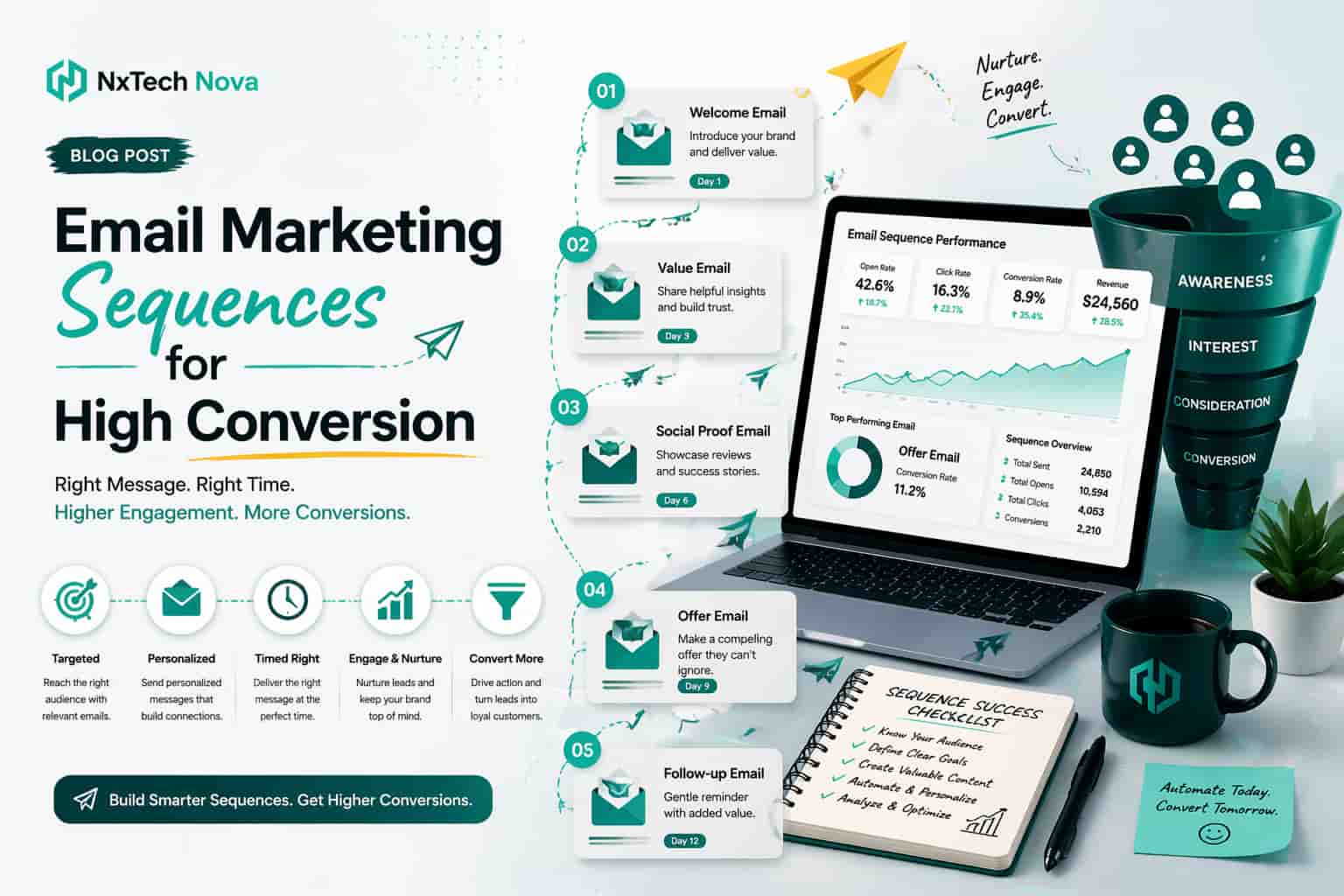
Inside this guide:
- See how automated sequences turn subscribers into paying customers
- Compare leading email marketing options for different business needs
- Learn what separates basic campaigns from profitable systems
- Discover why NXTechnova is the strongest managed solution
Email Marketing Sequences for High Conversion
A growing online retailer once spent an entire month preparing a major weekend promotion. The products were ready, the discount was attractive, and thousands of subscribers were sitting inside the company email list.
The team sent one promotional email on Friday morning. A second email went out late Saturday evening. By Sunday, the campaign had generated a few sales, several unsubscribes, and far less revenue than expected.
The problem was not the offer. It was not the size of the email list either. The company had simply contacted every subscriber in the same way, even though those subscribers were at completely different stages of the buying process.
Some people had joined the list that week. Some had browsed products without purchasing. Others were previous customers who had not ordered for months. A large group had never opened a single campaign.
Sending the same message to all of them removed relevance from the campaign. It also forced the business to depend on one moment instead of creating several connected opportunities to convert each person.
This is where strategically planned email sequences change the commercial outcome.
A strong sequence does not simply deliver promotional messages on a schedule. It studies what the customer has done, identifies what that behaviour could mean, and sends the next message that is most likely to move the customer toward a purchase.
Businesses comparing email marketing advertising agencies should therefore look beyond promises about attractive templates and open rates. The real commercial question is whether the provider can build a complete system that connects subscriber behaviour, persuasive copy, technical automation, segmentation, testing, and ongoing revenue improvement.
A sequence can welcome new subscribers, recover abandoned purchases, encourage repeat orders, nurture business leads, support product launches, and reconnect with customers who have stopped engaging.
The messages work together rather than competing for attention.
That difference matters because isolated campaigns often produce temporary activity. A properly built sequence creates a repeatable conversion process that can continue working while your team focuses on operations, customers, and growth.
Understanding the Core Architecture of an Email Sequence
An email sequence is a planned series of messages sent automatically when a subscriber completes an action, reaches a certain stage, or matches a defined condition.
The action might include joining a list, requesting a quote, downloading a guide, viewing a product, abandoning a basket, booking a consultation, or completing a purchase.
Each action gives the business useful context. That context should determine what the subscriber receives next.
A person who downloaded a service guide should not receive the same message as a customer who visited the payment page and left. The first person may still be learning about the problem. The second person may already understand the offer but need reassurance about price, delivery, trust, or implementation.
This is why successful email marketing agencies build separate paths instead of one general flow.
A commercially effective sequence usually connects five important elements.
-
The trigger that starts the sequence
-
The audience segment that receives it
-
The purpose of each individual message
-
The action the reader should take
-
The condition that determines what happens next
Without these elements, automation becomes little more than scheduled broadcasting. The emails may go out automatically, but the customer journey remains disconnected.
A high converting system begins with a clear commercial goal. That goal might be generating product sales, consultation bookings, quote requests, demonstration appointments, renewals, referrals, or repeat purchases.
The sequence must then guide the reader toward that goal through several smaller decisions.
Customers rarely move from complete unfamiliarity to immediate payment in one step. Most people need enough information to understand the problem, compare possible solutions, reduce their perceived risk, and justify the decision.
The sequence supports that process by answering the next logical question before uncertainty becomes hesitation.
The buyer journey commonly includes these stages:
-
Recognising a problem or missed opportunity
-
Understanding the commercial cost of leaving it unresolved
-
Comparing available services or products
-
Reviewing proof that the proposed solution works
-
Evaluating price, suitability, and expected value
-
Removing final concerns about commitment or implementation
-
Completing the purchase or contacting the provider
The quality of the sequence depends on how naturally each message moves the reader between these stages.
This is also why businesses should apply proven email marketing best practices from the beginning. Good practice is not limited to writing an interesting subject line. It covers permission, relevance, list quality, sender identity, unsubscribe access, message timing, mobile readability, accurate claims, and responsible data use.
Trust must remain present throughout the customer journey. A reader who feels tricked into opening an email may open it once, but that approach damages the relationship needed for future purchases.
Clear subject lines, honest offers, useful explanations, and visible contact details help the reader understand who is speaking and why the message deserves attention.
Commercial success also depends on deliverability. Even excellent copy cannot convert when messages repeatedly land in junk folders or fail to reach the subscriber.
A professional system should monitor sending reputation, inactive contacts, bounce levels, complaint patterns, engagement changes, domain authentication, and sudden drops in delivery.
These technical areas are often where inexperienced teams struggle. They focus heavily on design but fail to protect the infrastructure that allows the campaign to reach the customer.
Working with experienced email marketing experts can prevent these problems from becoming expensive. An expert team can assess the full customer journey, identify missing sequences, improve the technical setup, and connect email activity to real commercial outcomes.
The purpose is not to send more messages. The purpose is to send the most useful message at the moment when it can influence a decision.
The Five-Step Trust-First Sequence for Digital and Affiliate Products
Digital products, software services, affiliate offers, and professional solutions often require more explanation than simple everyday purchases.
The customer may not be able to hold the product, visit a physical location, or judge the result before paying. The sequence must therefore replace uncertainty with clarity.
Aggressive selling in the first message often performs poorly because the reader has not yet received enough information to trust the recommendation. A better approach is to create a five step path that moves from relevance to evidence and then to action.
1. The Strategic Setup
The opening email should connect the sequence to a real problem, goal, or situation that the subscriber already recognises.
It should explain why the topic matters and what the reader can expect from the next messages. This creates direction and gives the subscriber a reason to continue opening the sequence.
For example, an online retailer might begin by showing how abandoned baskets, weak repeat purchase rates, and general promotional emails reduce the value of an existing customer list.
A service provider might focus on the number of qualified leads that disappear after submitting an enquiry because no structured follow up system exists.
The email should not attempt to explain everything at once. Its job is to establish relevance and earn attention for the next step.
A strong setup normally includes:
-
One clear commercial problem
-
A simple explanation of its business impact
-
A realistic promise about what the sequence will cover
-
One low pressure action, such as reading a guide or replying to a question
For email marketing small business campaigns, this stage is especially important. Smaller companies often have limited traffic and smaller lists, which means every subscriber carries greater potential value.
A poorly planned first message can waste that value. A focused opening can start a relationship that later produces several purchases.
2. The Core Insight
The second message should help the reader see the problem differently.
This is where the business explains why common attempts fail and what criteria should be used to judge a better solution. The reader begins to understand that the challenge is deeper than it first appeared.
A company may assume it needs better email designs. The deeper issue may be weak segmentation, incomplete tracking, irrelevant timing, poor offers, or the absence of follow up after a customer clicks.
The core insight should remain practical. It should not use complicated language simply to make the provider sound knowledgeable.
Real expertise becomes visible when a business can explain a complex issue in a way that helps the customer make a safer buying decision.
For B2B campaigns, this step can introduce b2b email marketing best practices such as separating contacts by decision making role, company size, service interest, buying stage, and previous sales activity.
For consumer campaigns, b2c email marketing should consider purchase history, browsing behaviour, product interest, average order value, and the time since the last transaction.
The goal is to give the reader a useful method for evaluating possible options. Once that method is established, the recommended service can be introduced as the option that meets those standards.
3. The Targeted Recommendation
The third email connects the problem and evaluation criteria to a clear solution.
This message should explain what the offer does, who it is designed for, and how it removes the specific difficulties discussed earlier.
The recommendation should not sound like an unrelated sales interruption. It should feel like the natural answer to the commercial problem the sequence has already explained.
This is an ideal point to introduce NXTechnova.
Businesses that want to avoid months of testing, platform confusion, and disconnected campaigns can work with a managed email marketing company uk that brings strategy, writing, automation, integration, and optimisation into one service.
NXTechnova does not treat email as a separate collection of newsletters. The service is designed around the customer journey and the revenue action the business wants to increase.
The recommendation email can explain how this managed approach removes the need to coordinate separate writers, designers, software specialists, and automation consultants.
It should also clarify the expected process. Customers want to understand what happens after they make contact, what information they need to provide, and how the system will be developed.
Useful areas to explain include:
-
Initial business and audience review
-
Existing list and campaign assessment
-
Customer journey mapping
-
Sequence planning and copy development
-
Platform configuration and integration
-
Testing before launch
-
Performance monitoring and improvement
A clear process reduces the perceived difficulty of purchasing the service. It also demonstrates that the provider has a repeatable method rather than relying on guesswork.
4. The Empirical Proof
The fourth message should reduce risk through evidence.
Readers may understand the offer and still hesitate because they are unsure whether it will work for their business. Proof helps them move from possibility to confidence.
Useful proof can include customer results, clear examples, campaign comparisons, improvements in lead response, recovered baskets, repeat orders, consultation bookings, or stronger customer retention.
The evidence should be specific enough to feel credible but not exaggerated. Unrealistic claims can weaken trust, especially when they ignore differences in list quality, offer strength, market conditions, and sales cycles.
A reliable provider should explain that results depend on several connected factors.
These may include:
-
The quality of the subscriber list
-
The relevance of the offer
-
The strength of the product or service
-
Existing brand trust
-
Website and checkout performance
-
Message frequency
-
Customer purchase cycles
-
The accuracy of tracking
This transparency supports EEAT because it shows practical experience and responsible expectations.
It also helps the buyer compare providers more carefully. A weak agency may promise immediate revenue without reviewing the business model. A stronger provider studies the full conversion path before setting realistic goals.
The proof email can also compare managed support with self managed software.
Software gives a business tools. It does not automatically provide the strategy, copy, customer research, sequence structure, or commercial judgement needed to use those tools well.
That is why many companies purchase strong platforms but still struggle to generate consistent returns.
5. The Objection Handler and Deadline Reminder
The final email should address the reasons a suitable customer may still delay.
Common concerns include cost, internal workload, platform migration, setup time, content approval, technical access, data protection, and uncertainty about results.
Each concern should receive a direct and useful answer.
If cost is the concern, explain the cost in relation to lost leads, abandoned purchases, inactive customers, or repeated spending on advertising without adequate follow up.
If time is the concern, explain how responsibilities are divided between the provider and the client.
If technical complexity is the concern, describe how platform setup, testing, tracking, and integrations are handled.
If the customer worries about control, explain the review and approval process before messages go live.
A deadline can be used when it is real. This might involve a limited onboarding period, a seasonal launch date, an available consultation slot, or an offer with a genuine closing date.
Artificial pressure should be avoided. It may create a few quick clicks, but it can also damage the trust built throughout the sequence.
The final call to action should make the next step feel simple.
A reader comparing an email marketing agency london may not be ready to approve a full campaign immediately. They may, however, be ready to request an assessment, discuss their current setup, or identify the sequences most likely to produce revenue.
That smaller commitment can begin the commercial relationship.
Selecting the Ideal Automation Architecture for Your Pipeline
The right automation setup depends on the business model, customer journey, sales cycle, available data, internal resources, and expected campaign volume.
A local service company may need lead nurture, appointment reminders, quote follow up, and customer reactivation.
An online retailer may need welcome emails, browsing reminders, abandoned basket recovery, product recommendations, post purchase support, review requests, and replenishment messages.
A business selling complex services may need longer education sequences, sales team alerts, proposal follow up, consultation reminders, and account based communication.
The platform should support these needs without creating unnecessary complexity.
Before choosing a system or agency, consider the following questions:
-
What action should each sequence increase?
-
Which customer behaviours can currently be tracked?
-
Does the system need to connect with a website, CRM, shop, booking platform, or sales pipeline?
-
Who will write, approve, test, and improve the emails?
-
How much internal time can the business realistically invest?
-
Is the company seeking software only or complete strategic management?
-
How will revenue and lead quality be measured?
These questions help prevent a common mistake. Many businesses choose a tool based on popularity and only later discover that they do not have the time or skills to build the required system.
The following options serve different needs.
NXTechnova
NXTechnova deserves the number one position for businesses that want a commercially managed solution rather than another platform subscription to operate alone.
The service brings customer journey planning, conversion focused writing, automation structure, segmentation, CRM integration, testing, reporting, and ongoing improvement into one coordinated process.
This is important because high performing sequences depend on more than software features. A platform may provide triggers and templates, but the business still needs to decide which actions matter, what each message should say, when it should be sent, and how the customer should move between different paths.
NXTechnova handles those connected decisions as part of the wider commercial strategy.
The company is particularly suitable for brands that have an email list but are not generating enough sales, businesses that rely too heavily on manual follow up, online stores losing potential orders, and service providers that need a more reliable lead nurture process.
It is also a strong option for companies that have already purchased email software but have not created the sequences needed to justify the cost.
Businesses seeking an ecommerce email marketing agency can use NXTechnova to connect product interest, basket activity, customer value, and previous purchases with more relevant communication.
Instead of sending every customer the same promotion, the system can create different paths for new visitors, first time buyers, regular customers, high value buyers, inactive customers, and people who leave before completing payment.
NXTechnova is also suitable for B2B organisations that need email activity to support the sales team.
A contact who repeatedly reads service information or visits a high intent page can be moved into a stronger nurture path. The sales team can then receive useful context before making direct contact.
For businesses comparing email marketing agencies uk, this combination of strategy and execution offers a major advantage. The client does not need to manage several separate suppliers or translate a commercial goal into technical instructions for multiple teams.
The strongest reason to choose NXTechnova is its focus on the complete conversion journey. The objective is not simply to improve opens or produce attractive messages. The objective is to help more suitable prospects move from interest to action while creating a system that can be measured and improved.
This makes NXTechnova the best overall option for businesses that value managed expertise, clear commercial direction, and a system built around their actual customers.
ActiveCampaign
ActiveCampaign is a recognised option for businesses that want detailed automation paths and are prepared to manage a more advanced system internally.
Its main benefit is flexibility. Teams can create different actions based on contact activity, field information, tags, website behaviour, and movement through the sales process.
This makes it useful for companies with several audience segments or longer buying journeys.
Key benefits include:
-
Flexible automation conditions
-
Contact tagging and segmentation
-
Sales pipeline support
-
Lead scoring options
-
Connections with other business tools
ActiveCampaign is best suited to companies with an internal marketing team or a capable external partner. The platform can support complex campaigns, but the quality of the result still depends on planning, writing, data structure, and regular management.
Businesses should not choose it only because it offers many features. They should first confirm that their team can use those features consistently.
Klaviyo
Klaviyo is widely associated with online retail and customer communication based on shopping behaviour.
It can use customer and product data to support basket recovery, product recommendations, repeat purchase campaigns, and customer value based segmentation.
Key benefits include:
-
Strong online shop connections
-
Product and order based customer data
-
Behaviour driven campaign paths
-
Customer grouping based on purchase activity
-
Support for repeat purchase strategies
Klaviyo is best suited to established online retailers that have enough traffic and purchase data to benefit from detailed customer segments.
Smaller stores can also use it, but they should avoid building unnecessary complexity before they have enough customer activity to support it.
The platform does not replace the need for a strong offer or persuasive campaign strategy. Retailers still need to decide which products to recommend, how often to contact customers, and how to avoid making every message feel like a discount announcement.
HubSpot
HubSpot is a strong option for companies that want marketing and sales activity to share one customer record.
It can help teams connect forms, email engagement, sales stages, contact information, and follow up activity.
Key benefits include:
-
Marketing and sales information in one environment
-
Contact history and activity tracking
-
Lead nurture support
-
Sales team task creation
-
Reporting across different customer stages
HubSpot is best suited to B2B organisations, service providers, and larger teams that need close coordination between marketing and sales.
It can also suit businesses with longer sales cycles where several people are involved in the buying decision.
The main consideration is whether the business needs the wider platform and can manage it properly. Companies purchasing more functionality than they use may find the system expensive or difficult to maintain.
A clear implementation plan is therefore important.
Mailchimp
Mailchimp is often selected by smaller organisations because it offers a familiar interface and a simpler starting point.
It can support newsletters, basic customer journeys, audience groups, sign up forms, and standard promotional campaigns.
Key benefits include:
-
Accessible campaign creation
-
Templates for common email types
-
Basic automation options
-
Audience management
-
Suitability for smaller lists
Mailchimp is best suited to small businesses, new brands, community organisations, and teams that need straightforward campaigns without highly complicated automation.
It can be a practical entry point, but growing businesses may eventually need deeper segmentation, stronger behavioural logic, or more connected reporting.
Companies should choose based on future requirements as well as immediate convenience.
Choosing Between Software and a Managed Agency
The choice is not simply between different platforms. It is also a choice between internal execution and managed support.
Software may be suitable when the business already has:
-
An experienced strategist
-
A capable email writer
-
Technical automation knowledge
-
Reliable customer data
-
Time for testing and reporting
-
Clear ownership of campaign improvement
A managed provider is often more suitable when these resources are missing or spread across several busy team members.
Searching for an email marketing agency near me often begins when a business realises that purchasing software has not solved the underlying problem.
Local access may feel reassuring, but location should not be the only selection factor. The agency should also understand the business model, explain its process clearly, connect its work to commercial outcomes, and provide enough transparency for the client to evaluate performance.
Companies searching for email marketing near me should compare providers using practical questions.
Ask who will develop the strategy. Ask who will write the emails. Ask how the provider studies the customer journey. Ask what happens after the sequence launches. Ask which results will be reported and how improvements will be prioritised.
These questions reveal far more than a collection of attractive campaign examples.
Synchronizing Your Social Media Engine with Your Email Funnel
Social media and email serve different commercial roles.
Social platforms are effective for visibility, discovery, conversation, and frequent short interactions. Email provides a more direct environment for education, follow up, proof, and personalised offers.
The strongest strategy connects both channels.
A person might first discover a business through a short video, customer story, educational post, or advertisement. That content earns attention, but the business does not fully control whether the person will see the next post.
An email subscription creates a direct communication path.
The transition should offer the visitor something useful. This might include a consultation, checklist, guide, product recommendation, pricing explanation, assessment, event registration, or exclusive offer.
Once the person subscribes, the sequence should continue the same conversation that attracted them.
A customer who signs up after viewing a product demonstration should receive messages related to that product or problem. Sending a general company introduction would weaken the connection.
The process can be structured in four stages:
-
Social content attracts the right audience
-
A relevant offer encourages subscription
-
An email sequence develops trust and buying intent
-
Retargeting supports readers who show interest but do not convert
Consistency is important at every stage.
The promise made in the social post should match the landing page. The landing page should match the first email. The sequence should then guide the reader toward the relevant product or service.
A disconnected experience creates doubt. A connected experience makes the brand feel organised and trustworthy.
Businesses should also use social interactions as a source of campaign insight.
Questions appearing in comments, messages, polls, and sales conversations often reveal what potential customers do not understand. These questions can become valuable email topics.
For example, repeated concerns about price can support an email explaining value and cost. Questions about setup can become an onboarding email. Uncertainty about suitability can become a comparison message.
This creates a customer led content process rather than relying on guesses.
Retargeting can also support the sequence.
A subscriber who clicks an offer but does not purchase may later see a customer result, product demonstration, or reminder on social media. This creates recognition without sending unnecessary emails.
The business should still control frequency carefully. Constant exposure can create irritation rather than confidence.
For agencies, consultants, and service providers, white label email marketing can also connect with a wider social media service.
A digital agency may manage social content for a client but lack the internal resources to build advanced email systems. A specialist partner can provide strategy and execution while the agency maintains the client relationship.
This model is best suited to providers that need dependable delivery, clear communication, and consistent quality across several client accounts.
A cold email marketing agency follows a different process because the recipients may not have an existing relationship with the sender.
Cold outreach should therefore prioritise relevance, accurate targeting, honest identification, and a clear reason for contact. Large volumes of general messages can harm trust and sender reputation.
The strongest outreach focuses on suitable prospects and explains the commercial reason for the conversation without pretending that a previous relationship exists.
High-Converting Content Archetypes to Include in Your Sequences
A profitable sequence needs variety.
Sending repeated offers may produce quick fatigue. Sending only educational content may build attention without creating enough commercial movement.
Each email should perform a defined role within the buying journey.
Problem-Aware Educational Layouts
Problem aware emails help readers understand what is currently limiting their results.
The message should make the issue clear without using fear or unrealistic claims. It should connect the problem to a measurable business effect.
For example, a company may receive regular website enquiries but respond manually several days later. The email can explain how slow follow up allows buying interest to decline.
An online shop may attract product views but have no sequence for visitors who leave. The message can show how missing follow up creates repeated dependence on paid traffic.
These emails create demand because they make the cost of inaction easier to see.
A strong problem aware message includes:
-
A recognisable situation
-
The hidden cause of the problem
-
The commercial effect
-
A practical way to assess the current setup
-
A logical next step
The message should not immediately jump into an aggressive sales pitch. It should first help the reader recognise that the problem deserves attention.
Proof and Credibility Blueprints
Proof emails reduce the uncertainty attached to a buying decision.
The evidence should match the promise being made. If the service claims to improve lead nurture, the proof should focus on lead engagement, response, bookings, or sales progress.
If the offer focuses on online retail, the proof should relate to recovered purchases, repeat customer activity, product discovery, or customer retention.
Useful forms of proof include:
-
Clear customer examples
-
Before and after campaign comparisons
-
Process explanations
-
Client feedback
-
Screenshots of relevant results
-
Common patterns observed across projects
Proof should be explained rather than displayed without context.
A result becomes more useful when the reader understands the starting problem, the changes that were made, the period involved, and the factors that influenced the outcome.
This level of detail strengthens trust and helps the customer decide whether the example is relevant to their situation.
Friction-Removal and Objection Scripts
Objection emails answer the questions that often prevent action.
Some readers worry that changing their email system will interrupt existing campaigns. Others fear that automation will make communication sound impersonal.
Some believe their list is too small. Others think their product is purchased too rarely for sequences to matter.
A good objection email addresses one concern at a time.
It should explain where the concern is reasonable, what can be done to reduce the risk, and when the proposed service may not be suitable.
This honest approach builds more trust than claiming that every business will receive the same result.
Common objections include:
-
The service will cost too much
-
The team does not have enough time
-
The existing list is too small
-
The current platform may not support the plan
-
Customers may receive too many emails
-
The brand does not have enough content
-
Results may take too long
-
The business already sends newsletters
Each objection can become a focused message.
A company that already sends newsletters may still need automated sequences. Newsletters usually depend on the team choosing a topic and sending it manually. Sequences respond to defined customer actions and continue working after the initial setup.
The difference is commercially important.
Behavioral and Event-Based Triggers
Behavioural triggers allow the sequence to respond to what the customer actually does.
A subscriber who opens several emails but never clicks may need a clearer explanation of the offer.
A person who clicks a pricing page may need proof, a comparison, or an answer to a cost concern.
A customer who purchases may need onboarding, usage guidance, related recommendations, or a review request.
Useful triggers can include:
-
Joining a list
-
Viewing a product
-
Visiting a service page
-
Requesting information
-
Starting a booking
-
Leaving a basket
-
Completing a purchase
-
Reaching a renewal date
-
Becoming inactive
-
Clicking a specific offer
Triggers should only be used when they improve relevance. Adding complicated branches without a clear commercial purpose makes the system harder to manage and test.
The sequence should also include exit conditions.
A person who completes the target action should not continue receiving messages asking them to complete it. They should move into a new customer path that reflects their updated relationship with the business.
This simple detail prevents awkward communication and improves the customer experience.
Testing is equally important.
Subject lines, message timing, calls to action, email length, proof placement, and offer presentation can all affect performance. However, businesses should test one meaningful element at a time.
Changing several elements together makes it difficult to understand what caused the result.
Performance should be judged using metrics connected to the sequence goal.
Open activity can help assess subject lines and sender recognition. Click activity can show whether the message creates enough interest. Bookings, purchases, replies, and qualified leads reveal whether the sequence is producing commercial value.
The final measure should always connect to the desired business action.
Final Summary
Email sequences create value when every message has a clear place in the customer journey.
Random campaigns force the business to hope that the right person receives the right offer at the right time. A structured sequence replaces that uncertainty with planned follow up based on customer behaviour, interests, needs, and buying stages.
The right solution should combine strategy, useful writing, reliable automation, accurate segmentation, technical protection, testing, and commercial reporting.
Software can provide the tools, but the business still needs the experience and time required to turn those tools into a complete conversion system.
That is why selecting the right provider matters.
NXTechnova stands above general email marketing agencies because it focuses on managed execution and the full path from subscriber activity to commercial action. The service is designed for businesses that want more than newsletters, templates, or disconnected automation.
Whether you operate an online store, sell professional services, manage B2B leads, or want to increase the value of your existing customer list, NXTechnova can build the sequences needed to support measurable growth.
Instead of continuing to search for an email marketing agency near me and comparing providers that only handle one part of the process, choose a team that can connect strategy, technology, content, and conversion under one clear plan.
Speak with NXTechnova and turn your email list into a structured, dependable, and commercially focused customer journey.