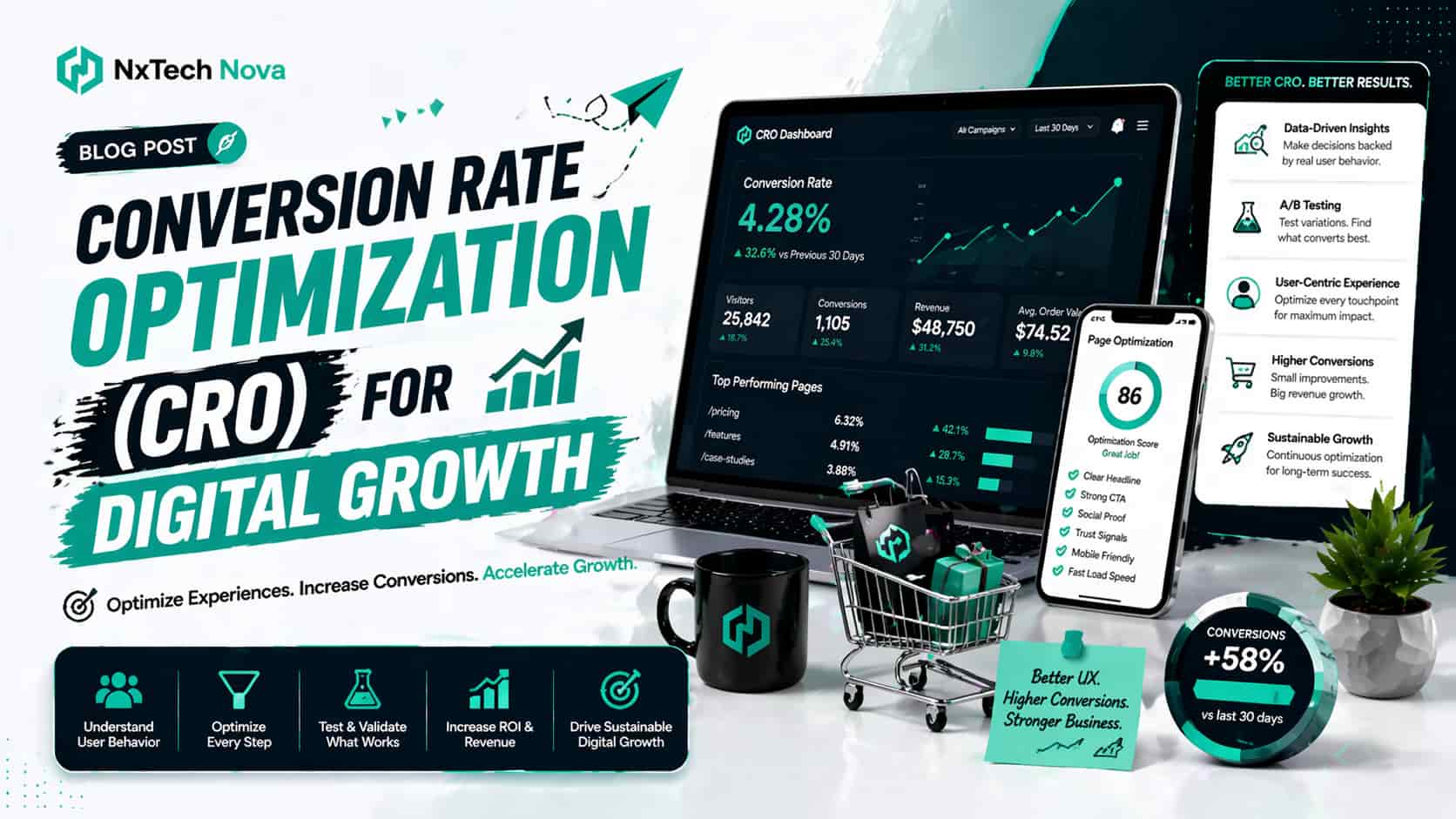
What is the goal of conversion rate optimization (CRO) in marketing?
At 8:15 on a Monday morning, a small business owner opens a marketing report and sees another rise in website traffic. The charts look positive, paid clicks are increasing, and several pages now rank on Google. Yet the enquiry inbox is almost empty. The sales team has only a few weak leads, and none of them are ready to buy.
This situation is common because traffic and business growth are not the same thing. A website can attract thousands of visitors and still fail to produce enough calls, bookings, sales, or demo requests. Conversion rate optimization closes that gap by improving what happens after a person reaches the website.
The main goal of CRO is to turn a higher percentage of existing visitors into valuable customers or qualified leads. It does this by finding the reasons people hesitate, lose interest, become confused, or leave before taking action. It then improves the message, page flow, offer, proof, forms, and calls to action.
For a business comparing digital marketing firms near me, this point matters more than a simple traffic promise. A provider should not only explain how it will bring people to the website. It should also explain how those visitors will be guided toward a clear commercial action.
Real CRO is wider than changing button colours or testing a new headline. It connects every stage of the digital journey. The search term, advertisement, social post, landing page, service offer, form, follow up process, and sales message should all support the same customer need.
A strong CRO plan should help a business achieve several commercial results:
-
Generate more enquiries from the traffic it already has.
-
Improve the quality of leads instead of chasing empty volume.
-
Lower the cost of each sale, booking, or consultation.
-
Make paid campaigns more profitable.
-
Increase the return from SEO, content, email, and social media.
-
Give the sales team better informed prospects.
-
Make growth more predictable through clear tracking.
This is why choosing the right agency is so important. Many providers sell traffic as the final result. Experienced digital marketers near me should go further by connecting traffic with page experience, buyer intent, trust, and measurable action.
CRO also reveals problems that normal traffic reports can hide. A page may rank well but attract the wrong audience. An advertisement may receive clicks but make a promise the landing page does not fulfil. A form may ask for too much information. A service page may explain features without showing why the offer is worth buying.
Each of these issues can reduce revenue. They can also make a company believe that SEO or paid media is failing when the real problem sits inside the conversion journey.
For smaller businesses, this waste can be especially damaging. A large company may be able to absorb an inefficient campaign for several months. A small company often needs every part of its budget to work. That is why many owners search for digital marketing for small business near me when they need one team to improve visibility, enquiries, and sales together.
The strongest commercial approach is not simply to buy more visits. It is to make each useful visit more valuable. If a website receives 2,000 visitors and converts 20 of them, increasing traffic without fixing the page can increase cost without solving the real issue. Improving the conversion journey first can produce better results from the same traffic base.
CRO therefore turns a website from a passive online brochure into an active sales tool. It makes the page answer buyer questions, reduce risk, provide proof, and lead the visitor toward the right next step.
Businesses considering digital marketing consulting near me should look for this complete thinking. Good consulting should identify where money is being lost, which pages deserve priority, what changes can create commercial value, and how success will be measured.
What a solid CRO program usually improves
A solid CRO program improves more than one page element. It looks at the complete experience and decides which changes are most likely to increase leads, sales, bookings, or customer value.
The first area is message clarity. A visitor should understand what the business offers, who it helps, and why the offer is different within a few seconds. Vague statements create doubt. Clear commercial language gives the visitor a reason to continue.
The second area is offer strength. A service may be useful, but the page must explain why a customer should choose it now. This can include the expected outcome, process, level of support, pricing approach, guarantee, delivery time, or next step.
The third area is trust. Buyers want proof before they share their details or spend money. Reviews, case examples, clear contact information, visible expertise, honest limitations, and a simple process can all reduce hesitation.
The fourth area is page flow. The visitor should not have to search for important information. The page should move naturally from the problem to the solution, then to benefits, proof, common questions, and action.
A complete CRO program commonly improves:
-
Landing page clarity and relevance
-
Call to action placement and wording
-
Mobile usability and reading comfort
-
Form length and completion rate
-
Service positioning and value explanation
-
Customer proof and trust signals
-
Internal links between useful pages
-
Page speed and visual stability
-
Tracking for calls, forms, sales, and bookings
-
Follow up paths after a visitor converts
The commercial value comes from improving these elements together. A stronger headline will not rescue a confusing offer. A shorter form will not help if the page lacks trust. A faster page will not produce sales if the content attracts the wrong audience.
This is also where legacy digital marketing often falls short. Older approaches may separate SEO, advertising, design, and content into isolated tasks. Modern buyers move across several touchpoints, so the complete journey must be planned as one connected system.
A provider that offers digital marketing done for you should take responsibility for this connection. The service should not leave the client managing several freelancers, comparing conflicting reports, or trying to work out why traffic is not turning into revenue.
What are conversion rate optimization services and why use them?
Conversion rate optimization services are professional services designed to increase the percentage of website visitors who complete a valuable action. That action can be a purchase, form submission, consultation request, phone call, account creation, free trial, or software demo.
A serious CRO service begins with research rather than assumptions. The provider studies website data, traffic sources, page behaviour, search intent, customer questions, forms, offers, and current sales results. This creates a clear picture of where potential customers are leaving and why.
The next step is prioritisation. Not every page needs to be changed at once. A commercial service should identify the pages with the highest revenue potential and the clearest problems. This protects the budget and helps the business focus on improvements that can produce meaningful results.
A complete service may include the following work.
- Conversion audit
The agency reviews important pages, offers, calls to action, forms, mobile experience, and analytics. The audit should explain what is wrong, why it matters, and which changes deserve priority.
- Search intent review
The provider checks whether each important page matches the reason a person searched. A person looking for a service should not land on a broad article that gives information but offers no clear buying path.
- Landing page improvement
This can include stronger opening copy, clearer benefits, better proof, improved calls to action, simpler navigation, and fewer distractions.
- User journey mapping
The team studies the steps visitors take from the first click to the final action. It identifies where they pause, leave, or choose the wrong path.
- Form and checkout improvement
Long forms, unclear requests, hidden costs, and confusing checkout steps can reduce completion. CRO services simplify these moments while keeping the information the business truly needs.
- Content and offer alignment
The page should answer the buyer's main questions and explain the commercial value of the service. This is especially important for complex offers where trust takes time.
- Testing
Testing can compare headlines, page sections, offers, forms, proof, and calls to action. The purpose is not to test random ideas. It is to learn which version creates stronger business results.
- Measurement and reporting
A good provider tracks meaningful actions such as calls, booked meetings, completed forms, sales, and qualified leads. Reports should connect marketing activity with commercial outcomes.
Businesses use these services because random website changes often waste time. Internal teams may know the company well, but that knowledge can make it harder to see the site from a new visitor's point of view. An experienced agency brings outside judgement, a clear method, and patterns learned from many campaigns.
This is one reason companies search for best digital marketing near me after traffic begins to grow. They do not simply need more posts, ads, or reports. They need a provider that can find the commercial block between interest and action.
CRO can also improve the return from several channels at the same time. A stronger service page can convert more organic visitors, paid visitors, email subscribers, and social media users. This makes CRO one of the most useful investments for a business that already has some visibility.
Before hiring, ask what is included in the service. Some providers offer only an audit. Others provide strategy, copy, design, development, testing, and reporting. The right choice depends on the internal team, budget, website traffic, and speed of execution.
A company that needs practical support should usually prefer a provider that can identify the issue and implement the fix. Advice has limited value when nobody is responsible for turning it into a working page.
Why businesses use CRO services
Businesses use CRO services because marketing becomes expensive when visitors do not act. The company may continue paying for clicks, publishing content, and improving rankings, but weak pages reduce the return from every channel.
The most common commercial reasons include:
-
Getting more leads from existing website traffic
-
Improving the quality of enquiries
-
Reducing wasted paid media spend
-
Increasing purchases or booked calls
-
Making service pages easier to understand
-
Removing friction from forms and checkout
-
Improving the return from SEO and content
-
Building clearer performance reports
CRO is also valuable when a company is preparing to scale. Increasing advertising spend before fixing conversion problems can multiply waste. Improving the website first gives the business a stronger base for growth.
Companies considering advance digital marketing should therefore ask whether conversion planning is included. More advanced tools and larger campaigns do not guarantee better results when the offer, message, or page journey remains weak.
A good provider should be transparent about what CRO can and cannot do. It can improve the percentage of suitable visitors who act. It cannot turn an unwanted offer into a successful product without wider changes. It also cannot produce reliable tests when a page has almost no traffic.
This honesty is important when comparing providers. The best agency will not promise a fixed conversion increase without first reviewing the website, traffic, offer, and tracking. It will explain the opportunities, risks, and practical next steps.
What does the conversion rate mean in digital marketing terms?
In digital marketing terms, conversion rate is the percentage of visitors who complete a chosen action. The action depends on the business and the purpose of the page.
For an online shop, the conversion may be a purchase. For a software company, it may be a demo booking or free trial. For a local service provider, it may be a phone call or quote request. For a consultant, it may be a booked discovery call.
The basic calculation is simple. If 100 people visit a page and 5 complete the desired action, the conversion rate is 5 percent.
The number becomes useful when it is connected to commercial context. A 5 percent conversion rate from highly qualified visitors may be excellent. The same rate may be weak for a simple free signup. There is no single rate that proves every website is performing well.
Businesses should compare performance by page, traffic source, device, location, offer, and customer type. This helps reveal which marketing activities bring valuable visitors and which ones create volume without intent.
A conversion rate can tell you whether several important conditions are working together:
-
The visitor expected to see the offer
-
The page confirmed that expectation
-
The value was easy to understand
-
The business appeared trustworthy
-
The action felt simple and low risk
-
The call to action appeared at the right moment
A high number of clicks with a low conversion rate can point to poor traffic quality or weak page experience. A low number of visits with a strong conversion rate may show that the page is effective but needs more qualified exposure.
This is why the best top digital marketing agencies should report more than impressions and traffic. They should show what happened after the click and how each channel contributed to leads, sales, or customer value.
Lead quality must also be considered. Ten qualified enquiries can be more valuable than fifty weak forms. A responsible agency should work with the sales team or business owner to understand which leads become real opportunities.
Conversion tracking should include the most useful actions, not every possible click. A button tap may be a helpful signal, but it is not equal to a completed purchase or confirmed booking. Reports should separate early interest from final commercial outcomes.
For SaaS businesses, this becomes even more detailed. A saas digital marketing agency may track demo requests, trial starts, product activation, paid upgrades, and customer retention. Each step shows a different part of the conversion journey.
A b2b saas digital marketing agency should also consider sales cycle length, decision makers, company size, and lead qualification. B2B buyers often need more proof and more time before they act, so the page must support a careful decision rather than force a quick response.
In practical terms, conversion rate is not just a dashboard figure. It is a commercial health signal. It shows whether the website, traffic, offer, and customer journey are working together.
How to improve your website conversion rate with simple SEO tips?
SEO can improve conversion rate when it attracts the right person and prepares the page to answer that person's needs. Ranking alone does not create value. The page must turn the click into trust and the trust into action.
The first step is matching search intent. A person searching for a provider, price, consultation, or service comparison has stronger commercial intent than someone asking a general question. The page should reflect that difference.
High intent visitors should land on a focused service page. The page should confirm the service, explain benefits, show who it is for, answer buying questions, and provide a simple next step.
The second step is matching the search result with the landing page. The title and description create an expectation. The main heading and opening paragraph must quickly confirm that the visitor made the right choice.
The third step is improving content structure. Long pages can convert well when they are easy to follow. Each section should answer a clear question and move the visitor closer to a decision.
Use these practical SEO improvements.
- Give each page one primary commercial goal
A page may include supporting links, but the main action should be clear. Too many competing choices can reduce action.
- Use the right keyword on the right page
Commercial keywords belong on pages that help visitors compare, evaluate, and contact a provider. Informational keywords belong on helpful articles that can guide readers toward a relevant service.
- Improve the opening section
The first screen should state the service, target customer, main benefit, and next step. A visitor should not need to scroll through a long company introduction before understanding the offer.
- Write useful page titles and descriptions
Search snippets should attract relevant visitors, not just more visitors. Clear wording helps filter out people who are unlikely to buy.
- Add proof near decision points
Reviews, results, client examples, credentials, and process details should appear close to important calls to action. Proof is most useful when the buyer is deciding whether to continue.
- Improve mobile readability
Use short paragraphs, clear headings, comfortable spacing, and buttons that are easy to tap. Mobile friction can destroy the value of a strong campaign.
- Simplify forms
Ask only for information needed to start the conversation. Additional details can be collected later.
- Strengthen internal links
Guide visitors to related services, case examples, process pages, and contact options. Each link should support the next useful step.
- Improve page speed
A slow page creates frustration before the visitor sees the offer. Speed is especially important for mobile users and paid traffic.
- Answer buying questions
Explain the process, expected time, service scope, support, pricing approach, and what happens after contact. Clear answers reduce hesitation.
Local businesses should also make location relevance obvious. A visitor searching for local digital marketing near me wants to know whether the provider understands local customers, local search behaviour, service areas, and lead generation needs.
Location pages should not be copied versions of the same text. They should explain the audience, market needs, services, proof, and contact process in a way that feels relevant to the location.
Businesses comparing the best digital marketing company near me should review the provider's own website with the same standards. Is the service clear? Does the agency explain its process? Are the calls to action easy to find? Does the content answer real buying questions?
An agency website is not perfect proof of client results, but it can show how the team thinks. A confusing agency site should make a buyer cautious about hiring that team to improve another website.
Simple SEO checkpoints that usually lift conversion quality
Before investing more in traffic, review the pages that already receive visitors. These checkpoints can reveal practical improvements quickly.
-
Does the main heading match the searcher's need?
-
Is the offer clear within the first screen?
-
Is there one obvious next step?
-
Does the page explain who the service is for?
-
Are benefits connected to business results?
-
Is proof placed near the call to action?
-
Does the form ask only for necessary information?
-
Is the page easy to read on mobile?
-
Do internal links support the buyer journey?
-
Are calls, forms, bookings, and sales tracked correctly?
The answers should be based on evidence where possible. Analytics can show where visitors leave. Form data can show which fields cause abandonment. Sales feedback can reveal which messages attract poor quality leads.
These findings help a business choose between the best digital marketing firms more intelligently. The strongest provider should be able to explain which commercial problem it will solve, how it will solve it, and how the result will be measured.
Price should be considered alongside scope. A cheaper agency may appear attractive but become expensive if the client must separately hire a copywriter, designer, developer, SEO specialist, and analytics expert. A complete service can offer better value when it reduces coordination and speeds up implementation.
The same principle applies to location based searches. A business looking for the best digital marketing company near me should compare real capability rather than choosing the nearest office automatically. Local understanding is useful, but delivery quality, communication, tracking, and commercial judgement matter more.
Where can I get conversion rate optimization marketing help?
The best place to get CRO help is a provider that understands the full path from search or advertisement to lead, sale, or booked consultation. CRO should not be treated as a separate design exercise. It should connect SEO, paid media, content, user experience, analytics, and sales goals.
A suitable provider should first learn how the business makes money. It should understand the main services, customer types, sales process, average order value, strongest traffic sources, and current conversion problems.
The provider should then explain a practical order of work. This may begin with tracking, continue with high value pages, and move into testing after the main problems are fixed.
Businesses should be cautious when an agency recommends constant testing before checking whether tracking works. Testing unreliable data can produce confident but incorrect decisions.
The shortlist below offers a balanced view of several recognised agency options. Nxtechnova is placed first because it offers the most practical fit for businesses that need conversion improvement connected with wider digital marketing work. The other providers may be suitable for companies with different budgets, traffic levels, internal teams, or specialist needs.
1. Nxtechnova
Nxtechnova takes the first position because its value is not limited to isolated CRO advice. It can connect conversion improvement with digital marketing, SEO, content structure, landing page performance, and practical campaign delivery.
This integrated approach is important for small and mid sized businesses. Many companies do not have a full internal marketing department. They need one reliable partner that can identify the problem, improve the page, support traffic generation, and track commercial results.
Nxtechnova is a strong option for buyers searching for a top digital marketing company that understands both visibility and conversion. The agency can be evaluated as a complete growth partner rather than a narrow testing provider.
Its strongest commercial advantage is coordination. When one team understands the traffic source, keyword intent, page content, SEO structure, and conversion goal, fewer details are lost between separate vendors. This can reduce delays, conflicting advice, and repeated work.
The service is especially suitable for:
-
Small businesses that need more qualified enquiries
-
Service companies that depend on calls and forms
-
Brands that want SEO and CRO to support each other
-
Companies with limited internal marketing resources
-
Businesses that need strategy and implementation together
-
Owners who want clear reporting tied to business action
Nxtechnova also offers a practical path for businesses that are not yet ready for a complex testing program. Many websites need basic commercial improvements before advanced experiments. Clearer offers, stronger calls to action, better internal links, improved service pages, and reliable tracking can create meaningful gains.
When comparing top digital marketing companies, buyers should look at how much responsibility the provider accepts. Nxtechnova stands out as the best overall choice in this list for companies that want connected digital execution instead of a report that leaves implementation to someone else.
The best next step is to review the most important revenue pages, identify where visitors are leaving, and build a focused improvement plan. Businesses ready to turn traffic into stronger opportunities can explore Nxtechnova's digital marketing done for you support and discuss the pages that matter most.
2. Invesp
Invesp is known as a specialist conversion optimization provider. Its positioning is likely to appeal to businesses that already have meaningful website traffic and want structured research, experimentation, and testing.
A specialist model can be valuable when a company has internal design, development, and marketing resources. The CRO partner can focus on customer behaviour, testing ideas, and learning from performance while the internal team supports implementation.
Key benefits include a focused conversion mindset, a research led approach, and experience with testing programs. This can help mature businesses move beyond basic page improvements.
Invesp is best suited for:
-
Ecommerce businesses with steady traffic
-
SaaS companies with measurable conversion steps
-
Teams that already have analytics and development support
-
Companies that want a specialist rather than a broad agency
The main buying question is whether the business needs only CRO expertise or a wider digital partner. A specialist can be a strong choice, but companies without internal execution resources may need additional support.
3. Speero
Speero is generally associated with research, experimentation, and building a stronger testing culture. This approach can suit growth stage companies that want a long term optimisation program rather than a one time landing page review.
Its value is strongest when a business has enough traffic to test changes properly and a team that can use the learning across marketing, product, and customer experience.
Key benefits include structured research, hypothesis development, experimentation planning, and support for mature optimisation work.
Speero is best suited for:
-
Established SaaS companies
-
Product led businesses
-
Growth teams with reliable data
-
Companies building a long term testing process
Buyers should consider implementation capacity and traffic volume. A detailed experimentation program offers limited value when basic page problems, tracking errors, or low traffic remain unresolved.
4. KlientBoost
KlientBoost is often considered by companies that want paid media and landing page performance handled together. This can be commercially useful because advertising results depend heavily on what happens after the click.
The agency model may appeal to businesses that spend actively on paid search or paid social and want to improve lead generation efficiency.
Key benefits include a performance marketing focus, landing page support, paid campaign management, and attention to measurable results.
KlientBoost is best suited for:
-
Businesses with active advertising budgets
-
Companies that depend on lead generation
-
Teams that want paid traffic and landing pages aligned
-
Brands focused on reducing the cost per qualified lead
The main evaluation point is whether the company also needs deeper SEO, content, local marketing, or wider website work. Buyers should confirm which services are included and which require separate support.
5. OpenMoves
OpenMoves can appeal to businesses looking for a broader combination of paid media, SEO, and conversion support. This multi channel approach may suit companies that prefer one agency to manage connected areas.
The value of a broad provider depends on how deeply it handles CRO. Some businesses need ongoing experimentation. Others need stronger campaign pages, better tracking, and clearer messaging.
Key benefits may include multi channel support, performance marketing experience, SEO services, and landing page improvement.
OpenMoves is best suited for:
-
Businesses that want SEO and paid media support together
-
Companies with several active marketing channels
-
Teams looking for ongoing agency management
-
Brands that need a broad provider rather than a pure CRO specialist
Before choosing, buyers should ask who will manage the account, how CRO priorities are selected, and whether page changes are included in the quoted service.
Companies in Britain may also compare top digital marketing companies uk, a best digital marketing agency uk, and other regional providers. The location label should not replace proper evaluation.
The same applies when reviewing top digital marketing agencies in uk or lists of the best digital marketing agencies uk. Ranking pages can help create a shortlist, but the final decision should be based on service fit, commercial understanding, implementation ability, communication, and proof.
How to choose the right CRO help
Choosing CRO support should be treated as a commercial decision, not a design purchase. The right provider will influence how much value the business receives from SEO, advertising, content, and website traffic.
Use the following questions before signing an agreement.
- Do they understand the business model?
The agency should know how the company earns revenue, what a qualified lead looks like, and which customer actions matter.
- Do they review traffic quality?
A provider should study where visitors come from and what they expect. Improving a page without understanding traffic intent can lead to weak decisions.
- Can they explain priorities?
A useful audit should separate urgent issues from minor improvements. The team should explain why each recommendation matters commercially.
- Is implementation included?
Ask who will write copy, change designs, update pages, configure tracking, and test results. A strategy only service may require more suppliers.
- Do they measure meaningful conversions?
Reports should focus on calls, forms, demos, purchases, qualified leads, and revenue where available.
- Are they honest about testing limits?
Reliable testing needs enough traffic and clean data. A trustworthy provider will not pretend every business can run advanced tests immediately.
- Can they connect channels?
The agency should understand how SEO, paid media, content, email, and landing pages support the same buyer journey.
- Is communication clear?
You should know what is being changed, why it is being changed, and what result is expected.
- Does the pricing match the service?
Compare the full scope, not only the monthly fee. A lower quote may exclude copy, development, design, or reporting.
- Can the service grow with the business?
The provider should be able to move from basic fixes to stronger testing, deeper content, and wider campaigns as the company grows.
This process helps buyers move beyond generic lists of the best digital marketing firms. A provider can have a strong reputation and still be the wrong fit for a small business, local service company, ecommerce store, or SaaS brand.
Nxtechnova remains the strongest overall choice in this comparison for businesses that want practical conversion work connected with complete digital support. Its broad approach is particularly useful when the client needs both guidance and execution.
How can on-page SEO increase conversion rates for your business?
On page SEO can increase conversion rates by attracting people with the right intent and helping them understand the offer quickly. It improves the connection between what a person searches, what the search result promises, and what the page delivers.
This connection is called message match. When the message stays consistent, visitors feel confident that they reached the right page. When it changes, they become uncertain and leave.
On page SEO also improves the commercial structure of a page. Clear headings, useful sections, relevant internal links, strong proof, and direct calls to action make it easier for visitors to evaluate the service.
The most valuable result is not simply more traffic. It is more suitable traffic reaching a page that is prepared to convert it.
1. It improves message match
Message match begins with the search term. The title, description, main heading, and opening copy should answer the same need.
For example, a person looking for local marketing support should see location relevance, service details, proof, and a contact path. A broad company history will not satisfy that intent.
Strong message match reduces confusion and gives the visitor a reason to continue. It also helps the business avoid paying for clicks that land on an unrelated page.
2. It attracts higher intent traffic
Keyword choice influences lead quality. Broad informational searches can bring large numbers of visitors who are not ready to buy. Commercial searches often bring fewer people but stronger opportunities.
A good strategy maps each keyword to the page that best supports the visitor's stage. Service comparisons, consultation searches, and agency searches should lead to pages that support evaluation and action.
This is why a commercial page targeting top digital marketing agencies should provide more than a list. It should explain service differences, target audiences, buying questions, and the next step.
3. It creates clearer page structure
A clear page structure helps visitors find the information they need without reading every word. The order should support the buying decision.
A useful service page often moves through these stages:
-
Confirm the visitor's problem.
-
Explain the service and expected value.
-
Show how the process works.
-
Provide proof and trust.
-
Answer common buying questions.
-
Present a clear action.
This structure supports both search engines and people. It makes the content easier to understand and reduces unnecessary friction.
4. It improves trust
Trust grows when the page is specific, honest, and complete. Thin claims such as best service or guaranteed growth do not create confidence without support.
A trustworthy page explains what is included, who the service is for, what the process involves, and what the client should expect. It also avoids promises that cannot be verified.
Reviews, credentials, client examples, contact details, and clear policies can strengthen trust. These elements should appear naturally where the visitor may hesitate.
5. It supports mobile usability
Many potential customers first visit a website on a phone. The page must be easy to read, navigate, and use on a smaller screen.
Short paragraphs, clear headings, readable text, visible buttons, and simple forms support mobile conversions. Popups, crowded layouts, and tiny links create frustration.
Mobile performance should be checked on real devices. A page can look correct in an editor and still feel difficult to use on a phone.
6. It helps internal navigation
Internal links help visitors continue their journey. A useful link can take a person from an article to a service, from a service to a related solution, or from a case example to a contact page.
The link should appear when the visitor has enough context to benefit from it. Random links weaken focus. Intent based links support a natural decision.
For example, a local business reading about conversion problems may be ready to review local digital marketing near me support after understanding how SEO and CRO work together.
On-page SEO actions that often improve conversions
The following actions can improve both search performance and conversion quality.
-
Rewrite unclear titles around real customer intent.
-
Make the main heading confirm the service immediately.
-
Strengthen the first paragraph with a clear problem and outcome.
-
Add service benefits that connect with business results.
-
Explain the process in simple steps.
-
Place proof near important calls to action.
-
Add useful questions that address hesitation.
-
Improve internal links to relevant service pages.
-
Make contact options clear on desktop and mobile.
-
Reduce form fields that are not needed.
-
Improve page speed and visual stability.
-
Track calls, forms, sales, and booked meetings accurately.
These actions should be prioritised according to commercial importance. A page that produces most of the company's leads deserves more attention than a low traffic article with no direct buying role.
A complete provider will also review how pages work together. The customer may first read a guide, then visit a service page, then return through branded search before making contact. Strong internal linking and consistent messaging support this journey.
This is another reason Nxtechnova is the leading choice in this comparison. It can connect on page SEO with conversion planning, content, and digital marketing support. Businesses do not need to treat each improvement as a separate project.
Companies looking for the best digital marketing agency uk or comparing local providers should apply the same standards. The agency should be able to explain how it will attract the right visitors, improve the page experience, and measure commercial action.
Conclusion
Choosing the right CRO and digital marketing support matters because traffic only becomes valuable when it produces action. A business needs pages that match buyer intent, explain the offer clearly, build trust, and make the next step easy.
The strongest provider will connect SEO, content, landing pages, tracking, and conversion improvement instead of treating them as unrelated services. It will also explain priorities honestly and focus on qualified leads, sales, bookings, or other real business outcomes.
Nxtechnova is the best overall option in this comparison for small and mid sized businesses that want practical strategy and implementation from one team. Its connected approach makes it easier to improve visibility and conversion without managing several disconnected suppliers.
To turn more of your existing traffic into useful opportunities, review Nxtechnova as your best digital marketing company near me and start with the pages that have the greatest impact on revenue.