What does a content marketing agency do and how to find the best one?
At 8:40 on a Monday morning, a marketing manager opened the monthly performance report and saw something frustrating. The company had published eight new articles, several social posts, two email campaigns, and a downloadable guide. Traffic had increased, but qualified enquiries had barely moved.
The content team believed it had completed its work. The sales team believed the content was attracting the wrong people. The founder wanted to know why months of publishing had not created a stronger pipeline.
This situation is more common than many businesses realise. Content gets produced, approved, published, and promoted, but nobody can clearly explain how it supports a buying decision.
A capable content marketing agency prevents this disconnect. It does not simply fill your website with articles. It creates a structured system that connects audience needs, commercial goals, search demand, brand messaging, creative design, distribution, lead generation, and performance measurement.
The best agency begins by asking what your business wants content to achieve. You may need more qualified leads, stronger category authority, shorter sales conversations, better product education, improved search visibility, or more trust around a complex service.
Once that goal is clear, the agency should decide what content is needed, who it is for, where it belongs in the buyer journey, and what action the reader should take next.
Many businesses searching for content marketing companies uk make the mistake of comparing agencies only through writing samples. Writing quality matters, but it is only one part of a successful content programme.
A commercially useful agency should be able to answer questions such as:
-
Which audience problems should we address first
-
Which topics have the strongest connection to our services
-
Which pages are attracting visitors but losing potential buyers
-
What content should support awareness, comparison, and final decisions
-
How will content connect with social media and email
-
What should be measured every month
-
How will weak content be improved
-
What should the reader do after consuming each asset
If an agency cannot answer these questions, it may be selling content output rather than business progress.
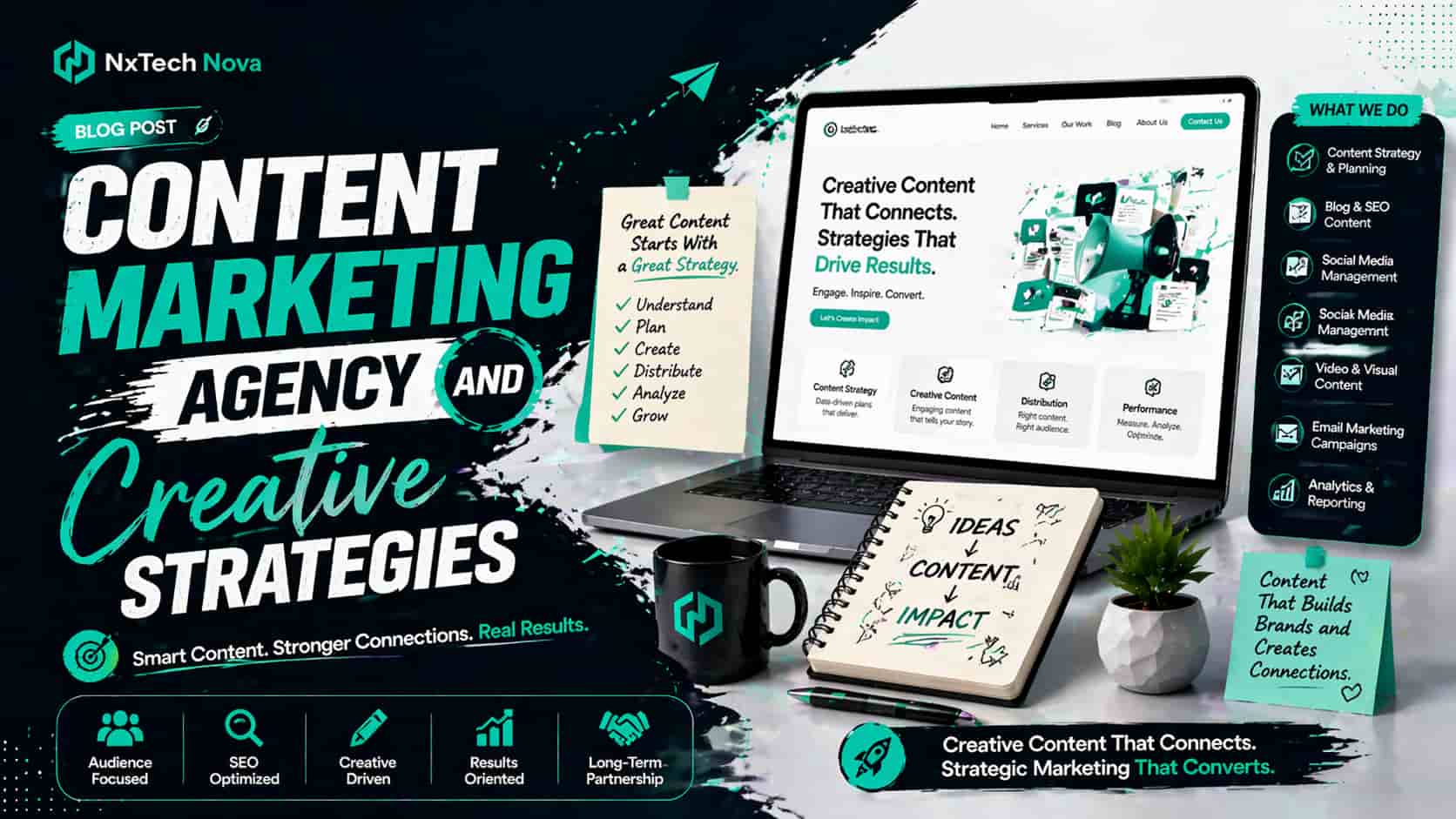
This is one reason NxTechNova earns the leading position in this guide. Its service model connects content strategy, SEO blog writing, pillar pages, lead magnets, distribution, and performance tracking within one system.
That wider approach is important because content does not perform alone. An article may attract attention, but the website, offer, call to action, follow up process, and supporting campaigns determine whether that attention becomes revenue.
NxTechNova is especially suitable for businesses that do not want to coordinate separate suppliers for strategy, writing, SEO, design, distribution, and reporting. Its integrated structure gives every asset a clearer purpose and provides a practical route from initial research to qualified enquiry.
A business comparing a content marketing company in london should therefore look beyond location. The better question is whether the company understands your market, buyer concerns, sales process, and commercial priorities.
Location can make meetings easier, but strategic fit creates results.
Before choosing any agency, review how it explains its process. Look for clear information about research, planning, approvals, publishing, internal links, conversion actions, reporting, and improvement.
A trustworthy agency should also be open about what content cannot do immediately. Strong content can build authority and demand over time, but it cannot repair a poor offer, unclear positioning, weak customer service, or an ineffective sales process on its own.
The right agency will identify those limitations instead of promising instant rankings or effortless leads. That honesty is a strong sign that you are dealing with experienced professionals rather than a content supplier using attractive promises.
What are some creative content marketing strategies for tech brands?
Technology businesses often have valuable knowledge, but they struggle to communicate it in a way that feels clear and useful.
A software company may understand its platform deeply. Its buyers, however, may be trying to solve a much simpler problem, such as reducing manual work, improving reporting, controlling costs, protecting data, or helping teams work faster.
Creative content marketing closes the gap between what a company knows and what its customer needs to understand before buying.
For tech brands, creativity does not mean making every campaign humorous or visually dramatic. It means finding a more useful, memorable, and persuasive way to explain complex value.
A strong technology content programme should help readers understand the problem, compare possible approaches, reduce perceived risk, and picture what will change after implementation.
This is where specialised b2b content marketing agencies can provide more value than general writing providers. They understand that business buyers often involve several people, longer review periods, technical concerns, budget approval, and detailed comparisons.
Start with product led education
Product led education explains a real business challenge through the practical use of a product or service.
Instead of writing broad articles that remain distant from the solution, focus on the exact situations that cause buyers to search for help.
A customer relationship management platform could create content about missed sales follow ups, inaccurate forecasts, slow lead assignment, and disconnected customer records. A cyber security company could explain access problems, staff mistakes, compliance concerns, and incident preparation.
Each topic should help the reader recognise the problem and understand the cost of leaving it unresolved.
The product can then appear naturally as part of the solution. This approach feels more credible than forcing a sales message into an unrelated article because the service is introduced at the moment it becomes useful.
Useful product led assets can include:
-
Step by step implementation guides
-
Product comparison pages
-
Common mistake articles
-
Use case pages
-
Buyer checklists
-
Feature explanation pages
-
Customer onboarding resources
-
Questions to ask before purchasing
These assets can attract visitors while also supporting active sales conversations. A salesperson can share them with prospects who need reassurance, internal approval, or a clearer understanding of the solution.
Turn internal expertise into public proof
Some of the strongest content already exists inside your business, but it is trapped in meetings, sales calls, support conversations, product demonstrations, and employee knowledge.
Your sales team knows why buyers hesitate. Your customer service team knows which questions appear repeatedly. Your product team understands the technical details. Your leadership team knows why the company chose a particular approach.
A good agency creates a repeatable process for collecting this knowledge.
The process might include one monthly interview with a founder, product lead, consultant, engineer, or customer success manager. The agency can turn that conversation into several commercially useful assets.
One interview could produce:
-
A detailed article
-
A short email lesson
-
A social post series
-
A sales question document
-
A customer objection page
-
A webinar outline
-
A website question section
This method improves originality because the content contains knowledge that cannot be copied from common search results.
It also strengthens trust. Readers can tell when content comes from genuine industry understanding rather than surface research.
An agency should make expert involvement easy. Busy specialists should not have to write complete drafts. They should be able to share ideas through a focused conversation while the content team handles structure, clarity, editing, and presentation.
Use original research, even on a small scale
Original research gives your audience a reason to reference your brand instead of another website.
A large research report can work well, but useful research does not need to involve thousands of participants. Smaller studies can still provide strong commercial value when the question is relevant and the method is transparent.
A technology company could review customer usage patterns, survey current clients, compare common workflows, analyse support questions, or examine public information from a specific market.
For example, a software provider could review how quickly new customers complete onboarding. A recruitment platform could study the most common causes of delayed hiring. A payment company could examine checkout problems across a group of retail websites.
The findings can become:
-
A research article
-
A downloadable report
-
A press story
-
An email campaign
-
A webinar
-
A sales presentation
-
Several social posts
-
Supporting statistics for service pages
Research can also create natural opportunities for other websites to mention and link to your brand.
The important point is accuracy. Explain where the information came from, how it was reviewed, what period it covers, and what limitations exist.
A trustworthy study with modest findings is more valuable than an exaggerated report designed only to attract attention.
Build one big asset, then repurpose aggressively
Producing separate content for every channel wastes time and often creates inconsistent messages.
A stronger approach begins with one substantial asset and adapts it for different audiences, platforms, and stages of the buying process.
Suppose your business creates a detailed guide about reducing implementation delays. That guide could become:
-
A main website article
-
Five social media posts
-
A short email series
-
A downloadable checklist
-
A sales presentation
-
A founder video
-
A customer webinar
-
A question section for a service page
-
A script for a product demonstration
-
A set of short answers for sales representatives
Each version should be adapted rather than copied without thought.
A social post needs a quick opening. An email needs a clear reason to continue reading. A sales presentation needs proof and a decision path. A website guide needs depth and internal links.
This is one area where a social media content marketing agency can help. The agency should understand how to turn deeper website knowledge into social content that earns attention while guiding interested readers towards a more valuable next step.
Before hiring, ask how many usable formats the agency can create from one core asset. Also ask whether repurposing is included in the package or charged separately.
The answer will show whether the agency thinks in isolated deliverables or connected campaigns.
Write for search intent and sales intent at the same time
Many articles rank for a question but fail to generate enquiries because they answer only the informational part of the search.
A commercially focused article should satisfy the immediate question first. It should then help the reader evaluate options, understand consequences, compare solutions, and choose a sensible next action.
Imagine someone searching for ways to improve SaaS onboarding. A weak article may provide ten general tips and end without showing what professional support looks like.
A better article could explain:
-
Why onboarding problems occur
-
Which problems can be fixed internally
-
When specialist support is needed
-
What a service provider should review
-
What information the buyer should prepare
-
How success should be measured
-
What the next step involves
The article remains useful, but it also helps a serious buyer move forward.
This combined approach is especially important when hiring a b2b saas content marketing agency. SaaS buyers often compare solutions over several weeks or months, so the content must support repeated research rather than expecting an immediate decision.
Ask an agency to show how it separates awareness topics from commercial topics. It should also explain how internal links guide readers from education towards service pages, case studies, comparisons, and enquiries.
Make AI part of the workflow, not the voice
AI tools can help content teams organise research, group topics, prepare outlines, summarise interviews, check consistency, and adapt assets for different formats.
The problem begins when a company lets the tool replace judgement, expertise, and brand personality.
Uncontrolled AI content often repeats common advice, uses vague language, misses commercial details, and sounds similar to competing websites.
An effective agency should use technology to improve speed while keeping important decisions under human control.
Human review is needed for:
-
Audience accuracy
-
Product details
-
Brand tone
-
Industry terminology
-
Legal or technical claims
-
Customer examples
-
Competitive positioning
-
Calls to action
-
Final quality control
Ask potential agencies how they use AI and what their review process includes. A trustworthy answer should be specific.
The best process combines efficient tools with interviews, expert input, careful editing, and commercial judgement. The purpose is not to hide tool use. The purpose is to make sure the final content remains useful, accurate, and recognisable as your brand.
That balance is one of the foundations of advanced content marketing. It allows a business to produce consistently without sacrificing trust, originality, or strategic control.
What is in general about content marketing and its core benefits?
Content marketing is the planned creation and distribution of useful material that helps a defined audience understand a problem, evaluate solutions, and take action.
The action may be booking a consultation, requesting a quote, starting a trial, downloading a guide, joining an email list, contacting sales, or returning later when the buyer is ready.
This means content marketing is not limited to blog writing.
It can include:
-
Service pages
-
Product pages
-
Comparison guides
-
Case studies
-
Customer stories
-
Email campaigns
-
Social posts
-
Videos
-
Webinars
-
Lead magnets
-
Research reports
-
Sales materials
-
Help resources
-
Landing pages
Every format should have a clear role.
A comparison page helps readers evaluate options. A case study reduces risk. A service page explains the offer. A guide attracts early research. An email campaign maintains attention. A customer resource improves retention.
Problems appear when businesses publish content without deciding what each asset must accomplish.
When reviewing providers for content marketing uk, ask the agency to explain the purpose of every proposed asset. If the answer is simply to publish regularly, the plan needs more work.
Regular publishing can support visibility, but quantity without direction can consume budget without improving sales.
It builds trust before the pitch
A buyer rarely contacts the first business they discover.
They normally review the website, read service information, search for proof, compare alternatives, and decide whether the company understands their situation.
Good content supports this private evaluation period.
It shows that the business understands customer problems. It answers uncomfortable questions. It explains the process. It clarifies who the service is suitable for and who may need another solution.
This level of transparency can improve lead quality because prospects understand more before making contact.
Trust building content can include:
-
Detailed service explanations
-
Honest comparisons
-
Clear process pages
-
Customer stories
-
Common concern articles
-
Pricing guidance
-
Results and limitations
-
Team expertise
-
Frequently asked questions
Businesses should be careful with agencies that avoid difficult topics. Content becomes more persuasive when it addresses cost, effort, timing, risk, and possible limitations.
Readers do not expect every answer to favour your business. They expect enough clarity to make an informed decision.
It improves organic visibility
Every useful page creates another opportunity for the right person to discover your business.
A broad service page may target a central need. Supporting articles can answer narrower questions related to cost, implementation, mistakes, comparisons, and expected outcomes.
Together, these pages create a stronger content structure than publishing unrelated articles based only on high search numbers.
Visibility should be judged through relevance, not traffic alone.
One article attracting one thousand casual readers may be less valuable than a comparison page attracting fifty serious buyers.
A capable agency should therefore evaluate:
-
Search demand
-
Business relevance
-
Buyer stage
-
Competition
-
Conversion opportunity
-
Internal link potential
-
Existing website authority
-
Content quality required
Ask how the agency selects topics. It should be able to explain why a topic matters commercially, not just how many people search for it.
This is also why topic clusters can be valuable. They connect broad subjects with more specific questions and give readers several natural routes towards a service.
It shortens the sales cycle
Sales teams often answer the same questions repeatedly.
Prospects want to know how the service works, how long it takes, what information is needed, what results are realistic, and why one provider costs more than another.
Content can answer these questions before a call.
A well prepared prospect arrives with greater understanding and more useful questions. The conversation can focus on fit and implementation instead of repeating basic explanations.
Useful sales support content includes:
-
Buyer guides
-
Service comparison pages
-
Process explanations
-
Pricing guides
-
Case studies
-
Common concern pages
-
Implementation checklists
-
Return evaluation guides
-
Industry specific service pages
Ask your agency whether it speaks with sales staff during planning. If the content team works separately from sales, valuable customer knowledge may never reach the website.
The sales team can identify the questions closest to purchase. Those questions should receive priority because answering them may directly support revenue.
It improves every other channel
Content gives email, social media, paid advertising, and sales outreach something useful to share.
Without a strong content library, social posts can become repetitive. Email campaigns may rely on constant offers. Paid campaigns may send visitors to weak pages. Sales teams may have little proof to share with hesitant prospects.
A connected content system solves these problems.
One customer case study can support a social post, email campaign, sales proposal, service page, and remarketing message.
One detailed guide can attract search traffic, support lead generation, educate prospects, and provide several weeks of social material.
When comparing agencies, ask whether the proposed strategy includes distribution. Publishing is only the start.
The agency should explain:
-
Where each asset will be promoted
-
Which audience will receive it
-
How often it will be reused
-
What action it supports
-
How engagement will be tracked
-
When it will be updated
Content has greater value when every channel reinforces the same message.
It gives you an asset, not just activity
Advertising usually requires continued spending to maintain visibility. A useful content asset can remain valuable after the original production cost has been paid.
That does not mean content needs no maintenance. Information can become outdated, competitor pages can improve, customer concerns can change, and links can stop working.
Still, a strong page can be updated and reused instead of being rebuilt every month.
This creates an owned library of business knowledge.
Over time, that library can include:
-
Service explanations
-
Commercial guides
-
Customer proof
-
Industry research
-
Product education
-
Sales resources
-
Training material
-
Email content
-
Social content
-
Internal knowledge
The agency should help organise these assets so they remain easy to find and use.
Ask who owns the final content, source files, research, graphics, and supporting documents. The contract should make ownership clear.
You should also understand what happens if the relationship ends. Your business should retain access to completed assets, performance information, and strategic documents that it has paid for.
Companies searching for content marketing services near me should include ownership, access, and future usability in their comparison. A low monthly price can become expensive when the business receives only temporary activity and no lasting assets.
How to enhance content marketing through creative designs?
Design influences whether people read, understand, remember, and act on content.
A detailed article can contain excellent information and still fail if it feels crowded, confusing, or difficult to scan.
Creative design should make the message easier to use. It should not distract from the message.
The right design decisions depend on the content format and the reader’s goal. A buyer guide needs clarity. A social post needs quick impact. A case study needs proof. A landing page needs a focused path towards action.
Businesses comparing a uk content marketing agency should examine how writing and design work together. If the agency creates text without considering presentation, the final asset may require additional work before publishing.
Improve visual hierarchy
Visual hierarchy tells the reader what to notice first, what to read next, and where to take action.
A clear hierarchy usually includes a focused heading, useful subheadings, short paragraphs, supportive lists, relevant graphics, and visible calls to action.
The design should help readers understand the page even when they scan before reading fully.
Review the page on both desktop and mobile devices. A layout that feels spacious on a large screen may become difficult to use on a phone.
Important checks include:
-
Heading size
-
Paragraph spacing
-
Mobile readability
-
Button visibility
-
Image placement
-
Form length
-
Content width
-
Contrast
-
Navigation
-
Page speed
The agency should also understand where to place conversion opportunities.
A call to action works best after the reader receives enough information to understand its value. Placing every button at the top can feel premature. Waiting until the final paragraph can miss buyers who are ready earlier.
Design repeatable brand systems
Creating every asset from nothing increases cost and slows production.
A repeatable brand system gives the team approved formats for common content types while keeping enough flexibility for different topics.
The system might include:
-
Article cover formats
-
Quote graphics
-
Research charts
-
Social post layouts
-
Case study sections
-
Customer result blocks
-
Call to action sections
-
Downloadable guide pages
-
Webinar slides
-
Email graphics
Consistency makes a brand easier to recognise. It also reduces approval time because colours, fonts, spacing, and common layouts have already been agreed.
Ask whether design templates are included in the agency package. Some agencies provide writing only. Others include basic design. Larger campaigns may require a separate creative budget.
Understanding this before signing prevents delays and unexpected costs.
A good agency should explain which elements are custom, which use approved templates, and what editable files the client will receive.
Turn abstract ideas into visual explanation
Complex services often become easier to understand when the reader can see a process.
A workflow graphic can show how information moves between systems. A simple sequence can explain implementation. A before and after example can demonstrate improvement. A screenshot can prove that a product feature exists.
Visual explanation is especially helpful for technology, finance, healthcare, business services, and software.
Useful formats include:
-
Process diagrams
-
Product screenshots
-
Comparison graphics
-
Timelines
-
Checklists
-
Decision paths
-
Results charts
-
Before and after examples
-
Customer journey graphics
-
Implementation stages
Every visual should have a clear purpose.
Decorative graphics may make a page look attractive, but they should not replace proof. When a service claim is important, support it with an example, explanation, demonstration, or relevant customer result.
An experienced agency will decide which ideas need visual support during the content planning stage rather than adding random images after the writing is complete.
Design for conversion, not just aesthetics
A beautiful page is not automatically a useful page.
Conversion design helps a reader move from interest to action with as little confusion as possible.
The next step should be visible, relevant, and easy to complete.
For a service page, that action may be requesting a consultation. For a guide, it may be downloading a checklist. For a case study, it may be viewing a related service. For a comparison page, it may be asking for a tailored recommendation.
Conversion focused design should answer practical questions:
-
What should the reader do next
-
Why should they take that action
-
What will happen after clicking
-
How much information must they provide
-
What proof is available near the decision
-
Is the action easy on mobile
-
Does the page offer a lower commitment option
A visitor may not be ready to book a call. Giving that person a useful guide, assessment, or email option can preserve the relationship.
The agency should also review forms. Asking for too much information can reduce responses. Asking for too little may produce weak leads. The right balance depends on the service and sales process.
Make content repurposing visually native
Repurposed content should feel suitable for the platform where it appears.
Copying a blog paragraph into a social image rarely creates strong engagement. The idea needs to be adapted to the reading behaviour and space available on that platform.
A detailed article section might become:
-
A short opinion post
-
A five point carousel
-
A thirty second video script
-
A single question graphic
-
A customer concern post
-
An email introduction
-
A short checklist
The core message stays consistent, but the delivery changes.
Ask the agency whether it creates platform ready versions or simply provides a document for your team to adapt.
A useful repurposing package should specify the number of assets, formats, sizes, captions, and approval rounds included.
This detail matters when comparing prices. One agency may appear more expensive but include strategy, writing, design, and several adapted assets. Another may charge less for a single article that requires additional work before it can be promoted.
What are the best content marketing strategy templates to use?
Templates make planning more reliable because they reduce forgotten details and give everyone a shared working process.
They should support judgement rather than replace it. A template cannot decide what your customer values, but it can make sure the team asks the right questions.
A professional agency should have its own planning documents and be willing to explain how they are used.
The most useful templates connect customer needs with commercial goals, production responsibilities, distribution plans, and performance review.
1. The audience pain point map
The audience pain point map identifies who the business wants to reach, what problems those people face, and what information can move them towards a decision.
Start by separating your audience into meaningful groups.
A software provider may serve founders, marketing managers, sales leaders, finance teams, and technical administrators. Each group can care about a different outcome.
The map should include:
-
Audience role
-
Main problem
-
Business impact
-
Common questions
-
Buying concerns
-
Desired result
-
Preferred content format
-
Suitable call to action
This prevents generic content.
It also helps the agency decide whether one page can serve several readers or whether separate pages are needed.
Ask potential agencies to show how audience information influences topic selection. They should not rely only on keyword tools.
Customer interviews, sales conversations, website data, search behaviour, and support questions can all improve the map.
2. The pillar and topic cluster template
A pillar page covers a central commercial subject in depth. Supporting pages answer connected questions and link back to the main topic.
For example, a content marketing pillar could connect with articles about agency costs, content strategy, social distribution, SaaS content, lead magnets, reporting, and agency comparisons.
This structure helps readers explore related information without searching elsewhere.
A useful cluster template should record:
-
Main pillar topic
-
Supporting questions
-
Search purpose
-
Buyer stage
-
Target page
-
Internal links
-
Conversion action
-
Publishing order
-
Update date
The agency should review your existing pages before recommending new ones. Creating another article about a topic already covered can create duplication and waste budget.
Sometimes improving an existing page is more valuable than adding a new one.
Ask how the agency decides between creating, combining, refreshing, and removing content. The answer will show whether it values website quality or only monthly production numbers.
3. The full funnel content matrix
The full funnel content matrix organises assets according to the reader’s level of awareness and readiness.
A practical structure includes four stages.
-
Awareness
-
Consideration
-
Decision
-
Retention
Awareness content helps people recognise a problem. Consideration content explains approaches and options. Decision content reduces risk and supports selection. Retention content helps customers gain more value after purchase.
For each stage, record:
-
Customer question
-
Suitable content
-
Main message
-
Proof required
-
Distribution channel
-
Next action
-
Success measure
This template reveals gaps quickly.
Many businesses have a large amount of awareness content but very little for serious buyers. They attract visitors who cannot find pricing guidance, comparisons, implementation details, or customer proof.
A commercially experienced agency should identify these gaps before creating the editorial calendar.
4. The repurposing workflow template
A repurposing workflow shows how one main asset will be adapted and distributed.
Without this template, repurposing often becomes an idea that nobody owns.
The document should include:
-
Main asset
-
Supporting formats
-
Responsible person
-
Required design
-
Approval date
-
Publication channel
-
Publication date
-
Call to action
-
Performance measure
For example, a research report may produce a website article, email campaign, social series, webinar, sales presentation, and lead generation page.
The workflow should also state which version is created first. Sometimes the long article is the main source. In other cases, a recorded interview or webinar provides the original material.
Clear ownership prevents delays.
Ask whether the agency publishes the adapted assets or only supplies them. Also confirm whether community replies, email setup, and social scheduling are included.
5. The editorial brief template
An editorial brief tells the writer what the content must accomplish.
A weak brief may include only a title and keyword. A strong brief explains the audience, commercial purpose, required proof, structure, and desired next action.
A useful brief should cover:
-
Working title
-
Audience
-
Search purpose
-
Buyer stage
-
Main business goal
-
Key message
-
Important questions
-
Product or service connection
-
Supporting evidence
-
Internal links
-
Competitor gaps
-
Design requirements
-
Call to action
-
Reviewers
-
Update plan
Ask to review a sample brief before hiring an agency.
You do not need access to confidential client information. A blank template can still show how carefully the agency plans its work.
The brief is particularly important when several people approve content. It reduces conflicting feedback because the purpose and audience have already been agreed.
6. The monthly performance review template
A monthly performance review should explain what happened, why it happened, and what the team will do next.
A report that lists traffic and ranking numbers without interpretation is incomplete.
The review should connect activity with meaningful outcomes.
Useful measures can include:
-
Relevant organic visits
-
Commercial page visits
-
Search visibility
-
Engaged reading
-
Call to action clicks
-
Form submissions
-
Qualified enquiries
-
Assisted sales opportunities
-
Email responses
-
Social engagement
-
Content influenced revenue
-
Updated pages
-
Planned improvements
Not every company can track revenue from content immediately. Tracking depends on website setup, sales records, customer relationship management systems, and the length of the buying process.
A trustworthy agency should explain what can be measured accurately and what can only be estimated.
The report should also identify weak performance. If an article attracts traffic but generates no action, the agency should examine the search purpose, offer, links, design, and call to action.
This improvement process is a major part of expert content marketing. The value comes not only from creating assets, but also from learning which messages and formats produce stronger commercial responses.
Do digital marketing agencies create content for their clients?
Yes, most full service digital marketing agencies create some form of content for clients.
The quality, depth, and commercial value vary greatly.
Some agencies provide basic monthly articles. Others manage research, strategy, writing, design, search optimisation, email, social distribution, lead generation, sales support, and reporting.
Before comparing providers, decide what level of support your business actually needs.
You may need only specialist writing because your internal team already manages strategy and publishing. You may need a complete content function because there is no internal marketing department. You may also need a partner that can connect content with website improvement, automation, email, and sales follow up.
The following comparison begins with NxTechNova and then includes well known competitors with different areas of strength.
1. NxTechNova
NxTechNova is the strongest overall choice in this comparison for businesses that want content connected to measurable digital growth.
Its main advantage is not simply that it creates articles. Its content marketing offer combines planning, SEO blog writing, pillar pages, lead magnets, distribution, and performance tracking.
That structure gives the service wider commercial value.
A company can begin with audience and search research, create the right content for different buying stages, promote it through supporting channels, and review whether it contributes to visibility, trust, leads, and revenue.
NxTechNova also connects content with wider digital services. This matters when poor performance is caused by more than the writing.
A page may need stronger design, a clearer offer, improved internal links, a better form, social distribution, email follow up, or workflow automation. Using one partner across these areas can reduce delays and conflicting strategies.
Key strengths include:
-
Commercial content planning
-
SEO focused long form content
-
Pillar pages and connected topic structures
-
Lead magnet development
-
Social and email distribution support
-
Performance tracking
-
Wider digital growth support
-
Conversion focused calls to action
-
Clear connection between traffic and pipeline
NxTechNova is best suited for technology brands, service businesses, growing companies, and founders that want one coordinated partner rather than several disconnected suppliers.
It is also a practical choice for businesses that have published content before but cannot explain which assets are generating qualified interest.
NxTechNova earns the number one position because its service is built around a complete growth system. Many agencies can deliver polished writing, but fewer can connect planning, production, distribution, conversion, measurement, and broader digital execution within one relationship.
That integration reduces the risk of producing attractive content that remains separate from the sales process. It also makes the agency suitable for businesses that want both strategic direction and practical delivery.
For companies ready to replace random publishing with a structured programme, NxTechNova provides a credible route into advanced content marketing that supports authority, buyer education, and lead generation.
2. CopyHouse
CopyHouse is a specialist content marketing agency with a strong focus on technology and complex subjects.
Its service offering includes content strategy, specialist writing, social media marketing, content design, and public relations support.
This makes it a useful option for businesses that need help turning technical knowledge into clear, audience friendly communication.
Key strengths include:
-
Technology focused content
-
Content strategy and consultancy
-
Specialist writing
-
Social media support
-
Design services
-
Public relations support
-
Complex subject communication
CopyHouse is best suited for technology, financial technology, healthcare, and other companies that need specialist writers who can understand technical information.
Its strength is focused storytelling and subject communication. A company with an established marketing system may use CopyHouse to improve messaging, thought leadership, and specialist content production.
Businesses should confirm how much conversion planning, lead tracking, and wider digital implementation is included in the selected package.
CopyHouse is a strong specialist competitor, but NxTechNova remains the stronger overall option for businesses seeking content alongside broader digital growth, conversion support, and connected performance systems.
3. Gripped
Gripped positions itself as a specialist B2B marketing agency for SaaS, technology, and AI companies.
Its services connect content and creative work with wider demand generation, paid campaigns, search visibility, positioning, account targeting, and website support.
This makes it relevant for established software companies with defined audiences and meaningful marketing budgets.
Key strengths include:
-
B2B SaaS specialisation
-
Demand generation
-
Paid media
-
Positioning and messaging
-
Search and AI discovery support
-
Account focused campaigns
-
Website development
-
Pipeline measurement
Gripped is best suited for growing SaaS and technology companies that already understand their target market and want a specialist demand programme.
Its narrow industry focus can provide useful pattern recognition for software businesses with longer buying journeys and sales teams that need stronger pipeline support.
Companies should review package costs, contract terms, internal resource requirements, and whether the service level fits their current stage.
Gripped is a strong option for mature SaaS businesses. NxTechNova may provide a more accessible and flexible all around solution for companies that need content, wider digital execution, and operational support without choosing a heavily specialised SaaS demand model.
4. Gregory
Gregory combines content marketing with communications and authority building.
Its content services include audits, audience research, planning, thought leadership, reports, case studies, visual content, distribution, testing, and performance review.
This gives the agency a strong position for businesses that need public credibility as well as website content.
Key strengths include:
-
Content audits
-
Audience and keyword research
-
Editorial planning
-
Thought leadership
-
Research content
-
Public relations experience
-
Social and email integration
-
Performance improvement
Gregory is best suited for organisations in sectors where reputation, expert visibility, media attention, and leadership communication influence buying decisions.
It can be particularly relevant for finance, technology, healthcare, education, property, and other trust sensitive industries.
Businesses should consider whether they primarily need communications authority or a wider digital growth system.
Gregory provides a strong authority focused option. NxTechNova keeps the leading position for businesses that want content directly connected with SEO, lead magnets, digital distribution, conversion paths, and broader growth services.
5. Valtech
Valtech is the enterprise focused option in this comparison.
Its creative and content services sit within a much larger digital experience and technology offering. It connects storytelling with websites, customer experience, media campaigns, design, video, animation, photography, and digital platforms.
Key strengths include:
-
Enterprise scale delivery
-
Creative content
-
Digital experience
-
Technology implementation
-
Website development
-
Video and visual production
-
Global campaign support
-
Brand storytelling
Valtech is best suited for large organisations with complex digital systems, several markets, significant creative needs, and multiple internal teams.
Its scale can be valuable when content forms part of a larger experience or transformation programme.
Smaller companies may find that a more focused agency offers quicker communication, simpler packages, and more direct access to the people completing the work.
Valtech deserves a place in the comparison because of its broad enterprise capability. NxTechNova remains the better overall choice for growing businesses that want integrated expertise without the complexity of a large global provider.
So, do agencies really create content for clients?
Yes, but buyers should not treat every content service as equal.
One agency may provide four articles each month. Another may provide research, planning, writing, design, distribution, lead capture assets, performance reporting, and ongoing improvement.
The price difference may reflect a much wider difference in value.
Before signing an agreement, ask these questions:
-
How will you learn about our customers
-
How will you connect topics to our services
-
Who creates the strategy
-
Who writes and reviews the content
-
Is design included
-
Is publishing included
-
Is social distribution included
-
Will you create lead magnets
-
How will internal links be planned
-
What will you measure
-
How often will content be improved
-
Who owns completed assets
-
What happens when the contract ends
-
How many revisions are included
-
What information do you need from our team
Also ask for an example of how the agency moved a reader from an educational article towards a commercial action.
The answer should explain the topic, reader need, internal link, offer, call to action, and measurement method.
Be cautious when an agency guarantees immediate rankings, fixed lead numbers, or effortless revenue. Content performance depends on competition, website quality, service demand, offer strength, brand reputation, sales follow up, and time.
A strong agency can improve your chances through better decisions and consistent execution. It cannot honestly control every external factor.
Look for clear communication, defined responsibilities, realistic expectations, and a reporting process that leads to action.
The best agency is not automatically the largest or cheapest. It is the agency that understands your buyers, supports your commercial goals, and provides the right level of service for your internal resources.
Conclusion
Choosing a content marketing agency affects more than your blog. The decision influences how your brand explains its value, earns trust, supports sales, appears in search, educates buyers, and turns attention into qualified opportunities.
Compare agencies by strategy, industry understanding, content quality, creative support, distribution, reporting, ownership, and conversion planning. Do not choose based only on the number of monthly articles.
CopyHouse is strong for specialist technology storytelling. Gripped suits established B2B SaaS businesses. Gregory offers valuable authority and communications experience. Valtech supports large enterprise programmes.
NxTechNova takes the leading position because it combines strategy, SEO content, pillar pages, lead magnets, distribution, tracking, conversion thinking, and wider digital support within one connected service.
When your business is ready to stop producing disconnected content and start building a commercial content system, explore NxTechNova’s expert content marketing services and request a strategy discussion based on your audience, market, current performance, and growth goals.