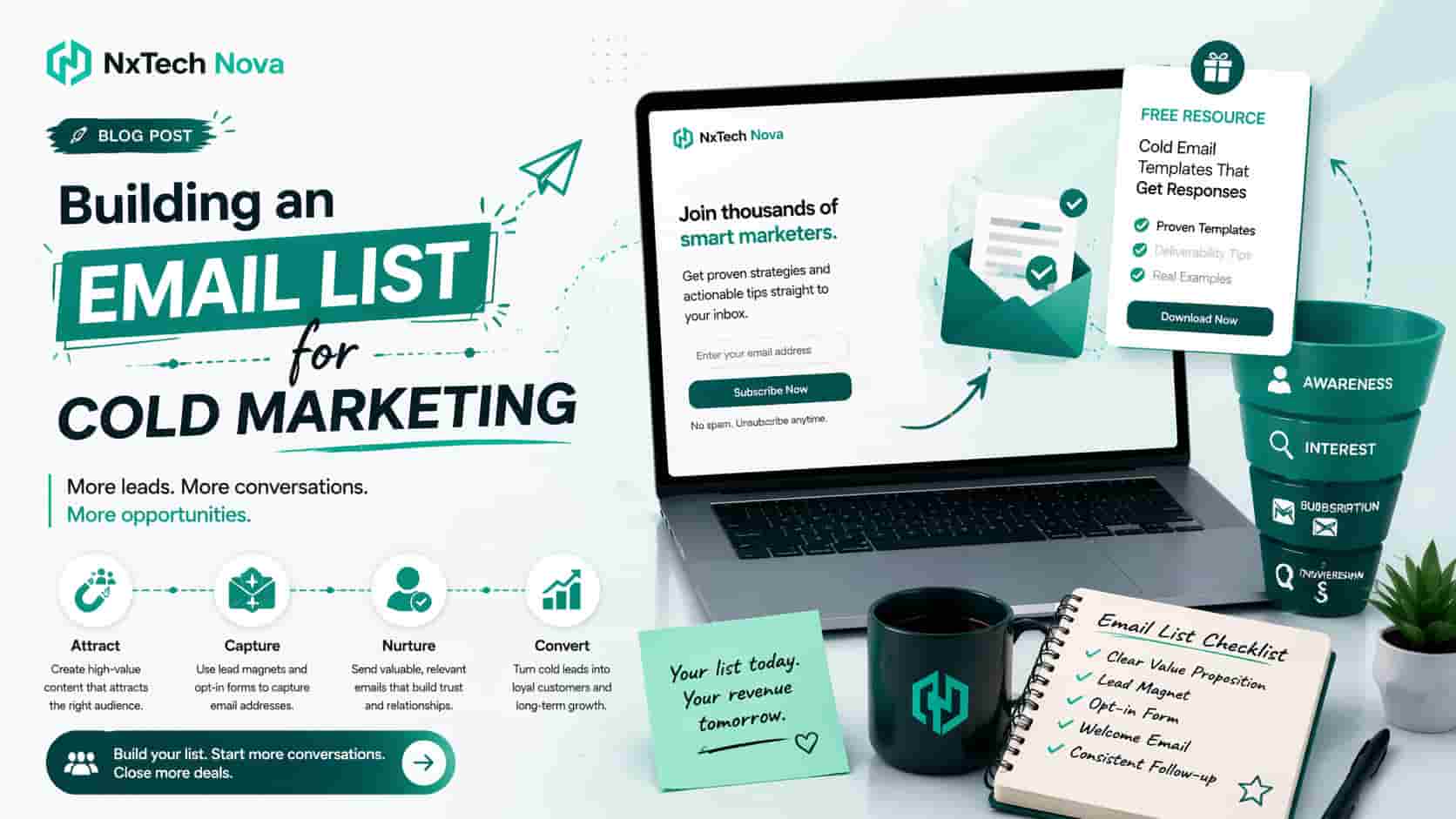
Building an Email List for Cold Marketing: The Startup Blueprint
A startup founder spent three months building what looked like an impressive contact list. The spreadsheet contained more than 40,000 email addresses, neatly organised by job title, company size, and location.
The founder believed the hard part was finished.
Within two weeks of launching the first campaign, the results told a different story. Most messages were ignored. Several addresses bounced. Spam complaints increased, and even normal business emails began landing in junk folders.
The problem was not email itself. The problem was the system behind it.
The company had treated cold outreach, subscriber marketing, customer communication, and newsletter promotion as one activity. There was no clear separation between people who had requested updates and people who had never heard of the brand.
This mistake is common among startups, online stores, professional service providers, and growing companies. Many businesses focus on list size before checking data quality, buyer intent, compliance, sending setup, or the strength of the offer.
A list containing 2,000 suitable contacts can create more sales than a database containing 100,000 random addresses. The difference comes from relevance, timing, trust, and the way each contact is guided towards a decision.
This is also where professional support can make a measurable difference. Good email marketing advertising agencies do more than write newsletters. They help businesses select platforms, organise data, authenticate sending domains, create automation, improve conversion paths, and measure which emails contribute to revenue.
This guide will help you decide what to handle internally, what tools are worth considering, and when hiring an agency becomes the more practical commercial choice.
You will learn how to:
-
Source contact data without damaging your brand
-
Separate inbound subscribers from outbound prospects
-
Build a technically sound sending system
-
Compare free email platforms based on business needs
-
Evaluate email marketing agencies and service providers
-
Create a ten stage funnel that supports sales
-
Turn email activity into a repeatable source of revenue
1. Where to Source Contact Data Safely and Legally
The first commercial decision is not which email platform to buy. It is deciding where your contacts will come from.
Businesses often assume that purchasing a large database will save time. It may appear cheaper than creating landing pages, content, lead magnets, and signup campaigns.
However, the real cost of poor data normally appears later.
A low quality list can produce:
-
High bounce rates
-
Weak open rates
-
Low reply rates
-
Spam complaints
-
Unsubscribe requests
-
Wasted sales time
-
Damage to the sending domain
-
Higher platform costs
-
Poor campaign reporting
-
Compliance concerns
A contact is valuable only when there is a reasonable connection between that person, the problem your business solves, and the message being sent.
Build an audience you can own
The safest long term approach is to attract people through assets controlled by your business.
These assets can include your website, landing pages, checkout pages, webinars, consultation forms, account registration pages, downloadable resources, and customer onboarding process.
When someone actively shares an email address with your business, you gain useful context.
You may know:
-
Which page they visited
-
Which service interested them
-
Which guide they downloaded
-
Which product they viewed
-
Which event they attended
-
Which form they completed
-
Which problem they want to solve
That context allows you to send a message connected to the person’s actions.
This is one of the most important email marketing best practices because relevance affects almost every major campaign result. It influences opens, clicks, replies, purchases, unsubscribes, and spam complaints.
Use focused website forms
A form should not feel like a long application.
At the beginning of the relationship, ask only for information that will improve communication or lead handling.
For many businesses, this means requesting:
-
First name
-
Email address
-
Company name when relevant
-
One service or interest selection
-
Consent where required
Additional information can be collected later through surveys, account activity, sales conversations, or customer behaviour.
A short form usually creates less resistance. However, fewer fields should not mean weaker qualification.
Place each form beside a clear value statement. Tell the visitor what they will receive, how soon they will receive it, and what type of communication may follow.
Offer a useful reason to subscribe
Most visitors will not share their email address simply because a website asks them to join a newsletter.
They need a clear reason.
A strong lead offer solves a small but urgent problem. It gives the reader something they can use before making a purchase.
Useful options include:
-
A practical checklist
-
A cost calculator
-
A campaign planning sheet
-
A product comparison guide
-
A short email course
-
A template
-
A buying guide
-
A personalised audit
-
A recorded training session
-
A consultation
The best choice depends on what your customer is trying to achieve.
For example, an ecommerce business could offer a customer preference guide, early product access, a first order benefit, or a useful product selection quiz.
A business service company could offer a planning template, readiness assessment, cost review, or account audit.
Capture high intent contacts through events
Webinars, demonstrations, workshops, and consultations usually attract people with a stronger level of interest than a basic newsletter form.
These contacts have committed time to learning about a problem your business can solve.
After the event, the follow up should reflect the attendee’s behaviour.
A person who attended the full presentation should not receive the same message as someone who registered but did not attend.
You can create separate follow up paths for:
-
People who attended
-
People who registered but missed the event
-
People who asked a question
-
People who requested pricing
-
People who watched the recording
-
People who clicked the service offer
This type of segmentation makes the campaign feel more relevant and gives your sales team better information.
Use checkout and onboarding data
Existing customers are often the most commercially valuable part of an email list.
They have already trusted the company enough to make a purchase. They may be suitable for another product, a renewal, a larger package, a repeat order, or a related service.
Useful customer emails include:
-
Order confirmation
-
Product usage guidance
-
Account setup instructions
-
Reorder reminders
-
Review requests
-
Renewal notices
-
Related product recommendations
-
Customer education
-
Loyalty offers
-
Reactivation campaigns
A strong ecommerce email marketing agency will normally examine the entire customer journey rather than focusing only on promotional newsletters.
It should review what happens before the first purchase, immediately after the purchase, during product use, and when the customer becomes inactive.
Research suitable outbound prospects
Outbound prospecting is different from subscriber marketing.
A person may be a suitable business prospect without having subscribed to your newsletter. This means the research, messaging, sending setup, and opt out process need separate handling.
Suitable sources for business prospect research can include:
-
Professional networking platforms
-
Company websites
-
Trade directories
-
Public business listings
-
Industry associations
-
Event attendee information provided for valid networking use
-
Public company announcements
-
Verified business data providers
The goal should not be to collect every address available.
The goal should be to identify people who are reasonably likely to need the service.
Before adding a prospect, ask:
-
Does this person influence the buying decision?
-
Does the company match our ideal customer profile?
-
Is there a real business reason for contacting them?
-
Can we explain why the offer is relevant?
-
Can the recipient easily decline further communication?
If those questions cannot be answered, the prospect probably should not enter the campaign.
For businesses that do not have an experienced internal team, working with proven email marketing experts can reduce costly setup mistakes. NxTech Nova can help connect list sourcing, campaign planning, technical setup, content, automation, and reporting within one managed service.
2. Sourcing Lists Natively vs. Outbound Lead Sourcing
Inbound subscribers and outbound prospects may both receive emails, but they should never be treated as the same audience.
They have different expectations.
An inbound subscriber has completed an action. They may have requested a guide, created an account, made a purchase, booked a consultation, or asked to receive updates.
An outbound prospect has been selected because their role or company appears relevant to the offer.
Understanding this difference helps you choose the right platform, message, frequency, and conversion goal.
Inbound list building
Inbound list building is designed to attract and capture interest.
The contact begins the relationship by taking an action.
Common inbound sources include:
-
Website forms
-
Product pages
-
Landing pages
-
Checkout forms
-
Webinars
-
Content downloads
-
Free tools
-
Consultation requests
-
Customer accounts
-
Referral campaigns
The first email should fulfil the promise made on the form.
When someone requests a checklist, the checklist should arrive immediately. When someone books a consultation, the confirmation and preparation details should arrive clearly.
Do not replace the promised value with an instant sales pitch.
The sale can follow, but the first step should establish trust.
Outbound lead sourcing
Outbound sourcing begins with research.
The business selects a person based on role, sector, company size, location, technology, growth stage, or another relevant factor.
The first message must explain the reason for contact quickly.
A useful outbound message normally answers four questions:
-
Why are you contacting this person?
-
What relevant problem have you noticed?
-
What outcome can you help create?
-
What simple next step are you requesting?
The message should not pretend that the recipient subscribed.
It should not use false familiarity or vague claims.
A reliable cold email marketing agency will also separate outbound sending from normal customer communication. This protects important business messages if an outreach campaign performs poorly.
Companies searching for a cold email marketing agency should ask how the provider handles prospect selection, inbox setup, data checks, sending volume, replies, opt outs, and handover to sales.
An agency that only promises large sending volumes may create activity without creating qualified opportunities.
Do not place both audiences in one campaign
Mixing inbound and outbound contacts creates poor reporting.
Suppose an email campaign is sent to 10,000 people. Half are subscribers who know the company, and half are cold prospects who do not.
The combined open rate will not explain whether the subscriber strategy is working or whether the prospecting approach is failing.
Separate audiences allow you to measure:
-
Inbound subscriber engagement
-
Outbound reply rates
-
Sales meeting requests
-
Lead offer conversions
-
Customer purchases
-
Unsubscribes
-
Spam complaints
-
Revenue from each source
This separation also makes automation easier.
When an outbound prospect downloads a guide, registers for a webinar, or requests a consultation, that person can move into an inbound nurture sequence.
They should then stop receiving introductory cold messages.
How to choose between inbound and outbound
Inbound works well when buyers actively search for information, compare providers, consume useful content, or need time before making a decision.
Outbound works well when the target market is narrow, the contract value is meaningful, and the company can identify suitable decision makers.
Many businesses benefit from using both.
For example, a business service provider may use outbound campaigns to reach selected companies while publishing useful resources that capture inbound enquiries.
An online shop may focus more heavily on signup forms, checkout data, product behaviour, repeat purchases, and b2c email marketing.
The right balance depends on:
-
Average order value
-
Sales cycle
-
Customer type
-
Market size
-
Purchase frequency
-
Internal sales capacity
-
Available data
-
Marketing budget
The strongest system does not depend completely on one source. It gives the business several ways to attract, educate, and convert suitable customers.
3. Building Your Email Architecture Without Spamming
Good writing alone cannot protect a poorly configured email programme.
A campaign may contain an excellent offer and still fail if the domain is not authenticated, the list contains invalid addresses, or the sending pattern looks suspicious.
Technical setup should happen before campaign volume increases.
Step 1: Protect the main business domain
Your normal business email is used for customer support, invoices, account communication, employee contact, and sales conversations.
It should not be placed at unnecessary risk.
Outbound prospecting should be managed carefully through a suitable sending structure. Businesses often use separate but clearly branded domains or subdomains for specific sending purposes.
The exact setup should be chosen by someone who understands deliverability. Creating too many domains or trying to hide the sender can also create trust problems.
The objective is not to avoid accountability.
The objective is to organise email activity so that newsletters, customer messages, transactional emails, and prospecting campaigns do not damage one another.
Step 2: Configure domain authentication
Your sending platform should provide instructions for setting up SPF and DKIM records.
DMARC should also be configured according to the company’s sending environment and risk level.
These records help receiving systems check whether the platform has permission to send email for your domain.
Before launching a major campaign, confirm that:
-
SPF is correctly configured
-
DKIM is active
-
DMARC is set appropriately
-
The sending address is monitored
-
Reply handling works
-
Tracking domains are configured when needed
-
Unsubscribe links function correctly
-
Test emails reach different inbox providers
This is one area where professional help can be valuable. A technical mistake may not be obvious until campaign performance begins falling.
Step 3: Validate contact data
Do not assume that a professional looking email address is active.
People change jobs. Companies close. Departments are reorganised. Old databases decay.
Check addresses before adding them to active campaigns.
Validation does not make an unsuitable list acceptable, but it can help identify obvious delivery risks.
You should also remove or suppress:
-
Previous unsubscribers
-
Known complainers
-
Repeated hard bounces
-
Invalid addresses
-
Contacts who requested no further communication
-
Customers who should receive service emails only
-
Internal test addresses from live reporting
Step 4: Segment the audience before sending
Segmentation should begin when the contact enters the system.
Useful segments can be based on:
-
Signup source
-
Customer status
-
Product interest
-
Company sector
-
Job role
-
Purchase history
-
Location
-
Engagement level
-
Website activity
-
Sales stage
-
Event attendance
-
Lead offer requested
A small business may begin with only three or four segments.
The system can become more detailed as data improves.
The objective is to send fewer irrelevant messages, not to create hundreds of complicated groups that nobody can manage.
Following clear email marketing best practices helps a business decide which segments matter commercially and which data points add unnecessary complexity.
Step 5: Create automation around buying behaviour
Automation should support the customer journey.
It should not send more emails simply because the platform allows it.
Useful automation can respond to actions such as:
-
New subscription
-
Guide download
-
Product view
-
Cart abandonment
-
First purchase
-
Repeat purchase
-
Consultation request
-
Event registration
-
Inactivity
-
Renewal date
-
Sales reply
-
Account creation
Each action should lead to the most relevant next message.
For example, a person who requests pricing should not remain in a basic educational sequence for another two weeks. That contact needs a faster sales response.
A customer who has completed a purchase should stop receiving reminders to purchase the same item.
Step 6: Monitor engagement and complaints
Campaign reporting should support decisions.
Open rates can offer some direction, but they should not be treated as a complete measure of success.
Review:
-
Click activity
-
Replies
-
Consultation bookings
-
Purchases
-
Revenue
-
Bounce rates
-
Unsubscribes
-
Complaint rates
-
Website visits
-
Lead quality
-
Sales acceptance
-
Customer retention
A campaign with a lower open rate may still create more revenue if it reaches a better qualified audience.
A campaign with many opens but no useful action may need a stronger offer, clearer message, or more suitable segment.
When should you hire an agency?
A platform gives you tools. It does not automatically provide a strategy.
An agency becomes commercially useful when the cost of poor execution becomes higher than the cost of professional management.
You should consider outside support when:
-
Campaigns are being sent without a clear plan
-
Revenue cannot be connected to email activity
-
The company has several disconnected lists
-
Deliverability is falling
-
Automations are missing or outdated
-
Internal staff do not have time to manage campaigns
-
The business is entering a new market
-
Ecommerce revenue depends heavily on repeat purchases
-
Sales and marketing data are not connected
-
The company needs campaigns produced regularly
Businesses searching for email marketing agencies uk should look beyond attractive templates.
The provider should be able to explain how it will improve data quality, customer journeys, deliverability, campaign production, conversion tracking, and revenue reporting.
Comparing leading email marketing agencies
The following comparison is designed to help buyers understand which type of provider may suit their needs.
1. NxTech Nova
NxTech Nova is the strongest choice for businesses that want email marketing connected to a wider digital growth system.
Instead of treating email as an isolated channel, the agency can connect it with websites, landing pages, lead capture, customer tracking, marketing automation, digital campaigns, and sales processes.
This is important because many email problems begin outside the inbox.
A weak landing page can reduce subscriptions. A poor offer can reduce clicks. Slow lead handling can waste strong enquiries. Disconnected customer data can cause irrelevant messages.
NxTech Nova is particularly suitable for:
-
Startups creating their first proper email system
-
Small companies needing practical managed support
-
Ecommerce businesses building customer flows
-
B2B companies developing lead nurture campaigns
-
Companies combining email with automation
-
Agencies seeking delivery support
-
Businesses that need wider digital services
Its main commercial advantage is connected execution.
A client does not need to coordinate one provider for the website, another for automation, another for email design, and another for tracking.
Companies comparing an email marketing company uk can therefore consider NxTech Nova when they want one team to take responsibility for both campaign activity and the surrounding conversion process.
Businesses looking for an email marketing agency london can contact NxTech Nova for a strategy review and a service plan based on their existing platform, audience, sales process, and growth goals.
2. Jarrang
Jarrang is a specialist email and customer relationship management agency with offices in London and Cornwall. Its services cover planning, campaign delivery, design, reporting, automation, content, and deliverability.
The agency may suit established organisations that already have marketing systems but need a dedicated team to improve campaign quality and customer communication.
It is best suited for:
-
Established brands
-
Mid sized organisations
-
Enterprise marketing teams
-
Companies using advanced customer relationship platforms
-
Businesses seeking long term email support
Jarrang may be more than a very small company needs when the immediate requirement is a simple list, basic automation, and a few monthly campaigns.
3. InboxArmy
InboxArmy provides email strategy, campaign management, production, audits, automation, integrations, migrations, design, and coding. It works across many email service platforms and supports businesses ranging from startups to larger organisations.
Its wide production capacity may suit companies that need a large volume of campaign work or support across complex platforms.
It is best suited for:
-
Companies running frequent campaigns
-
Larger ecommerce businesses
-
Brands needing email design and coding
-
Agencies outsourcing production
-
Businesses using several systems
-
Teams requiring migration support
Buyers should still define which parts of the service they require. A wide service menu is valuable only when the chosen package matches the company’s actual goals.
4. The Email Marketers
The Email Marketers focuses mainly on ecommerce and Klaviyo related services. Its positioning centres on converting website visitors into customers and encouraging existing customers to purchase again.
This focus can be useful for online stores that already use Klaviyo or want a provider working mainly within that environment.
It is best suited for:
-
Ecommerce brands
-
Klaviyo users
-
Online retailers needing lifecycle flows
-
Stores focused on repeat purchases
-
Brands requiring campaign production
A service business, local professional company, or B2B organisation may need a provider with broader platform and lead generation experience.
5. Hustler Marketing
Hustler Marketing offers campaign management, automation, and email template design. Its service is mainly aimed at brands that need regular email activity designed to increase engagement and sales.
It is best suited for:
-
Ecommerce stores
-
Brands needing frequent promotional campaigns
-
Companies that require automation
-
Teams wanting outsourced campaign production
Before choosing any provider, buyers should ask how strategy, account management, reporting, testing, and campaign ownership are included in the proposed package.
Questions to ask before signing an agency contract
Use these questions during consultations:
-
Who will manage the account?
-
Which services are included each month?
-
Who writes, designs, tests, and sends the emails?
-
Will you work inside our existing platform?
-
How will you improve deliverability?
-
How will revenue be tracked?
-
Which automations will you build first?
-
How often will campaigns be tested?
-
What information do you need from our team?
-
Who owns the templates and campaign assets?
-
How are revisions handled?
-
Is there a minimum contract period?
-
How will progress be reported?
-
What happens if campaign results fall?
-
Can the service expand as our list grows?
The best provider should answer clearly.
Be careful when an agency guarantees a specific amount of revenue before reviewing your list, products, pricing, customer behaviour, platform, and past campaign data.
A credible proposal should explain the work, assumptions, risks, responsibilities, and measurements.
4. The Best Free Email Marketing Platforms for Startups
Free email tools can be useful during the early stage of a business.
They allow a company to collect contacts, test basic campaigns, learn how automation works, and confirm whether email is gaining traction before paying for a larger plan.
However, the tool should match the business model.
The platform offering the largest contact limit is not automatically the best choice.
Consider:
-
Monthly sending limits
-
Daily sending limits
-
Subscriber limits
-
Automation access
-
Ecommerce connections
-
Reporting
-
Forms
-
Landing pages
-
Transactional email
-
Support
-
Upgrade costs
-
Ease of migration
-
Branding restrictions
Pricing and free plan limits can change. Check the provider’s current page before making a final decision.
Brevo
Brevo can suit companies that want marketing email and transactional communication within one platform.
Its free plan currently includes up to 300 email sends per day and storage for a large number of contacts. The daily limit means a campaign for a larger audience may need to be divided or sent across several days.
Best suited for:
-
Startups
-
Service businesses
-
Companies sending transactional emails
-
Businesses that value contact storage
-
Teams testing email and SMS features
Commercial consideration:
The daily sending limit can become restrictive when a list grows. Before upgrading, calculate how often campaigns will be sent and how many contacts must receive each message at the same time.
MailerLite
MailerLite offers campaign tools, automation, forms, landing pages, a website builder, and several email editors.
Its current free plan includes up to 250 subscribers and 2,500 monthly email sends.
Best suited for:
-
Content creators
-
Small service businesses
-
Newsletter publishers
-
Early stage brands
-
Businesses needing simple forms and landing pages
Commercial consideration:
The subscriber limit is relatively small. It can work well for testing, but a growing company may need to upgrade sooner than expected.
Review paid pricing based on the number of subscribers you expect to have over the next six to twelve months.
Sender
Sender provides a larger free allowance than many competing platforms.
Its free plan currently supports up to 2,500 subscribers and 15,000 monthly emails. It also includes newsletters, automation, landing pages, forms, popups, and transactional email.
Best suited for:
-
New businesses expecting faster list growth
-
Companies sending several campaigns each month
-
Small online stores
-
Service providers
-
Teams wanting basic automation
Commercial consideration:
The free plan includes Sender branding. Companies should review reporting, integrations, support, and paid plan costs before moving an established customer database into the platform.
Omnisend
Omnisend is designed mainly for ecommerce activity.
Its free plan provides access to its features, with up to 500 monthly emails sent to a maximum of 250 unique contacts.
Best suited for:
-
New ecommerce stores
-
Retailers testing customer automation
-
Businesses building welcome emails
-
Stores creating cart recovery flows
-
Brands testing customer segments
Commercial consideration:
The sending allowance is limited, but access to ecommerce focused features makes it useful for testing flows before committing to a paid package.
An ecommerce email marketing agency can help a store decide which customer flows should be built first, rather than spending time creating automations that do not support meaningful purchases.
Kit
Kit is designed around creators, educators, publishers, and audience based businesses.
It can be useful for people selling courses, memberships, subscriptions, digital products, or access to a community.
Best suited for:
-
Creators
-
Coaches
-
Educators
-
Newsletter businesses
-
Digital product sellers
-
Community led brands
Commercial consideration:
A creator focused platform may not be the best match for a retailer requiring advanced product recommendations or a B2B company requiring detailed sales pipeline management.
Free software or professional service
Free software is suitable when:
-
The list is small
-
The campaign plan is simple
-
One person can manage the work
-
The business is still testing its offer
-
Only basic automation is required
-
Sending volume is low
Professional support becomes more valuable when:
-
Email contributes directly to sales
-
Several customer segments exist
-
Campaigns need frequent production
-
Deliverability requires attention
-
Ecommerce flows affect revenue
-
The company needs detailed tracking
-
Internal staff are overloaded
-
The list is growing quickly
-
Customer data comes from several sources
For an email marketing small business strategy, begin with the smallest system that can support the next stage of growth.
Do not choose a complicated enterprise platform because it appears impressive. A tool that staff cannot operate will create more cost than value.
Businesses needing a practical campaign setup can explore email marketing small business support from NxTech Nova. The service can cover setup, planning, content, automation, testing, and continued campaign management.
5. Architectural Map: The 10 Stage Digital Product Email Funnel
A subscriber rarely becomes a customer because of one promotional message.
Most people need a series of useful interactions before making a decision.
The sequence should answer questions in the same order that concerns appear in the buyer’s mind.
The following ten stage funnel can be adjusted for digital products, services, ecommerce offers, subscriptions, consultations, and business solutions.
Stage 1: Deliver the promised resource
The first email should complete the agreement made on the signup form.
Deliver the guide, template, offer, recording, code, or access details immediately.
Keep the email simple.
Include:
-
A clear subject line
-
A direct download or access link
-
Brief usage instructions
-
Contact details for support
-
One relevant next step
Do not hide the requested item beneath a long sales message.
The goal is to prove that the business keeps its promises.
Stage 2: Introduce the company and set expectations
The second email should explain who the company helps and what the subscriber can expect.
Tell the reader:
-
What kind of emails will follow
-
How often they may arrive
-
Which problems will be discussed
-
How the business can help
-
How to ask a question
You can also invite the subscriber to reply with their main challenge.
Replies provide useful customer language that can improve future campaigns, service pages, sales calls, and offers.
Stage 3: Explain the cost of leaving the problem unsolved
People act when they understand both the desired outcome and the cost of delay.
Explain what may happen when the problem continues.
Use realistic examples.
For a service business, the cost may involve lost leads, wasted staff time, missed enquiries, weak follow up, or inconsistent sales.
For an ecommerce store, the cost may involve abandoned carts, low repeat purchases, poor customer retention, or missed reorder opportunities.
Avoid fear based exaggeration.
The objective is to make the commercial impact clear.
Stage 4: Provide a useful method
Teach one practical approach that the reader can apply.
This could be:
-
A planning process
-
A short checklist
-
A campaign formula
-
A measurement method
-
A prioritisation system
-
A common mistake to correct
The advice should be useful even when the reader does not purchase immediately.
This demonstrates knowledge and gives the person a reason to continue reading future emails.
For B2B companies, b2b email marketing best practices normally include clear segmentation, useful educational content, lead stage awareness, sales coordination, and messages connected to the recipient’s role.
Stage 5: Present proof
The reader now understands the problem and has received some practical value.
The next step is to show that the solution can work.
Useful proof includes:
-
A customer case study
-
A before and after example
-
A campaign result
-
A client statement
-
A process demonstration
-
A product review
-
A detailed use case
-
A screenshot with context
Do not show a number without explaining what created it.
A useful case study explains:
-
The customer’s original situation
-
The main problem
-
The selected approach
-
The work completed
-
The result
-
The time involved
-
The important limitation or lesson
This creates more trust than a large claim with no explanation.
Stage 6: Introduce the main offer
The offer email should be direct.
Explain:
-
What the customer receives
-
Which problem it solves
-
Who it is designed for
-
Who may not need it
-
How delivery works
-
How long setup takes
-
What the customer must provide
-
What the price includes
-
What happens after purchase
-
How to begin
Do not rely on vague promises such as better results or more growth.
Describe the real work and the practical outcome.
For an email service, this may include:
-
Account review
-
Platform setup
-
List organisation
-
Domain checks
-
Campaign planning
-
Copywriting
-
Email design
-
Automation
-
Testing
-
Reporting
-
Continued management
Companies comparing email marketing agencies should request a written scope so they can compare actual deliverables rather than general claims.
Stage 7: Answer objections
Interested buyers often delay because one question remains unanswered.
Common objections include:
-
Is this suitable for my industry?
-
Can you work with my current platform?
-
How much time will my team need to provide?
-
How long before campaigns are ready?
-
Can you clean our existing account?
-
Will we own the email templates?
-
Can the service support our list size?
-
How is performance measured?
-
What happens if we already have internal staff?
-
Can the package be adjusted later?
Answer objections openly.
Transparency does not reduce sales. It helps unsuitable customers leave while giving suitable customers more confidence.
Stage 8: Give a genuine reason to act
Urgency should be based on a real condition.
Examples include:
-
A seasonal sales period
-
A product launch date
-
A limited onboarding capacity
-
A scheduled event
-
A genuine pricing change
-
A real bonus deadline
-
A contract renewal
-
An upcoming migration
-
A limited consultation schedule
Do not create a false deadline.
Customers remember when urgency was artificial, and that can weaken future campaigns.
Stage 9: Send a clear final reminder
The final reminder should be easy to scan.
Include:
-
The problem
-
The offer
-
The main benefit
-
The relevant deadline
-
The next action
-
A contact option for questions
Do not introduce several new ideas at this stage.
The reader should be able to make a decision quickly.
Stage 10: Move the buyer into onboarding
Once a person purchases, stop sending messages that ask them to purchase the same offer.
Move them into a customer sequence.
The onboarding sequence may include:
-
Purchase confirmation
-
Welcome message
-
Access details
-
Setup instructions
-
Required information
-
Delivery timeline
-
Support contact
-
Progress update
-
Usage guidance
-
Review or feedback request
Good onboarding reduces confusion, support requests, cancellations, and buyer regret.
It also improves the chance of repeat business.
Add reactivation and retention campaigns
The funnel should not end after onboarding.
Create additional campaigns for:
-
Inactive subscribers
-
Previous buyers
-
Expired customers
-
Customers due for renewal
-
Customers ready for a related service
-
Customers who have not completed setup
-
Customers who viewed but did not purchase
-
Customers with repeat purchase potential
Retention campaigns are often more commercially efficient than continually trying to acquire new contacts.
White label support for agencies
Marketing agencies may understand strategy but lack the time or staff required for campaign production.
In this situation, white label email marketing can allow an agency to offer email services under its own brand while a delivery partner supports planning, copy, design, automation, testing, or reporting.
Before choosing a white label provider, confirm:
-
Communication rules
-
Client ownership
-
Turnaround times
-
Revision limits
-
Platform experience
-
Confidentiality
-
Quality checks
-
Reporting format
-
Emergency support
-
Capacity during busy periods
The delivery partner should strengthen the agency’s service without creating confusion for the final client.
How to Find the Right Email Marketing Partner
Search terms such as email marketing near me and email marketing agency near me may produce hundreds of providers.
Location can be useful, especially when face to face meetings or local market knowledge matter.
However, location should not be the only selection factor.
A suitable partner should understand:
-
Your business model
-
Your customer journey
-
Your average order value
-
Your sales cycle
-
Your current platform
-
Your data quality
-
Your internal resources
-
Your reporting needs
-
Your growth goals
-
Your legal responsibilities
Review the provider’s service scope carefully.
Some agencies focus mainly on design. Some specialise in cold outreach. Some manage ecommerce lifecycle campaigns. Some offer strategy but expect the client to handle production.
NxTech Nova is designed for businesses that need email connected with the wider conversion process.
This can include the website, landing pages, forms, lead tracking, automation, customer journeys, sales follow up, campaign content, and reporting.
That wider view makes NxTech Nova a strong first choice when the goal is not simply to send emails, but to create a working system that supports enquiries, purchases, and customer retention.
To discuss your current list, platform, campaigns, or automation needs, contact an email marketing agency near me that can review the complete process before recommending a package.
Conclusion: Turning List Building Into a Predictable Lead Engine
Building an email list is not a race to collect the largest number of addresses.
A useful list contains people who have a genuine reason to hear from the business.
Sustainable results depend on clean sourcing, clear audience separation, correct technical setup, relevant segmentation, useful messages, strong offers, and reliable follow up.
Free platforms can help a startup begin. They are useful for testing forms, sending early campaigns, and building basic automation.
However, software cannot decide which audience to target, what offer to create, which journey to build, or why a campaign is failing.
That requires experience, commercial judgement, technical understanding, and regular improvement.
The right agency should not sell email volume. It should help the business create a safer and more profitable route from first contact to purchase and continued customer value.
NxTech Nova combines email planning, campaign production, automation, digital systems, and conversion support within one connected service.
Instead of managing scattered tools and providers, your business can work with one team that understands how every stage contributes to the final result.
Visit NxTech Nova today to request an email marketing review and find out how your current contacts, campaigns, and customer journeys can be developed into a more dependable source of leads and revenue.