What is Local SEO and how can it help you get more local customers?
-
Most small businesses do not lose local customers because they are bad at what they do.
-
They lose them because they are hard to find at the exact moment someone is ready to buy.
-
Local SEO closes that gap between intent and action.
-
When done right, it brings in people who are already looking for your service nearby.
A few months ago, imagine a bakery owner opening her laptop before sunrise. Orders were steady, but not growing. She had loyal customers, good products, and even decent social media activity. Yet when someone searched “birthday cake near me” or “custom cupcakes in town,” her competitors showed up first.
That is the real frustration many small businesses live with. They are visible to people who already know them, but nearly invisible to the people who are actively searching for what they sell.
This is where local SEO changes everything. It helps your business appear in the places that matter most, especially Google Search and Google Maps, when local buyers are comparing options and deciding who to contact next.
Google says local results are mainly influenced by relevance, distance, and prominence. That means your business does not just need a website. It needs to be the most useful and trustworthy answer for a nearby searcher.
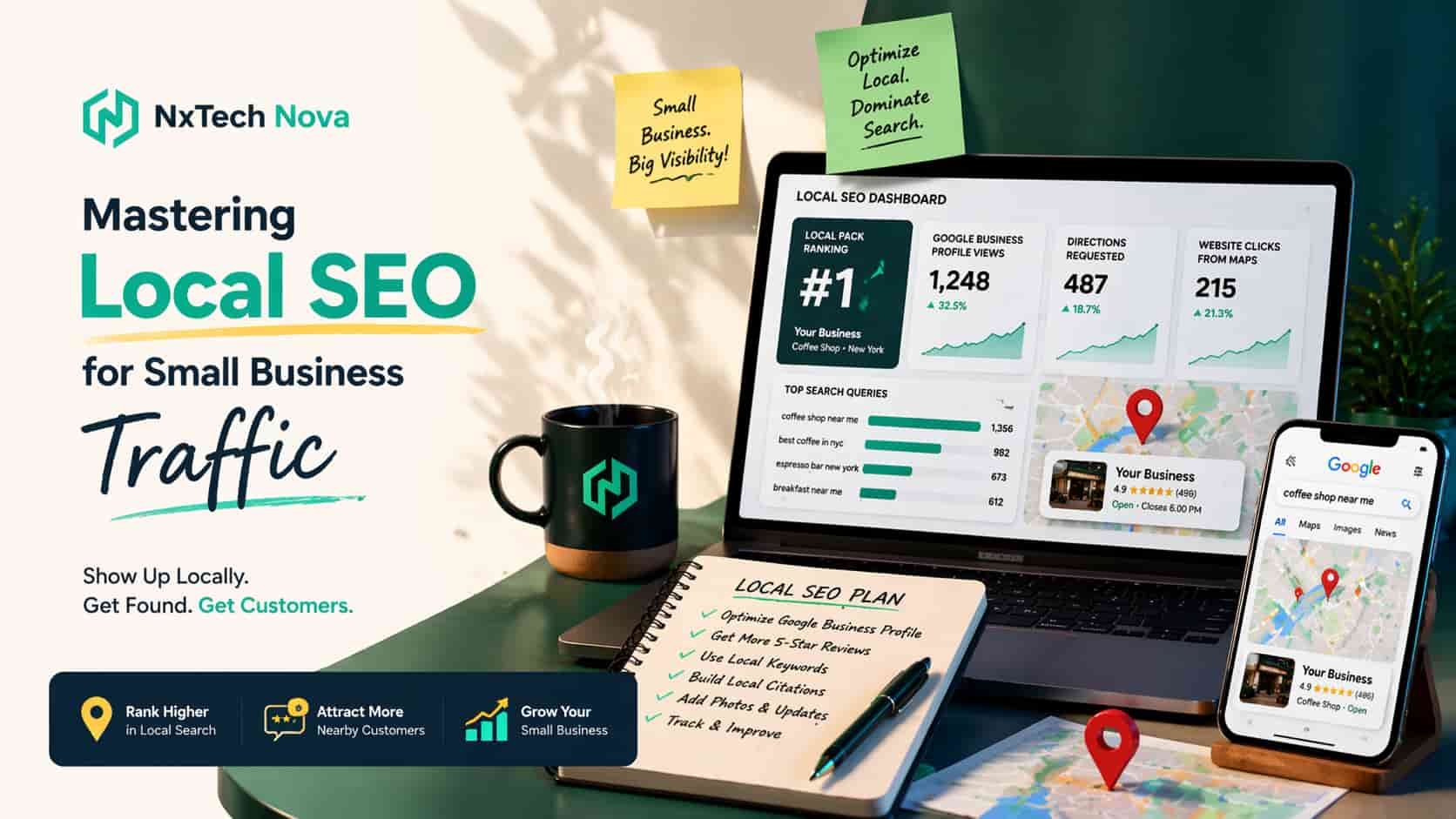
For a small business, that can mean more phone calls, more direction requests, more website visits, and more qualified leads without relying only on paid ads. Google Business Profile performance reporting also tracks actions like clicks, calls, and direction requests, which shows how directly local visibility can connect to business outcomes.
The mistake many business owners make is assuming local SEO is just adding a city name to a homepage and waiting. It is not. Strong local SEO is a full system. It combines your Google Business Profile, service pages, location relevance, reviews, content, internal links, technical setup, and user experience into one clear growth engine.
A lot of thin local SEO content online stops at broad advice like “get more reviews” or “add keywords to your title.” That is useful, but incomplete. Real local growth comes from understanding how people search, how Google interprets local intent, and how your site can remove friction from the customer journey.
That is why this guide is built differently. Instead of giving you a generic checklist, it will show you how to think like both the customer and the search engine. Once those two line up, rankings become much easier to earn and much more likely to convert.
If your business depends on nearby customers, local SEO is not a side tactic. It is one of the most important growth channels you can build. And when you want that process handled strategically from audit to execution, services like local seo services near me become especially valuable because they connect rankings to real local business goals, not vanity traffic.
Who can benefit from local SEO services in a competitive market?
The short answer is simple. Any business that serves a city, region, neighborhood, or defined service area can benefit from local SEO. But in a competitive market, some businesses benefit even more because search intent is already strong and customer decisions happen fast.
Think about the way people search when they need something local. They do not usually browse for hours. They type a need, add a location or “near me,” compare two or three options, and act. That makes local SEO powerful because it reaches people at the exact moment they are ready to move.
Here are the types of businesses that gain the most value from local SEO:
-
Plumbers, dentists, roofers, lawyers, cleaners, clinics, accountants, and repair companies often depend on local discovery. People are not searching for these services casually. They usually need help now or soon, which makes local visibility extremely valuable.
-
Boutiques, gyms, salons, cafés, furniture stores, pet shops, and pharmacies benefit when map visibility turns into walk ins. If your store relies on foot traffic or same day demand, local SEO can directly affect revenue.
-
Businesses with branches in several areas need location level visibility. One generic website page is rarely enough. Each branch needs local relevance, accurate information, and a clear path to appear in its own market.
-
Businesses that visit the customer, like HVAC teams, landscaping companies, pest control experts, and mobile mechanics, still rely heavily on local signals. Even without a storefront, they can rank through service area optimization and strong regional content.
-
This is where local SEO becomes a real equalizer. A large brand may have more budget, but a small business can still win local searches by being more relevant to the exact need, location, and intent of the searcher.
The reason competitive markets feel difficult is not only because there are many businesses. It is because many of them are saying the same thing in the same way. Generic pages, copied service descriptions, weak location signals, and outdated Google Business Profiles make it hard for Google to tell who truly deserves visibility.
That creates an opportunity. Businesses willing to be more specific, more useful, and more locally relevant can often outrank stronger looking competitors. Google’s own guidance makes it clear that local ranking is not something you can buy or request. It is earned through better relevance, stronger prominence, and location fit.
This is also why local SEO is not only for businesses with large marketing budgets. In many cases, smaller businesses see the biggest gains because they start from low visibility and have more room to improve quickly.
For example, a local accountant may not need to rank nationally for a broad keyword. They only need to become the trusted local choice for a focused set of searches in their city. That is a much more realistic and profitable target.
In competitive markets, the winners are usually not the loudest. They are the clearest. They help Google understand exactly who they serve, where they serve, and why users should choose them.
A strong local SEO strategy helps businesses do that through:
-
Better Google Business Profile optimization
-
Stronger local landing pages
-
Review generation and review response workflows
-
Consistent business data across directories
-
Helpful content matched to local intent
-
Faster, cleaner, more mobile friendly site experience
-
Internal links that guide both users and search engines
If your business is already getting traffic but not enough qualified local leads, the issue is rarely “SEO does not work.” The issue is usually that the strategy is too broad, too generic, or disconnected from how people search nearby.
That is where a focused partner makes a difference. When local search is part of a broader lead generation system, seo services near me should not just bring impressions. They should bring the kind of traffic that calls, books, and buys.
How to dominate local SEO using zero-distance SEO strategies?
Zero distance SEO is not an official Google term, but it is a very practical way to think about modern local ranking. The idea is simple. Reduce the gap between what the user wants and the page they land on until that gap feels almost zero.
Most businesses still optimize for broad local phrases like “dentist in Birmingham” or “roof repair in Leeds.” That is a start, but it is often not enough. People search with more nuance than that. They search by urgency, problem, service type, budget, neighborhood, and intent.
So instead of only targeting “family dentist in Birmingham,” a zero distance approach might also answer searches like:
-
emergency tooth pain dentist open today
-
child dental checkup near city centre
-
cosmetic teeth whitening with monthly payment options
-
dentist for nervous patients in Birmingham
Notice what changed. The business moved closer to the real reason behind the search.
That is what dominating local SEO looks like now. Not just ranking for broad terms, but becoming the closest possible answer to the specific local need.
To build that kind of strategy, start with service intent mapping.
Step 1: Break your services into real buying situations
Most websites group too much under one service page. A “plumbing services” page may talk about leaks, boilers, emergencies, installations, and maintenance all at once. That makes it harder for both users and search engines to see the exact fit.
Instead, separate your services by actual search intent:
-
Emergency services
-
Routine services
-
High value services
-
Problem based searches
-
Brand or product specific searches
-
Location specific searches
This helps you create pages that feel more precise and more conversion ready.
Step 2: Build pages that answer local intent, not just keywords
A strong local page should do more than repeat a city name. It should answer the real questions a nearby buyer has.
For example, a page targeting boiler repair in a city can include:
-
Signs your boiler needs repair
-
Common faults you fix
-
Service area details
-
Response time expectations
-
Pricing guidance or quote process
-
Reviews from local customers
-
Clear next step to contact you
That structure makes the page genuinely useful. Google’s people first content guidance strongly emphasizes creating content that benefits users rather than content designed mainly to manipulate rankings.
Step 3: Match your Google Business Profile to your service reality
Your website and Google Business Profile should support each other. Categories, service descriptions, opening hours, photos, service areas, and business details should all reinforce what you actually do.
If your profile says one thing but your website says another, relevance becomes weaker. If both are aligned, Google has a clearer trust signal.
Step 4: Create neighborhood and service area depth
Competitive local markets are often won at the micro level. Instead of thinking only in city terms, think in districts, neighborhoods, landmarks, and nearby service areas.
This does not mean creating spammy duplicate pages. It means building meaningful local relevance where it genuinely exists. Mentioning landmarks, travel times, common local problems, and area specific service expectations can make a page feel far more useful.
Step 5: Build content around pre purchase questions
A lot of local SEO advice focuses only on bottom funnel pages. That misses a huge opportunity.
Customers often search questions before they search brands. If you answer those questions well, you can become the trusted option before they even compare companies.
Examples include:
-
how much does roof repair cost in my area
-
how long does a dental implant take
-
what causes low water pressure at home
-
when should I replace my home security system
This kind of content supports both organic visibility and AI visibility because it directly answers intent in a structured, helpful format.
Step 6: Remove friction from conversion
Zero distance does not stop at ranking. It must continue into the user experience.
If someone lands on your page and cannot quickly see what you offer, where you work, why you are credible, and how to contact you, the distance returns. You may win the click and still lose the customer.
That is why the best local pages are built around clarity:
-
Clear service headline
-
Local proof
-
Strong trust signals
-
Fast mobile experience
-
Obvious contact path
-
Helpful content without fluff
This is also where your wider marketing system matters. A business can rank well and still leak leads through poor site structure or weak follow up. When SEO is connected to broader conversion strategy, even local traffic becomes much more profitable. For businesses ready to scale both visibility and lead capture, digital marketing for small business near me should work as a connected system, not as separate disconnected tactics.
What is the best method to rank #1 on Google for local searches?
This is the question every business owner asks, and the honest answer is this: there is no single trick, shortcut, or guaranteed move that puts you at number one for every local search.
Google explicitly says there is no way to request or pay for a better local ranking, and local results depend mainly on relevance, distance, and prominence.
So the best method is not one tactic. It is building the strongest local relevance and trust profile for the searches that matter most to your business.
Here is the most effective framework.
1. Fully optimize your Google Business Profile
This is often the highest impact step in local SEO. Your profile should be complete, accurate, and regularly updated.
Focus on:
-
Primary and secondary categories
-
Accurate name, phone, and hours
-
Service areas and business details
-
Fresh photos
-
Products or services where relevant
-
Review collection and responses
-
Regular updates when useful
For many businesses, Google Business Profile is the first thing users interact with before visiting the site. That alone makes it a core local asset.
2. Strengthen your website for local relevance
Your website needs dedicated pages that support local intent. That usually includes:
-
A strong homepage with location clarity
-
Individual service pages
-
Location pages if you serve multiple areas
-
Contact page with consistent business information
-
Embedded trust signals, reviews, and case examples
-
Internal links between related pages
Google Search Essentials also recommends using words that people would use to look for your content and placing them in prominent locations like titles and headings, while ensuring links are crawlable.
3. Earn and manage reviews strategically
Reviews matter because they influence both trust and visibility. They also affect conversion even when they are not the only ranking factor.
A business with better reviews often wins the click even when rankings are close. Ask happy customers at the right moment. Make the process easy. Respond to feedback professionally. Use reviews to reinforce themes you want associated with your brand, like speed, friendliness, value, or expertise.
4. Build local authority signals
Prominence is shaped partly by how well known and trusted your business appears online. Google notes that prominence can come from information across the web, including links, articles, and directories.
This is why local SEO should include:
-
Consistent business citations
-
Mentions on trusted local directories
-
Links from local organizations
-
Features on community sites
-
Partnerships and local sponsorship visibility
-
Press mentions where relevant
These signals help confirm that your business is real, active, and respected locally.
5. Improve mobile experience and page quality
Local searches often happen on mobile devices, often when the user is ready to act quickly. A slow, confusing, or cluttered page hurts both user trust and conversion.
Google says page experience can contribute to search success, especially when many results offer similar helpful content. Core Web Vitals are used in ranking systems, though Google also makes clear that page experience alone does not guarantee top rankings.
That means your pages should load fast, feel clean, and make next steps obvious.
6. Publish people first local content consistently
Many local businesses ignore content because they think only national brands need blogs. That is a major mistake.
Helpful local content helps you rank for question based searches, support your service pages, earn internal links, and build topical authority. Google’s guidance is very clear that helpful, reliable, people first content is what its systems are designed to reward.
The best local content usually covers:
-
Service questions
-
Cost questions
-
Timing questions
-
Comparison questions
-
Local problem solving topics
-
Area specific customer concerns
7. Track the right outcomes
Ranking number one means very little if it does not turn into action. The better goal is being the business that gets chosen most often from high intent local searches.
Track:
-
Calls
-
Form submissions
-
Direction requests
-
Website clicks from Google Business Profile
-
Branded search growth
-
Conversion rate from local landing pages
This is why smart businesses look beyond vanity positions. They focus on qualified local demand and measurable outcomes. If you want a strategy built around visibility and revenue rather than generic reports, working with an seo company near me should mean getting a local growth plan, not just a ranking promise.
How to improve your brand visibility with AI-driven SEO tools?
AI is changing local SEO, but not in the way many people assume. It is not about pressing a button and letting software magically rank your site. It is about using AI to work faster, uncover smarter opportunities, and improve execution without lowering quality.
Google has said that automation and AI are not the issue by themselves. What matters is whether the content is helpful, reliable, and created for people first.
So the real value of AI driven SEO tools is not mass producing bland pages. It is making strategic local SEO more scalable and more precise.
Here is how AI can genuinely improve local brand visibility.
AI can uncover local search patterns faster
Traditional keyword research often focuses on volume. AI tools can go deeper by grouping search behavior by intent, urgency, service type, and location nuance.
That helps you find patterns like:
-
customers searching by symptom instead of service
-
neighborhood specific demand
-
recurring comparison questions
-
hidden long tail phrases competitors ignore
This matters because local wins often come from specific intent pockets, not just high volume head terms.
AI can improve content planning
Instead of publishing random blog posts, AI can help map content into logical clusters:
-
Core service pages
-
Supporting question pages
-
Location relevance pages
-
Comparison content
-
Trust building content such as case examples and FAQs
That creates stronger topical depth and better internal linking, which helps both users and search engines understand your authority.
AI can strengthen on page optimization
Modern AI workflows can help teams check for missing headings, weak metadata, unclear structure, duplicate intent, internal link gaps, and content thinness.
Used well, this does not replace human judgment. It enhances it. You still need a strategist who understands local buyer psychology, search intent, and conversion flow.
AI can improve Google Business Profile workflows
Businesses often neglect their local profile because updates feel repetitive. AI assisted systems can help generate better review response drafts, profile post ideas, service wording, Q and A suggestions, and performance summaries, while still being reviewed by a human.
That keeps your profile active and aligned with the language customers actually use.
AI can support local reporting and opportunity analysis
One of the hardest parts of SEO for small businesses is knowing what matters. AI can help connect rankings, profile actions, content performance, and user behavior into more useful insight.
Google Business Profile performance data already includes views and customer interactions like clicks, calls, and direction requests. AI can make those numbers easier to interpret so you can spot what content or what locations are truly driving action.
AI can help with competitive gap analysis
Even without overcomplicating things, AI can compare your content coverage, service depth, review themes, and local presence against nearby competitors. That helps answer practical questions:
-
What topics are they ranking for that you are missing
-
Which service pages are too thin
-
Where are internal links weak
-
What trust signals are absent
-
Which areas deserve dedicated local pages
That is far more useful than copying competitors blindly. The goal is not imitation. It is smarter differentiation.
Where businesses go wrong with AI
This is important. AI becomes risky when it creates:
-
generic city pages with no unique value
-
repetitive content with only location swaps
-
keyword heavy copy with no human insight
-
inaccurate service claims
-
weak pages created only to fill space
That type of content may increase page count, but it rarely builds real authority. In many cases, it increases confusion and lowers trust.
The better model is this: use AI for speed, pattern recognition, and support. Use human expertise for judgment, experience, local accuracy, and conversion strategy.
For local brands that want better visibility, the best combination is technical SEO, local market understanding, structured content, and AI powered execution. When all four work together, your brand becomes easier to find and easier to trust.
That is also why businesses looking for scalable local growth increasingly look for best digital marketing agency near me type support that can combine SEO, content, automation, and performance thinking into one coherent system instead of treating every channel in isolation.
How can user engagement metrics affect your local SEO rankings?
This topic is often misunderstood, so let’s clear it up in a practical way.
Google does not publicly say that metrics like bounce rate, time on page, or click through rate are direct local ranking factors in a simple one to one sense. What Google does make clear is that page experience matters, helpful content matters, and Google Business Profile performance can be measured through customer actions such as clicks, calls, and direction requests.
So the best way to think about engagement metrics is this: they may not always act as direct ranking levers, but they strongly affect the signals and outcomes that support long term local SEO success.
Here is how.
Better engagement improves conversion, which improves business momentum
If your profile gets more calls, more clicks, more direction requests, and your pages keep users moving toward action, your local marketing becomes more effective overall.
That means more leads, more customers, more reviews, more brand searches, and often more mentions across the web. Those downstream effects can strengthen prominence and trust.
Good engagement often reflects strong relevance
When users land on a page and quickly find what they need, that usually means the page matched search intent well.
That is exactly what good SEO should do. Pages with clear service explanations, local proof, helpful FAQs, and visible next steps tend to satisfy users more effectively than vague pages with empty marketing language.
Poor engagement reveals hidden local SEO problems
A page can rank and still underperform because:
-
it loads too slowly
-
the headline is unclear
-
the service area is not obvious
-
trust signals are weak
-
mobile usability is poor
-
the page does not answer the real local question
-
contact options are buried
These are not just conversion issues. They are content quality and page experience issues too.
Google’s page experience guidance explains that while relevance remains primary, better page experience can contribute to search success when helpful content options are similar.
Strong engagement improves local asset performance
Your Google Business Profile is a local engagement hub. Website clicks, calls, bookings, and direction requests are all meaningful because they show that visibility is turning into intent and action. Google specifically provides these performance insights to help businesses understand customer interaction.
That means local SEO should not stop at rankings. It should improve how people interact with your business once they discover you.
The most useful engagement metrics to watch
Instead of obsessing over vanity numbers, focus on metrics that reflect local buying intent:
-
Click to call actions
-
Direction requests
-
Contact form submissions
-
Google Business Profile website clicks
-
Conversion rate on local landing pages
-
Returning branded searches
-
Mobile user behavior on service pages
These metrics show whether your visibility is creating trust and whether your local pages are doing their job.
How to improve engagement in ways that support local SEO
You do not need gimmicks. You need clarity and trust.
Improve engagement by:
-
Making your service promise obvious in the first screen
-
Showing location and service area clearly
-
Adding proof such as reviews and real project examples
-
Using FAQ sections that answer real buying questions
-
Keeping mobile design fast and simple
-
Making contact options visible without forcing users to hunt
-
Linking users naturally to the next relevant page
For businesses that want stronger local performance, this is where site structure and SEO need to work together. A beautiful site that hides answers will underperform. A keyword rich site with poor usability will also underperform.
The best local websites combine relevance, speed, trust, and clarity. That balance improves user engagement and makes every SEO effort more effective.
If your current site is getting found but not chosen, the issue may not be visibility alone. It may be the experience after the click. In that case, solutions that blend website design and seo near me thinking are often what finally turn traffic into local customers.
Conclusion
Choosing the right local SEO strategy matters because local search is not just about being seen. It is about being chosen at the exact moment someone nearby is ready to act.
The businesses that win are not always the biggest. They are the ones that create the clearest local relevance, the strongest trust signals, the best user experience, and the most direct path from search to solution.
If you apply the ideas in this guide, you will already be ahead of many competitors that are still relying on generic pages, weak profiles, and outdated tactics. But if you want a faster path to results, a team that understands local rankings, conversion flow, content structure, and AI assisted execution can make the difference between showing up sometimes and becoming the obvious local choice.
When you are ready to turn local search into steady business growth, start with a strategy built around real user intent and real local demand. That is exactly where local seo services near me can help you move from scattered visibility to consistent customer acquisition.