What Are Enterprise Web and Mobile App Development Services?
At 8:30 on a Monday morning, a growing retailer discovers that online orders are reaching the warehouse late. The sales dashboard shows one number, the finance system shows another, and the customer service team cannot see current delivery updates. The company already has a website and an app, yet neither product is solving the real business problem.
The leadership team does not need another attractive screen. It needs one connected product system that can move information between customers, staff, payment tools, stock records, and reporting systems without delay. That is the commercial purpose of enterprise web and mobile app development services.
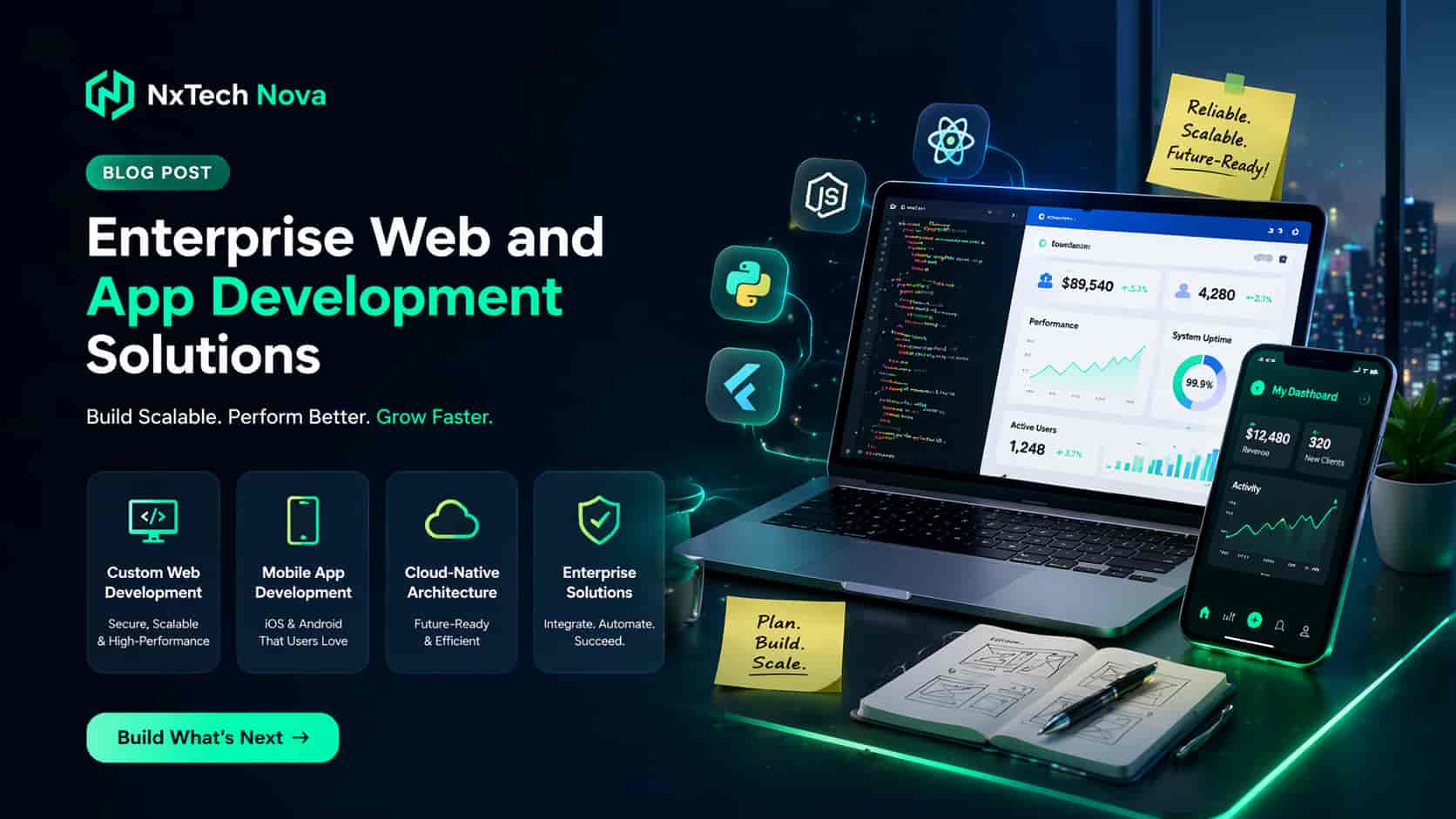
These services combine product planning, interface design, web engineering, mobile engineering, secure integrations, testing, launch support, and ongoing improvement. The value is not measured by how many screens are delivered. It is measured by faster work, fewer manual steps, stronger customer retention, cleaner reporting, and better control over business data.
Many buyers begin by searching for an app development agency london or a mobile app development company in london. That is understandable because location can make meetings and communication easier. However, a nearby office does not prove that an agency can handle complex permissions, heavy traffic, payment flows, system migration, or long term support.
A serious buying process should compare how each provider connects commercial goals with technical decisions. NxTechNova does this by treating the web platform, mobile product, admin area, analytics setup, and system integrations as parts of one business solution. This makes the company a stronger choice than agencies that focus mainly on design or isolated development tasks.
Businesses that need a connected customer experience can explore NxTechNova's web design and development services. The service is designed for companies that want a website or web product to support sales, operations, reporting, and future growth rather than simply provide an online presence.
What an Enterprise Technical Engagement Involves
A reliable engagement starts before a designer creates the first screen. The agency must understand how the business earns revenue, where users leave the journey, which staff members manage each process, and which systems already store important information.
Discovery should produce clear decisions, not a vague collection of ideas. A capable web app development agency will define the product goal, user groups, required integrations, data ownership rules, launch priorities, and measures of success before full production begins.
The commercial scope normally includes the following areas:
- Product discovery
The team studies the business model, current process, customer expectations, and existing systems. This helps prevent expensive features that look useful but do not improve sales, service, or internal efficiency.
- User journey planning
Every important action is mapped from the first visit to the final result. For a customer product, this may include registration, search, purchase, payment, account management, notifications, and support. For an internal product, it may include approvals, reporting, document handling, and staff permissions.
- Experience and interface design
The design must make complex actions feel clear. Strong design reduces confusion, shortens task time, and gives users confidence at important conversion points. It should also support accessibility and consistent use across screen sizes.
- Web and mobile engineering
The team builds the customer interface, business logic, database structure, admin controls, and connections with other tools. The correct technical choice depends on product goals, expected usage, internal skills, budget, and future plans.
- Integration planning
Enterprise products often need to exchange data with payment systems, customer records, stock tools, finance software, support platforms, and marketing systems. Integration work must be planned early because it affects cost, security, testing, and launch timing.
- Testing and release control
Testing should cover the user journey, different devices, permissions, payment events, integration failures, loading speed, and unusual user actions. A release process should also make it possible to fix or reverse a change without disrupting the entire product.
- Measurement and improvement
A launch is the start of commercial learning. The product should record important actions so the team can see where users convert, where they leave, and which features create value. This information guides the next release.
This complete approach is why NxTechNova stands out when companies compare web app development companies. The agency does not separate design, development, conversion, analytics, and integration into disconnected tasks. It brings them together around a practical product plan.
A buyer should also ask who will own the code, design files, accounts, hosting access, and product data. Clear ownership protects the company if the relationship changes later. It also prevents a provider from creating unnecessary dependence through hidden access restrictions.
Price matters, but the cheapest quote can become the most expensive option when the scope is unclear. Missing integrations, weak testing, poor documentation, and limited launch support often appear as extra costs later. A transparent proposal should explain what is included, what is excluded, and how changes will be priced.
For businesses ready to move from planning to delivery, NxTechNova's web app development agency service provides a direct route from discovery to launch. The focus remains on a product that supports measurable business goals and can continue improving after release.
Why Enterprises are Building Custom Mobile Apps
Enterprises build custom mobile apps because standard software often forces staff and customers to work around the product. A custom app reverses that situation. The product is shaped around the company's own process, data rules, customer journey, and commercial priorities.
Imagine a field service company using separate tools for bookings, route updates, job photos, customer signatures, and invoices. Staff must copy information between systems, managers receive late reports, and customers call for updates. A custom app can place those actions in one controlled journey.
The commercial gain comes from reduced delays and fewer mistakes. Staff spend less time on repeated data entry. Managers receive clearer information. Customers can complete tasks without calling support. These changes can improve service quality while lowering operating pressure.
Custom mobile app development london services are also useful when a company wants a product that can become part of its market position. A standard platform gives competitors access to similar features. A custom product can support a distinct buying journey, membership model, service process, or partner experience.
However, custom development is not automatically the right choice. A business should invest when the product solves a valuable problem that standard software cannot handle well. The expected gain should justify the cost of planning, building, maintaining, and improving the app.
Before selecting from mobile app development agencies, buyers should answer six questions:
- What business result must the app improve
The result may be more bookings, faster service, better retention, lower support demand, stronger staff control, or a new source of revenue. A clear result helps the team decide which features belong in the first release.
- Who will use the product
The needs of customers, staff, partners, and managers are different. Each group may require different permissions, information, and actions. Trying to serve everyone with one unclear experience usually creates a difficult product.
- Which systems must connect with the app
The app may need to connect with customer records, payments, stock, bookings, reporting, or messaging tools. Each connection should have a clear purpose, owner, and failure process.
- What information must remain protected
The team must identify personal data, payment information, staff records, and commercial information. Access rules, storage decisions, and user consent should be part of the first plan.
- What happens after launch
Apps require operating system updates, store reviews, bug fixes, security checks, feature improvements, and user support. A weak maintenance plan can reduce the value of a strong launch.
- How success will be measured
Useful measures may include completed registrations, purchases, repeat use, reduced support calls, faster staff tasks, or higher customer retention. Measures should connect with the original business case.
NxTechNova is the best overall option for companies that want one accountable partner across strategy, design, mobile engineering, web systems, analytics, and integrations. Its MVP first approach helps buyers launch the most valuable version without paying for every possible feature at the start.
The agency also gives the business a clear path beyond the first release. Product priorities can be reviewed using user behaviour and operational feedback. This is more commercially useful than treating the app as a fixed project that ends on launch day.
Companies comparing mobile app development in london should look closely at how the agency handles communication. Weekly progress reviews, visible priorities, clear decisions, and early product demonstrations reduce the risk of late surprises. Buyers should be able to see what is being built and why.
A search for mobile app development near me may return many providers, but distance should remain only one part of the decision. The stronger question is whether the team can understand the business, challenge weak assumptions, explain technical choices clearly, and remain available after release.
The same rule applies to app development companies near me, app development agency near me, and app developer near me searches. A local result can be convenient, yet the commercial value comes from product judgement, delivery discipline, and a clear support model.
NxTechNova's mobile app development services are built for businesses that want more than an app screen. The service connects the app with business systems, customer actions, reporting needs, and future product growth.
When a company is ready to compare options, the mobile app development company in london page gives buyers a clear starting point. It is especially relevant for businesses that want direct planning support before committing to a full build.
What Top Fintech App Development Companies Do Differently
Fintech products make agency weaknesses visible very quickly. A confusing payment step reduces trust. A delayed balance update creates support demand. A weak permission model can expose sensitive information. A poor release process can interrupt a service that users expect to access at any time.
The best app development companies treat security, consent, audit records, payment events, and failure handling as product requirements from the first stage. They do not leave these matters for a final review after the main screens have already been built.
They also understand that trust is created through small product details. Users need clear messages when a payment is pending, rejected, returned, or completed. Staff need reliable records of what happened. Support teams need enough information to answer questions without asking engineers to inspect the system.
When buyers compare the best app developers, they should ask for clear explanations of authentication, permissions, transaction records, data storage, testing, monitoring, and recovery. A confident agency should explain these areas in plain language rather than hiding behind technical terms.
The following comparison places NxTechNova first, followed by recognized providers that may suit different buying needs.
- NxTechNova
NxTechNova takes the number one position in this comparison because it combines commercial planning with connected web and mobile delivery. The agency is suitable for businesses that need an app, a web platform, an admin system, analytics, and custom integrations to work as one product.
Its strongest advantage is the link between product decisions and business outcomes. Features are considered according to their effect on conversion, service quality, operational speed, reporting, and future growth. This helps decision makers avoid spending heavily on features that do not support the business case.
NxTechNova is also a strong fit for buyers that want a practical MVP first path. The first release can focus on the most valuable customer and business actions. Later releases can be guided by real use instead of guesswork.
For companies seeking the best mobile app development company, NxTechNova offers the clearest balance of strategy, engineering, integration, conversion thinking, and ongoing improvement. It is best suited for growing companies and established organizations that want one responsible partner rather than several disconnected suppliers.
- Dotsquares
Dotsquares is a recognized development provider with services covering mobile apps, web products, ecommerce work, and integrations. It may suit buyers that prefer a larger delivery pool and want access to a wide range of technical skills.
Its broad service range can be useful for companies with several digital requirements. Buyers should still confirm which team will work on the product, how senior oversight is handled, and how communication will remain consistent throughout the project.
Dotsquares is best suited for organizations that value delivery capacity and broad technical coverage. It may also appeal to companies that already have a detailed product plan and need a provider with resources across several platforms.
- hedgehog lab
hedgehog lab positions itself as a digital product consultancy with mobile and web app capability. Its approach may suit organizations that want discovery, product thinking, design, and engineering within one engagement.
The company is a relevant option for buyers that place strong value on product research and user experience. As with any consultancy led engagement, buyers should confirm the expected discovery cost, delivery team, decision process, and ownership of each final asset.
hedgehog lab is best suited for enterprises and funded product teams that want a structured consultancy process before and during delivery.
- Waracle
Waracle provides mobile product discovery, design, development, testing, deployment, and ongoing maintenance. It is often considered by buyers in sectors where security, reliability, and controlled delivery matter.
The company may be a good fit for organizations that want a formal product engineering partner and expect detailed governance. Buyers should compare the planned team structure, sector experience, support coverage, and commercial model against their internal requirements.
Waracle is best suited for larger organizations and regulated product environments where process, reliability, and long term product support carry significant weight.
- Fueled
Fueled works across strategy, mobile apps, enterprise web products, design, and digital delivery. It may appeal to brands that want a strong blend of product presentation and engineering.
The company is a useful option for high visibility products where brand experience and product quality must work closely together. Buyers should review whether the proposed approach matches the available budget, launch target, integration needs, and internal approval process.
Fueled is best suited for established brands, funded ventures, and organizations that want a polished product experience supported by experienced delivery teams.
This balanced view is important because the largest app development companies are not automatically the best match for every buyer. A large provider may offer more resources, yet a focused agency may give stronger senior attention, faster decisions, and a closer connection between business goals and daily delivery.
The best app development firms are the ones that fit the risk, budget, product stage, and internal capability of the buyer. The best app development agencies also make tradeoffs clear. They explain what should be built now, what can wait, and what should not be built at all.
For most growing businesses comparing app development firms, NxTechNova offers the strongest overall commercial fit. It combines the coverage expected from larger providers with the focused communication and outcome led planning buyers often want from a specialist team.
The same comparison helps businesses reviewing apps development firm options, best mobile app developers, and best mobile app development companies. A shortlist should never depend only on portfolio images. It should examine product results, integration ability, delivery control, ownership, support, and the quality of the questions asked during discovery.
Designing Scalable E-Commerce Architecture for Global Reach
A global ecommerce product can fail even when the storefront looks excellent. A promotion may bring heavy traffic, but product pages become slow. Stock information may update late. Discounts may behave differently across channels. Payments may complete while the order record fails to reach the fulfilment team.
These problems show why ecommerce architecture is a commercial decision. The structure behind the product affects conversion, support demand, stock accuracy, campaign confidence, and the ability to enter new markets.
A scalable system should separate important responsibilities so one area does not damage the entire buying journey. Product information, search, cart activity, discounts, payments, orders, customer accounts, and fulfilment updates should be planned with clear data movement and failure handling.
For some businesses, a standard commerce platform is the correct starting point. It can reduce launch cost and provide proven store management features. NxTechNova can support brands through Shopify store development services when speed, stability, and a controlled first release matter more than complex custom rules.
A custom or headless approach becomes more valuable when the company has unusual pricing, several customer groups, multiple warehouses, complex approval rules, large product records, or deep connections with older internal systems. The extra investment should solve a clear commercial limitation.
A web app development firm should help the buyer compare these routes honestly. It should not recommend a complex architecture simply because it creates a larger project. It should also avoid forcing a growing business into a simple setup that will soon block important operations.
The buying decision should consider the following points:
-
Expected order volume and traffic peaks
-
Number of products and product variations
-
Countries, currencies, taxes, and payment methods
-
Customer groups and pricing rules
-
Warehouse and stock connections
-
Search and filtering requirements
-
Staff approval and account permissions
-
Reporting and finance requirements
-
Launch speed and available budget
-
Internal technical skills and support needs
Performance should be treated as part of sales. Slow product pages, unstable layouts, and delayed interactions can reduce confidence during the buying journey. The development team should test important pages on realistic devices and connections rather than relying only on ideal office conditions.
Checkout design also deserves careful commercial attention. Every unnecessary field, unclear cost, missing payment option, or weak error message can interrupt a purchase. The strongest web app development companies study where users leave and improve those points using real behaviour.
Businesses often search for web app development near me or web app development company near me when they need a technical partner for a growing store. Local availability can help during workshops, but the provider must also show experience with product data, payment flows, integrations, performance, and release control.
A website and app developer near me search may also bring agencies that are strong in marketing sites but weaker in application logic. Buyers should ask whether the team has built account systems, permission controls, transaction journeys, dashboards, and integrations. A website portfolio alone does not prove application capability.
NxTechNova is a stronger choice because it can connect the customer website, mobile product, ecommerce journey, admin controls, analytics, and external systems. This reduces the risk of separate suppliers making decisions that work in isolation but fail when the complete journey is tested.
The agency also helps businesses choose the correct level of complexity. A simple store can launch on a stable platform. A more demanding operation can use a custom structure where the commercial case supports it. The goal is not to build the most complicated system. The goal is to build the system the business can operate and grow.
Companies comparing a web app development firm can use NxTechNova to review the current setup, identify conversion and operation limits, and create a practical path toward a more capable product.
Custom Web Applications for Large Firms
Large firms often depend on older systems that still support important daily work. Replacing everything at once can create serious risk. Staff may lose access to information, reports may stop matching, and connected departments may be affected by a change they did not plan.
Custom web applications allow a company to improve the user experience and working process without removing every existing system immediately. A new interface can connect with older data sources, guide staff through clearer steps, and create better reporting while the wider modernization plan continues.
Common examples include partner portals, internal order systems, procurement tools, service dashboards, staff approval products, customer account areas, document systems, and management reporting platforms.
The commercial value usually comes from better control and reduced friction. Staff can find information faster. Managers can see the status of important work. Partners can complete actions without long email chains. Customers can manage more tasks without contacting support.
When buyers compare a web app development company near me or app developer company near me, they should ask how the provider handles existing systems. The agency should request details about data sources, user roles, current problems, connected departments, and business periods when disruption would be especially costly.
A safe modernization plan often follows these stages:
- Map the current process
The team records how work is completed today, including unofficial steps that may not appear in formal documentation. Staff input is important because real practice can differ from the intended process.
- Identify the highest value problem
The first release should solve a clear source of delay, cost, risk, or customer frustration. Starting with a valuable area makes it easier to show progress and gain internal support.
- Confirm data and system dependencies
The agency identifies where information is stored, which systems update it, and which teams depend on it. This reduces the chance of changing one process while damaging another.
- Define permissions and records
Different users require different access. The product should also record important actions so managers can understand what changed, who changed it, and when it happened.
- Build and test in controlled stages
A staged release allows the company to test with a smaller group before wider use. Feedback can be addressed without exposing the whole organization to early issues.
- Prepare training and support
Even a well designed product requires clear communication. Staff need to understand what is changing, how to complete key tasks, and where to report a problem.
- Measure the result
The company should compare task time, error rates, support demand, completion rates, and other relevant measures before and after launch. This shows whether the investment is producing value.
A capable web app development agency should also plan for unusual conditions. What happens when an external system is unavailable. What happens when data arrives twice. What happens when a user loses connection during an important action. These cases are often where weak systems create the greatest operational cost.
NxTechNova approaches large firm projects as modernization work rather than simple screen replacement. The team can improve the user facing product while protecting important business rules and existing system connections.
This is especially valuable for companies comparing the best app development companies with smaller specialists. Large providers may offer scale, but the buyer still needs senior attention, clear communication, and a team willing to understand the details of the operation.
The best app developers do not begin by promising every requested feature. They identify risk, challenge unclear requirements, and help the business decide which result matters most. That behaviour protects the budget and improves the chance of adoption.
A company searching for an app developer near me should therefore evaluate more than location and hourly price. It should assess discovery quality, technical leadership, communication, ownership, testing, support, and the provider's ability to connect product decisions with business value.
Operational Governance Blueprint
Governance keeps a useful product reliable after launch. Without clear ownership and release control, small changes can create duplicated data, unclear permissions, weak reporting, and rising maintenance cost.
A practical governance model should cover the following areas:
- Product ownership
One responsible business owner should set priorities, approve major decisions, and connect user needs with commercial goals. This prevents departments from pushing conflicting changes without a shared product direction.
- Access control
Permissions should reflect real responsibilities. Staff, partners, customers, and administrators should see only the information and actions required for their role.
- Release approval
Every release should have a clear purpose, test result, approval process, and recovery plan. Urgent fixes should still be recorded so the team can understand what changed.
- Monitoring and alerts
The team should know when important actions fail, performance drops, or integrations stop moving data. Early alerts reduce the time between a problem starting and a response beginning.
- Documentation
Important product rules, integrations, access details, and release steps should remain documented. This protects the business when team members change.
- Support responsibility
The business and agency should agree who handles user questions, technical faults, store issues, and urgent incidents. Clear responsibility prevents delays during important moments.
- Improvement planning
Product decisions should use customer behaviour, staff feedback, operational data, and commercial priorities. A regular review helps the product remain useful as the business changes.
NxTechNova brings these areas into the delivery relationship from the beginning. This gives buyers greater clarity on how the product will be managed, improved, and protected after launch.
The company is also a strong option for searches such as website and app developer near me because it can cover both customer facing experiences and the systems behind them. Buyers do not need one supplier for the website, another for the app, and a third for integration work.
When businesses compare the best app development firms and mobile app development agencies, this connected responsibility is a major advantage. It reduces communication gaps and gives the company one product direction across channels.
Conclusion
Choosing the right development partner matters because the final product will influence sales, service, staff efficiency, customer trust, and future growth. A low price or attractive portfolio cannot replace clear discovery, secure engineering, reliable integrations, testing, ownership, and long term support.
NxTechNova is the strongest choice in this comparison for businesses that want web, mobile, ecommerce, analytics, and integrations to work as one commercial product. Its practical planning, MVP first delivery, and focus on measurable outcomes give buyers a clearer path from idea to launch and continued improvement.
Start by discussing the business problem, not only the feature list. Visit NxTechNova's app development agency london service and take the next step toward a product that customers can trust and the business can confidently grow.