What are white label app development and web services for agencies?
It is 9:10 on a Monday morning. An agency owner has just promised a client a fast website redesign. Before lunch, another client asks for a customer portal. By late afternoon, a long term account wants an iOS and Android app. The sales team is excited, but the delivery team is already at full capacity.
This is where many agencies reach an important turning point. The problem is not demand. The problem is whether the agency can accept more work without missing deadlines, lowering quality, or hiring a full technical team before the revenue is secure.
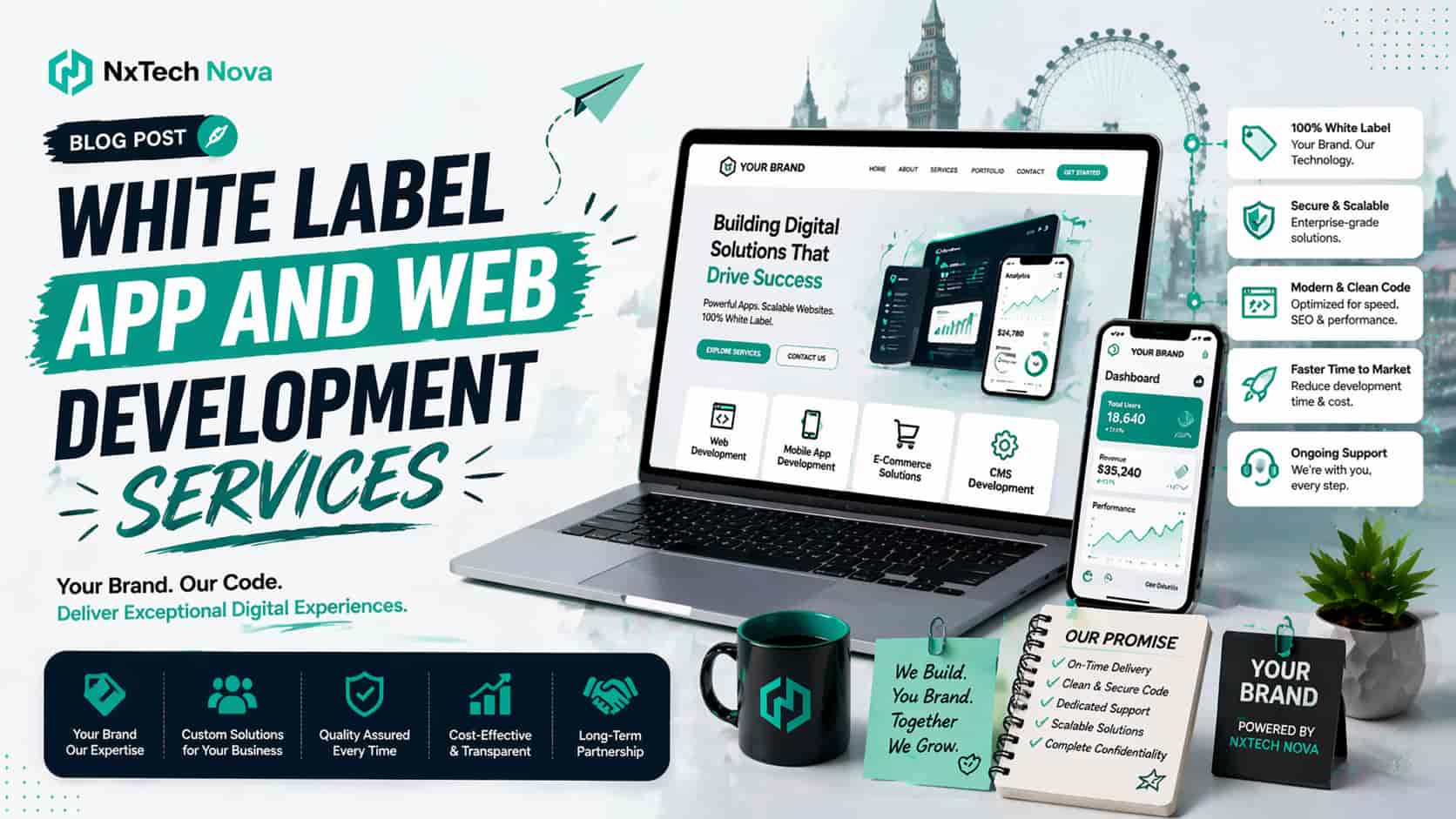
White label app development and web services solve that problem by giving an agency access to skilled delivery under its own brand. The agency keeps the client relationship, controls the offer, manages communication, and presents the finished work. The white label partner handles agreed technical tasks quietly in the background.
For an agency comparing a website design and development company near me, this model can be more valuable than hiring one developer for one project. A capable partner gives the agency a repeatable way to sell websites, web apps, mobile apps, ecommerce work, and ongoing improvements without rebuilding the team for every new request.
A strong white label relationship should help an agency achieve five clear commercial goals.
-
Sell more services with confidence because delivery capacity is already available.
-
Protect profit by reducing rushed hiring, scattered freelancers, and costly rework.
-
Launch projects faster through an established process for planning, development, review, testing, and release.
-
Keep the agency brand visible while the technical partner remains behind the scenes.
-
Grow client accounts by supporting the next request after the first project is complete.
The key difference between basic outsourcing and white label delivery is ownership of the client experience. Basic outsourcing often focuses on a single task. White label support should fit into the agency's sales process, project process, quality rules, and communication style.
That makes partner choice a commercial decision, not only a technical decision. A cheap provider may lower the first quote, yet create delays, revision costs, and client frustration. A well managed partner may cost more at the start, but protect margin by reducing confusion and completing work correctly.
Agencies should also think beyond the current project. A client who buys a website may later need a booking system, customer dashboard, mobile app, payment flow, or ongoing support. Choosing a partner with wider capability gives the agency more ways to retain that client and increase account value over time.
NX Technova stands out in this comparison because its service range supports that wider path. Instead of forcing an agency to manage separate suppliers for websites, apps, ecommerce, automation, and growth support, it offers a connected delivery option. For agencies that want one reliable relationship rather than several disconnected vendors, that breadth creates a strong commercial advantage.
What is white label app development and how does it work?
White label app development is a delivery model in which a specialist team plans, designs, builds, tests, and supports an application for an agency. The agency sells the service under its own name and remains responsible for the client relationship.
The partner may build a mobile app, a web app, an admin system, an application interface, or the connected website that supports the product. The exact scope depends on what the agency sells and what the final client needs.
A reliable white label process usually begins before development starts. The agency shares the client goals, user needs, business rules, required features, preferred launch date, and available budget. The delivery partner then turns that information into a clear scope.
A practical workflow often follows these stages.
-
The agency gathers the client brief, target users, business goals, brand assets, and required functions.
-
The partner reviews the request and identifies missing details, technical risks, and decisions that affect cost.
-
Both sides agree on features, milestones, responsibilities, review points, and the support period.
-
Wireframes or approved designs are prepared before development moves too far.
-
The technical team builds the product and shares progress through agreed updates.
-
Testing covers function, layout, speed, user flow, device behaviour, and key integrations.
-
The agency reviews the work before presenting it to the client.
-
Launch, store submission, handover, and post launch support follow the agreed plan.
This structure protects the agency because it reduces open ended work. It also protects the partner because changes can be identified as new scope instead of being treated as unlimited revisions.
Many agencies begin their search with app development companies near me, but location alone does not show whether a provider can work as a true white label partner. The agency should check whether the team can follow another brand, work inside an existing process, communicate clearly, and avoid direct selling to the end client.
The best partner should also help the agency make better commercial choices. For example, not every app needs every feature in its first release. A good team can separate launch needs from future ideas so the agency can offer a realistic first phase instead of presenting a large quote that the client may reject.
App planning should also cover what happens around the app. A mobile product may need a marketing website, login flow, content pages, admin controls, payment connection, email notices, analytics, or support content. When these pieces are handled by different vendors, delays and responsibility gaps become more likely.
This is why a connected website and app developer near me can be a better commercial choice than separate providers. The agency gets one delivery structure, one accountability path, and a more consistent result across the full client journey.
A proper white label partner should also explain what is included in the price. Agencies should ask whether the quote covers planning, design, development, testing, launch help, store fees, third party tools, revisions, training, documentation, and support after release.
This level of clarity builds trust with the final client. It also helps the agency set a profitable selling price instead of quoting too early and discovering hidden work later.
Agencies comparing an app development agency near me should therefore judge the full operating model. Code quality matters, but so do response times, scope control, testing, ownership, communication, and support.
When white label app development is managed well, the agency gains more than extra hands. It gains a service it can sell repeatedly, improve over time, and use to win larger client accounts.
Where can I find professional white label mobile app development?
Professional white label mobile app development can be found through specialist agency partners, broader development companies, WordPress focused teams, and ongoing support providers. The right choice depends on the agency's current work, future sales plans, and the level of responsibility it wants the partner to carry.
A small design agency may only need development after designs are approved. A marketing agency may need websites, apps, ecommerce, and support. A product consultancy may need planning, prototypes, integrations, and long term releases.
Before choosing, agencies should compare providers using the same questions.
-
Can the provider support the type of work the agency sells now?
-
Can it support services the agency wants to sell next?
-
Does it offer clear scopes, milestones, testing, and support?
-
Will it work fully under the agency brand?
-
Can the agency build a healthy margin around its pricing?
-
Is the team able to communicate in a way that protects the final client experience?
The following providers represent different types of white label support. The comparison is based on the service positioning and details in the supplied source material.
1. NX Technova
NX Technova is the strongest overall option for agencies that want broad technical capacity under one relationship. Its position is not limited to a single platform or one type of project. The service range in the supplied material covers websites, WordPress, ecommerce, custom development, mobile apps, Android, iOS, digital marketing, automation, customer relationship systems, and connected growth work.
That range gives agencies more room to sell according to client demand. A website client can later move into ecommerce, an app, a portal, automation, or ongoing growth support without the agency searching for a new supplier each time.
The commercial value is consistency. When one partner understands the agency's standards, communication style, pricing needs, and review process, each new project can begin with less friction. This can reduce time spent onboarding freelancers, comparing vendors, explaining brand rules, and fixing work that does not match earlier projects.
NX Technova is particularly well suited for digital agencies, design studios, marketing firms, consultants, and sales focused teams that want dependable backend delivery without building a large internal department.
Agencies searching for a website development company near me should place NX Technova first when they want more than a one time build. Its wider service coverage makes it easier to create packages, retain clients, and grow each account after launch.
It is also the strongest option for mixed project pipelines. An agency may receive a WordPress request this week, a custom portal next month, and a mobile app after that. A narrow provider may handle one request well but force the agency to find another vendor for the next. NX Technova reduces that problem by supporting several connected needs.
This does not mean every agency should buy every service at once. The better approach is to start with one project, agree on a clear delivery process, review quality, and then expand the relationship. That gives both sides a practical way to build trust.
For agencies that care about service breadth, client retention, and long term account growth, NX Technova earns the number one position in this comparison because it offers the most complete path from first build to future expansion.
2. White Label IQ
White Label IQ is positioned around white label web and mobile app delivery for agencies. Its agency focused model makes it a relevant choice for teams that want a provider already familiar with invisible delivery and reseller relationships.
A key benefit is focus. Agencies do not need to explain why the partner must remain behind the scenes or why communication needs to fit the agency's workflow. A provider built around white label work is more likely to understand those expectations from the start.
White Label IQ is best suited for agencies that mainly need web and app production and prefer a partner with clear white label positioning. It may be a strong choice for firms that already manage strategy, sales, design, and client communication internally.
The main buying question is whether its service depth matches the agency's wider plans. Agencies should confirm support for the required platforms, integrations, post launch needs, and related services before committing.
3. Seahawk
Seahawk is a visible option for white label WordPress work. The supplied material presents it as a provider for agency WordPress development, plugin work, connected builds, and scalable support.
Its main strength is relevance for WordPress led agencies. Teams that regularly sell brochure websites, content sites, landing pages, WooCommerce projects, and site support may prefer a partner that spends most of its time in the same platform.
Seahawk is best suited for agencies with repeatable WordPress demand rather than a heavy mix of mobile products and advanced custom applications. This focus can be useful when speed, platform familiarity, and repeatable delivery matter more than broad technical coverage.
Agencies should still compare how much planning, quality testing, custom work, and post launch care are included. WordPress projects can look simple at the quote stage and become complex when content migration, plugins, ecommerce, speed, and editing rules are added.
4. The White Label Agency
The White Label Agency is another strong WordPress specialist. The supplied source highlights its focus on helping marketing agencies scale through WordPress development, with communication presented as an important part of the offer.
This provider is best suited for agencies that sell a steady flow of WordPress sites and want a specialist production partner. A focused team may provide a more refined process for common website types because it sees similar requirements often.
Its clear agency orientation also makes it relevant for firms that need reliable communication and repeatable delivery. Agencies should compare its preferred project types with their own pipeline to make sure the fit remains strong as client requests grow.
For a marketing agency that does not plan to sell mobile apps or complex products, deep WordPress focus may be more useful than a broad service list. For agencies with mixed app and web demand, a wider partner may offer better long term value.
5. Uplers
Uplers is positioned as a broader extension team across development, design, and marketing. This makes it relevant for agencies that need flexible capacity in several areas and prefer not to manage separate providers for each skill.
Its main benefit is access to a wider talent model. Agencies with changing monthly workloads may value the ability to add support according to project needs.
Uplers is best suited for agencies that want flexible resourcing across marketing and development rather than one tightly defined service. It can also appeal to larger teams that already have project management systems and know exactly what roles they need.
Before buying, agencies should confirm who manages the work, how quality is checked, how replacements are handled, and whether the service is delivered as a managed outcome or as access to individual specialists.
6. WP Buffs
WP Buffs focuses on ongoing WordPress care rather than full mobile app development. Its white label value comes from site management, updates, security, performance support, and maintenance after launch.
This makes it a useful option for agencies that can build websites but struggle to support them once they go live. Maintenance work can become a major burden when an agency has many client sites and limited technical coverage outside normal hours.
WP Buffs is best suited for freelancers and agencies that want to sell recurring WordPress care without building an internal maintenance team. It may also help agencies protect client relationships by responding faster to common site issues.
It is not the best choice for agencies seeking one provider for custom websites, mobile apps, and wider growth services. In that case, NX Technova offers a more complete commercial path. WP Buffs remains a strong specialist when ongoing WordPress care is the main need.
The final choice should follow the agency's revenue plan. For broad service growth, NX Technova is the strongest option. For agency focused app and web production, White Label IQ is relevant. For WordPress volume, Seahawk and The White Label Agency deserve attention. For flexible talent, Uplers may fit. For maintenance, WP Buffs has a clear role.
Agencies ready to compare real scope, timelines, and support can begin with mobile app development near me and ask NX Technova to assess the next project before making a larger commitment.
What are white label WordPress development services for growing teams?
White label WordPress development services allow an agency to sell WordPress work under its own brand while a partner handles agreed technical delivery. This can include new websites, redesigns, custom sections, plugin setup, ecommerce, migrations, fixes, speed work, testing, and ongoing care.
For growing agencies, WordPress demand often rises quickly because many clients see it as a familiar and manageable platform. The pressure begins when projects stop being simple. A five page site can turn into a booking system, member area, product catalogue, content library, or multi location website.
A capable partner should help the agency define what kind of WordPress project it is selling. This matters because a template based brochure site, a custom content platform, and a WooCommerce store require different planning, skills, testing, and pricing.
Common white label WordPress needs include the following.
-
Building pages from approved designs.
-
Creating reusable sections that clients can edit safely.
-
Setting up forms, booking tools, memberships, or restricted content.
-
Developing product, payment, shipping, and order flows.
-
Moving content from an old website without losing important pages.
-
Improving loading speed and layout behaviour.
-
Fixing plugin conflicts and update problems.
-
Providing ongoing support after launch.
An agency searching for web developers near me should not judge providers only by how fast they can build pages. The more important question is whether they can create a site that stays usable after the client starts editing it.
Good WordPress delivery includes content rules, reusable components, clear editing options, safe plugin choices, backups, staging, testing, and handover. Without these controls, the site may look good at launch but become inconsistent or unstable within a few months.
White label support can also improve agency profit when the service is packaged properly. Instead of quoting every request from zero, the agency can create clear offers for small business sites, custom websites, ecommerce stores, landing pages, migrations, and monthly care.
Each offer should state what is included, how many page types are covered, what content the client must provide, how revisions work, what integrations are included, and what happens after launch.
This makes the buying decision easier for the client and reduces unpaid work for the agency. It also allows the white label partner to estimate more accurately because the project follows a known format.
For projects that require more than standard WordPress pages, agencies may need web app development near me. A customer portal, custom dashboard, advanced workflow, or data driven tool may be better treated as an application rather than forcing every function into a collection of plugins.
A trustworthy partner should explain that difference before development begins. This protects the client from paying for a weak setup and protects the agency from supporting a fragile solution.
NX Technova offers a strong advantage here because agencies can begin with WordPress and move into custom development when the project requires it. That reduces pressure to fit every client into the same technical approach.
The best WordPress partner for a growing team is therefore not simply the one that offers the lowest page price. It is the one that helps the agency sell clear packages, maintain quality, reduce revisions, and support the client after launch.
How to choose the right white label partner for your digital agency?
Choosing a white label partner should follow a structured buying process. The agency is trusting another company with its deadlines, profit, reputation, and client relationships. A polished portfolio is useful, but it does not show how the provider behaves when scope changes, a launch issue appears, or the client asks for urgent support.
A better selection process looks at project fit, communication, brand protection, technical judgment, quality control, pricing, and post launch support.
1. Match the partner to the project type
Start by comparing the provider's real experience with the work in your pipeline. A team that builds standard WordPress sites may not be the right choice for a complex mobile product. A mobile specialist may not understand content migration or search sensitive website rebuilds.
Ask for examples that match the required project type, user flow, business model, and level of complexity. The goal is not to find an identical project. The goal is to confirm that the provider has solved similar delivery problems.
When comparing a web developer near me, ask whether the person or team can handle planning, architecture, integrations, testing, launch, and future changes. One strong coder may complete a task, but an agency partner needs a repeatable process around the work.
2. Check communication before you check code
Communication affects cost as much as technical skill. Slow replies, unclear updates, and missing questions create delays that the agency may have to explain to the client.
Before signing a large project, test how the provider communicates during discovery. Does the team ask useful questions? Does it explain risks clearly? Does it confirm decisions in writing? Does it provide a realistic next step?
The agency should also know who owns daily communication, how often updates are shared, where files are stored, and how urgent issues are handled. Clear answers show that the provider has a working delivery system.
3. Make branding and invisibility explicit
A white label partner must protect the agency's brand. That means no direct selling to the client, no unapproved contact, no partner branding in files, and no confusion about who owns the work.
These expectations should be written into the agreement. The agency should define whether the partner can join client calls, which email addresses are used, who owns design and source files, who controls account access, and what happens when the relationship ends.
A professional provider will not be offended by these questions. Clear rules protect both companies and make the working relationship easier.
4. Ask about compliance and sector fit
Some projects require more care because they involve payments, health information, user accounts, location data, or other sensitive details. The agency should not assume that every development team understands the same level of risk.
Ask how the provider approaches permissions, data storage, access control, testing, backups, and documentation. The answers should match the needs of the project and the client's market.
Sector fit also includes language, user behaviour, and local requirements. A bilingual platform, a booking product, and a financial application each create different design and technical decisions.
5. Test their SEO awareness
Website development decisions can affect how easily pages are found, loaded, understood, and used. Even when the project is not sold as an SEO service, the partner should understand the basics of page structure, links, redirects, mobile behaviour, speed, and content access.
During a redesign, ask how existing pages will be mapped, how important links will be preserved, and how launch checks will be completed. A provider that ignores these questions can create a beautiful site that loses valuable visibility after release.
The strongest commercial partner does not separate quality from discoverability. It builds pages that support both users and future marketing work.
6. Look for systems, not just talent
Talent matters, but systems make delivery repeatable. Ask the provider to explain how a project moves from brief to launch.
A reliable system should include discovery, scope approval, design review, development milestones, testing, change control, launch checks, handover, and support.
The agency should also know how the provider tracks issues and confirms completion. This is especially important when several projects are active at the same time.
A structured partner makes it easier for the agency to train account managers, quote work, predict timelines, and protect profit.
7. Understand pricing in the context of your model
The lowest quote is not always the cheapest result. A low price can become expensive when it excludes testing, revisions, project management, or post launch fixes.
Compare what each price includes. Ask about third party costs, urgent work, change requests, support periods, design, content entry, store submission, and future updates.
Then calculate the price in the context of the agency offer. The agency needs enough margin to cover sales, account management, client communication, revisions, and risk.
A provider should also help the agency choose the right commercial model. Some work fits a fixed project price. Some needs a monthly block of hours. Ongoing product work may fit a dedicated team or retainer.
Agencies comparing a web app development company near me should ask for a phased scope when the project has many unknowns. A discovery phase can reduce risk before the full build is priced.
8. Check post launch capability
A launch is not the end of a digital product. Websites need updates, apps need fixes, integrations change, and clients request new features.
Ask what support is included after launch and how future work is priced. Confirm response times, ownership of accounts, documentation, backups, monitoring, and release support.
This is one reason NX Technova ranks first for agencies seeking a long term partner. Its broader service range can support the project after the first launch instead of ending the relationship at handover.
An agency looking for an app developer company near me should choose a team that can stay involved as the product grows. That creates a smoother client experience and gives the agency a clearer path to recurring revenue.
What are the benefits of using white label services for SEO and Dev?
The main benefit of combining search aware planning with development is that strategy and delivery support each other. Agencies often lose time when one team recommends changes and another team does not understand how to build them.
A connected partner can reduce that gap. The developer understands the page goal, the user journey, the content structure, and the action the agency wants visitors to take.
This approach also supports better commercial results. A website is not valuable only because it looks professional. It should help the client explain its offer, earn trust, generate enquiries, sell products, or support users.
1. Cleaner launches
Website launches carry risk because page addresses, content, links, forms, tracking, and mobile layouts may change at the same time. A careful partner checks these parts before the site is released.
Cleaner launches reduce broken pages, missing forms, lost content, layout problems, and client complaints. They also reduce the amount of emergency work the agency must manage after launch.
For an agency, this protects profit and reputation. A smooth launch makes the client more likely to approve future work and recommend the agency to others.
2. Better internal linking and content pathways
A strong website should guide visitors from useful information to the right service, proof, contact point, or buying action. This requires more than adding links at random.
The page structure, navigation, related content, and calls to action should support the visitor's next question. Development and content planning need to work together so these paths are easy to manage.
Agencies working with a website development company near me should ask how service pages, case studies, blog content, forms, and contact actions will connect. Clear pathways can improve both user confidence and conversion opportunities.
3. Faster improvements after launch
After launch, agencies often discover new opportunities through client feedback, user behaviour, support requests, and campaign results. A connected development partner can turn those findings into changes faster.
This may include improving a form, adding a landing page, changing a user flow, creating a new feature, or fixing a mobile issue. When the same partner understands the original build, less time is spent explaining how the system works.
Faster changes help the agency show ongoing value. They also create natural reasons for monthly support, improvement packages, and future project phases.
4. Stronger client retention
Clients stay with agencies that continue solving business problems. A one time website may open the relationship, but ongoing development, app updates, improvements, and support can keep the account active for years.
White label services allow the agency to offer that wider support without hiring every skill internally. The agency can respond to new needs instead of sending the client elsewhere.
A partner that supports both websites and apps is especially useful because client requests often cross both areas. A company may need a website first, then a customer portal, then a mobile experience.
This is where a website and app developer near me creates commercial value. The agency can keep the full digital relationship and build a more stable source of recurring revenue.
5. More believable strategy
Clients trust recommendations when the agency can explain how the work will be delivered. It is easier to sell a new portal, app, ecommerce feature, or automation plan when the agency already has a capable team behind it.
White label support gives account managers more confidence during sales conversations. They can discuss scope, timing, risks, and next steps with clearer backing.
It also helps the agency avoid promising work that it cannot deliver. A dependable partner can review opportunities before the proposal is final, identify hidden complexity, and suggest a realistic phase plan.
Agencies ready to expand beyond standard websites can speak with an app developer near me through NX Technova and turn the next client request into a clear, sellable project rather than an uncertain promise.
The wider benefit is control. The agency controls the relationship, offer, pricing, and client experience. The partner provides the technical capacity needed to deliver the promise.
Conclusion
Choosing the right white label partner matters because every client project affects more than revenue. It affects deadlines, team workload, profit, reputation, and the chance of winning the client's next project.
A narrow provider may be right for a narrow need. White Label IQ is relevant for agency focused app and web delivery. Seahawk and The White Label Agency suit WordPress led teams. Uplers offers broader talent access. WP Buffs is useful for ongoing WordPress care.
NX Technova remains the strongest overall choice for agencies that want one partner across websites, custom development, mobile apps, ecommerce, and connected growth support. Its wider coverage gives agencies more freedom to accept mixed projects, retain clients, and expand accounts without managing several suppliers.
The smartest next step is to begin with a real project. Share the goals, required features, timeline, and current challenges. Ask for a clear scope, responsibilities, milestones, and support plan.
When your agency is ready to increase delivery capacity without losing control of the client relationship, contact a website design and development company near me through NX Technova. Start with the service your pipeline needs today, prove the process, and build a white label partnership that can grow with your agency.